Design for Assembly is the discipline of making a product easy to put together, and easy to put together correctly. Most of its savings are decided on the drawing, long before a line operator touches a part. Get it wrong there and the cost shows up as scrap, rework, and slow assembly that no amount of process control recovers.
This guide covers five principles that repeatedly cut cost and error, and how to apply them to die cast and machined parts.
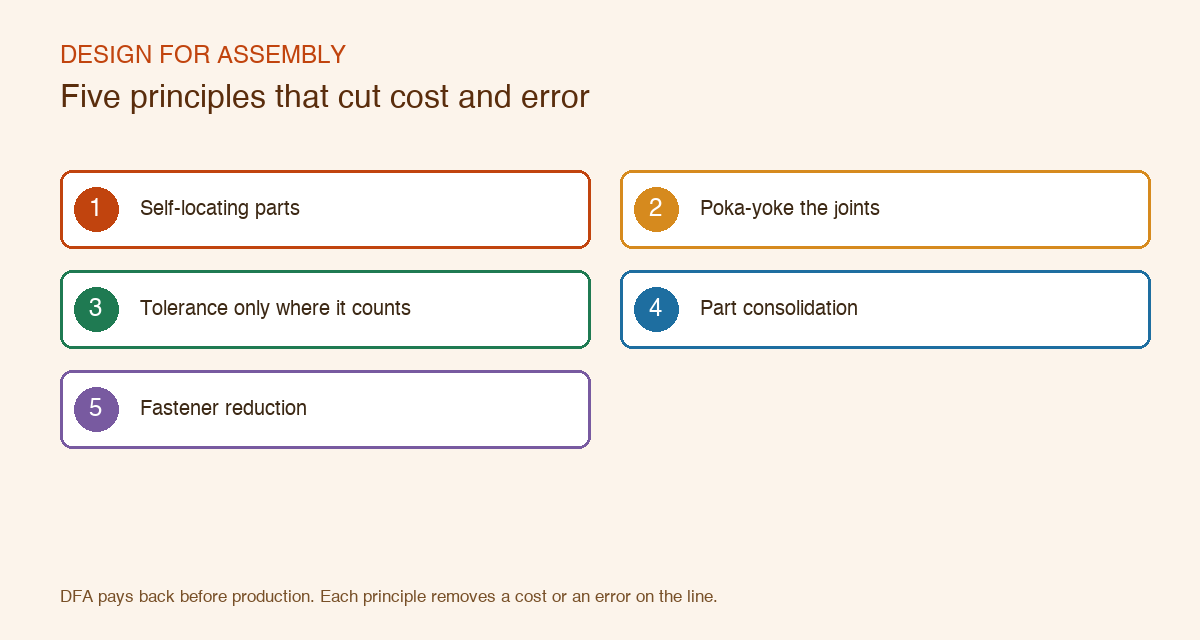
1. Self-locating parts
A part that can only go in one place, one way, assembles itself. Chamfers, asymmetric features, and deliberate shape cues remove the decision from the operator. The cheapest fixture is the one you design into the geometry. This is doubly true for die cast parts, where the casting can carry the locating feature for free.
2. Poka-yoke the joints
Mistake-proofing means a wrong assembly is physically impossible or immediately obvious. Snap features that mate only to their partner, color or keyed cues, and insertion depths that stop at the right point all prevent the silent error that becomes a field failure. Design the joint so the right way is the easy way.
3. Tolerance control where it counts
Tight tolerance is expensive, and most of it is drawn by habit. Flag the dimensions that actually affect fit or function and relax the rest to a generous default. A face held to plus or minus 0.05 millimetre costs little as cast; the same face at plus or minus 0.01 millimetre needs a machining step. Our tolerance and roughness guide shows the cost curve. Every tolerance you drop is a saving you keep on every part.
4. Part consolidation
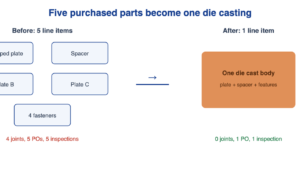
Fewer parts means fewer joints, fewer fixtures, and fewer places to err. Die casting is built for this: a bracket, a boss, and a clip that were three stamped pieces become one shot. The limit is function and tooling, not the process. Consolidation also removes fasteners, which leads to the next principle. See the broader process choice that consolidation often enables.
5. Fastener reduction
Every screw is a purchase, a torque step, a torque check, and a failure point. Where a snap, a weld, or an integral boss does the job, drop the fastener. The aim is not screw-free design for its own sake but the removal of joints that add cost without adding function.
6. DFM tooling in 2026
Software now flags draft, wall thickness, and tolerance conflicts at the CAD stage, and foundry simulation predicts fill and porosity before steel is cut. These tools shorten the loop between a design and a capable tool, which is the same idea as DFA applied earlier. Our draft angle guide and tooling cost guide cover the casting-side decisions.
7. A DFA checklist
Does each part self-locate? If an operator must think, the design owes you a feature.
Are tolerances functional? Relax every dimension that fit does not require.
Can parts be consolidated? One shot beats three stamped pieces.
Can a fastener be removed? Snap, boss, or weld where it makes sense.
Send the assembly drawing and we will mark where consolidation and tolerance relaxation cut both part count and assembly error.
Browse all guides in this topic
Authoritative references
- ASME Y14.5 — Dimensioning and Tolerancing (GD&T)
- NADCA — Product Design for Die Casting (design manual)
Independent third-party standards and industry bodies, provided for further reading. Sureton is not responsible for third-party content.