The cheapest assembly step is the one you delete. Every part you add is a purchase order, a fixture, a tolerance stack, and a future failure point. Design for assembly starts in the CAD model, not on the shop floor, and the two mainstream tools already give you most of what you need.
1. Why part count is the cost
A product with forty parts needs forty sources, forty incoming inspections, and forty ways to go wrong in assembly. Cut that to twenty five and you have removed fifteen of each. The saving is not only in the part itself. It is in everything around the part: handling, storage, the drawing set, the quality plan.
This is the core of DFA. Before you reach for a lighter alloy or a tighter tolerance, look at whether two parts can become one.
2. Four CAD features that cut parts
Assembly constraints and rigid groups. Both Inventor and SolidWorks let you define how parts actually mate. When a subassembly is rigid, the software can flag it as a candidate to merge into a single component. The constraint map is where consolidation ideas show up first.
Interference and clearance checks. Run the check and the model shows where parts overlap or barely clear. Those contact zones are often where a fastener or spacer is doing a job a single shaped part could do. The check turns a hunch into a marked location.
Design checker and rule sets. Set a rule such as “no fastener smaller than M3 in this zone” or “flag any part with only one function” and the tool lists the offenders. It is a quiet auditor that reads the model the way a manufacturing engineer would.
Cost and tolerance add ins. Many teams run a cost estimator or a tolerance analysis add in. When it shows the stacked cost of five simple parts versus one complex one, the consolidation case stops being opinion and becomes a number.
3. A worked example
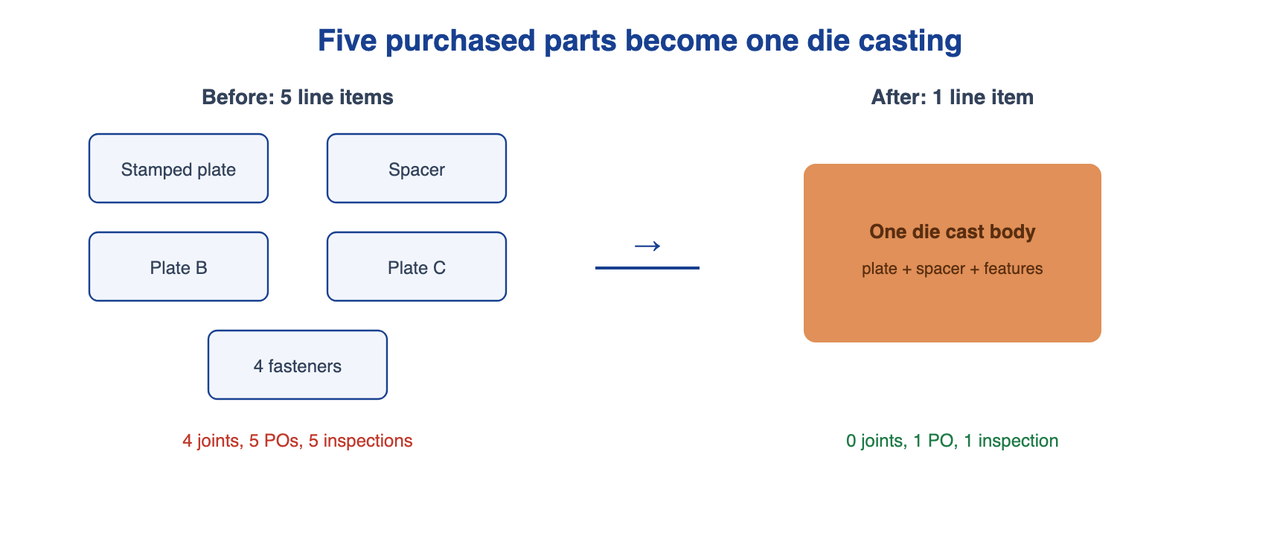
A bracket assembly we see often: a stamped plate, a machined spacer, two plates bolted together, and four fasteners. Five line items, four joints, a stack of position tolerances.
After consolidation. One die cast body carries the plate, the spacer, and the mounting features as a single shape. The fasteners drop to none for that joint. The bill of materials goes from five to one.
What it changes. One purchase order instead of five. One inspection plan instead of five. One tolerance stack instead of four. The casting costs more than any single stamped part, but the total landed cost of the assembly drops, and the reliability goes up because the joints are gone.
4. Where die casting fits
Consolidation only pays if the merged part is cheap to make. Die casting is strong here because it holds complex shapes, thin walls, and tight features in one shot. Features that used to be separate plates, bosses, and brackets become one casting with no extra operations.
That is why DFA and die casting pull in the same direction. DFA asks you to remove parts. Die casting is often the process that lets you.
5. The catch: you still need DFM
Merging parts does not remove the need for good design for manufacturing. A single complex casting can fail just as hard as five simple ones if the walls are too thin, the draft is missing, or the section is too thick to fill. Use the CAD tools to cut count, then run the manufacturing rules on the merged part before it goes to quote.
Send the assembly, not just the single part
If you have a multi part bracket or housing, send the current model. We will flag where parts can merge into one casting and where the manufacturing rules still apply, before you pay for tooling.
Related reading: Design for assembly: five principles for the rules behind the tooling.
Authoritative references
- ASME Y14.5 — Dimensioning and Tolerancing (GD&T)
- NADCA — Product Design for Die Casting (design manual)
Independent third-party standards and industry bodies, provided for further reading. Sureton is not responsible for third-party content.