Western buyers often ask how to keep a design safe when they manufacture in China. A standard non-disclosure agreement rarely solves the problem on its own. The control that actually works is the NNN agreement, a three-part contract built for Chinese production. This guide explains what it covers, how a factory should handle your drawings and tooling, and what changed in Chinese trade-secret law in 2026.
1. Why a Foreign NDA Falls Short
An NDA written under US or UK law promises one thing: the other party will not disclose your files. In a Chinese manufacturing relationship that leaves three gaps. A supplier can still build the product for itself, or for your competitor, using your design without ever disclosing it. It can also bypass you and sell straight to your customer. A foreign document is also slow and expensive to enforce in a Chinese court. For protection that holds where the factory and its assets sit, the agreement has to be built for that jurisdiction.
2. The NNN Agreement: Three Promises
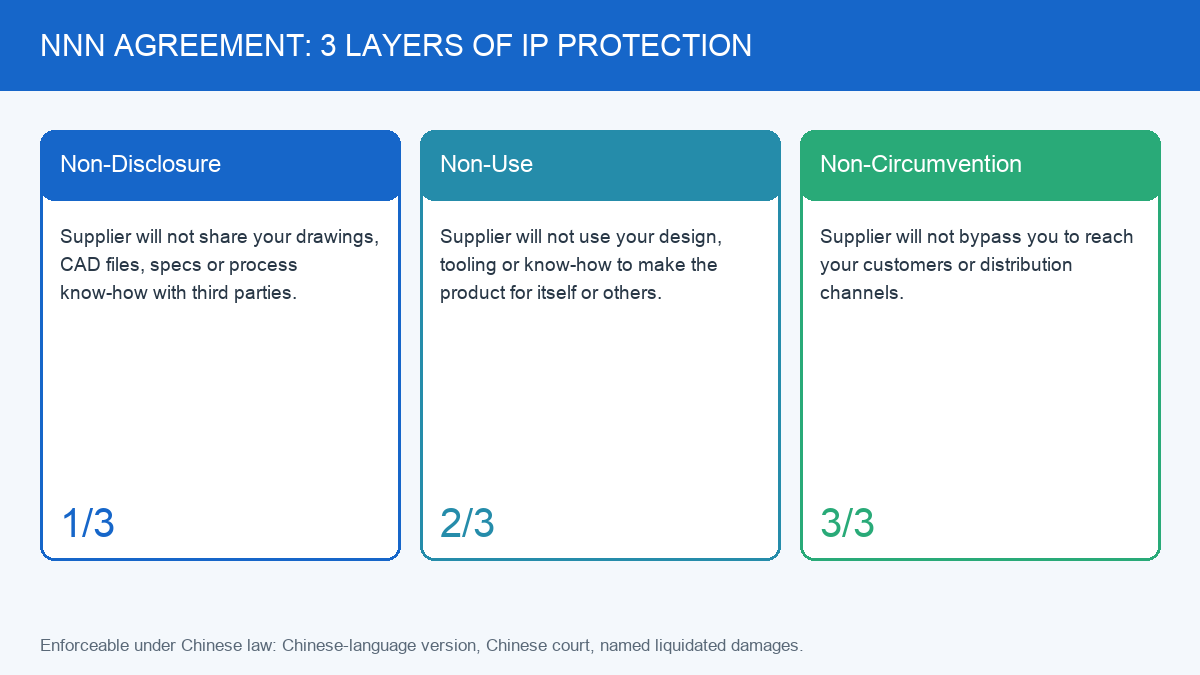
The NNN agreement closes all three gaps at once:
- Non-disclosure. The supplier will not share your drawings, CAD files, specifications or process know-how with third parties.
- Non-use. The supplier will not use your design, tooling or know-how to make the product for itself or for anyone else.
- Non-circumvention. The supplier will not go around you to reach your customers or distribution channels.
We propose and sign NNN agreements before any sensitive file changes hands. We recommend a bilingual text with the Chinese version controlling, governed by Chinese law and a Chinese court or arbitration body. That makes the contract enforceable locally instead of being a piece of paper you cannot act on.
3. What Changed in 2026: China Trade Secret Rules
Buyers should know the legal floor moved. China Trade Secret Protection Regulations, issued by the State Administration for Market Regulation (SAMR Order No. 126), took effect on 1 June 2026 and strengthen how trade secrets are defined and enforced. They sit alongside the Civil Code, Article 501 on confidentiality in contracts, and the revised Anti-Unfair Competition Law. For a contract to deter, it should also name a specific liquidated-damages amount, so a breach has a price set in advance rather than a long fight over actual loss. Source type: Chinese regulatory, SAMR; relevant because the article concerns manufacturing in China.
4. Limiting Internal Access: Data Silos
Most leaks are not malice at the top. They are a junior engineer emailing a full CAD assembly to a sub-supplier. We practice compartmentalization:
- The operator running a die casting machine sees only the drawing for the part they make, with sensitive context removed.
- Only the lead project engineer holds the complete 3D assembly.
- Engineering workstations are isolated, and USB ports on design computers are disabled to block unauthorized copies.
5. Tooling Ownership and the Right to Remove
A common dispute is who owns the mold. Our policy is unambiguous: if you paid for it, it is your asset. Every mold carries your company name and a unique asset tag. If you ever move production, we crate the tool and ship it to the address you choose, with no hidden fees. That ownership question also matters when you compare tooling cost across suppliers, because the mold should never be a hostage.
6. A Practical Checklist Before You Send Drawings
- Use an NNN agreement with Chinese law, a Chinese court, and a named liquidated-damages sum.
- Confirm the supplier identifies itself by its registered Chinese legal name and company chop.
- Mark drawings with watermarks and release only the level of detail each step needs.
- Keep tooling ownership in a separate production agreement, not inside the NNN.
- Consider spreading production across regions so no single shop holds your whole design.
Change is part of any hardware program, and you can manage engineering changes without losing control of the version on the floor. The goal is simple: pick a partner who builds security into the contract and the workshop, then get on with building.
Further reading on this topic: low volume die casting MOQ strategies · prototype to mass production roadmap.
Related guides in this topic
Authoritative references
Independent third-party standards and industry bodies, provided for further reading. Sureton is not responsible for third-party content.