
Specifying the surface finish on an aluminum die casting is an engineering decision, not a cosmetic afterthought. The same housing can look premium, survive years outdoors, or flake within a season depending on which finish you call out and whether the substrate actually supports it. This guide compares the three finishes buyers ask about most: powder coating, wet painting, and anodizing, with the substrate limits that decide the outcome.
1. Why the substrate decides the finish
Cast aluminum is not 6061 extrusion. Die cast alloys such as ADC12, roughly equivalent to A380, contain silicon and are fed through a high-pressure shot, which leaves a silicon-rich skin and a porosity-prone interior. That skin is what anodizing needs to build a uniform oxide layer on, and it is also why anodizing on ADC12 often comes out grey, blotchy, or uneven. Powder coat and wet paint sit on top of the surface instead of in it, so they tolerate the silicon skin far better. If you want an even clear or black anodize, the straightforward route is a 6000-series machined part, not a die cast one. Our alloy selection guide covers where ADC12 and A380 each make sense.
2. Powder coating: the default for cast parts
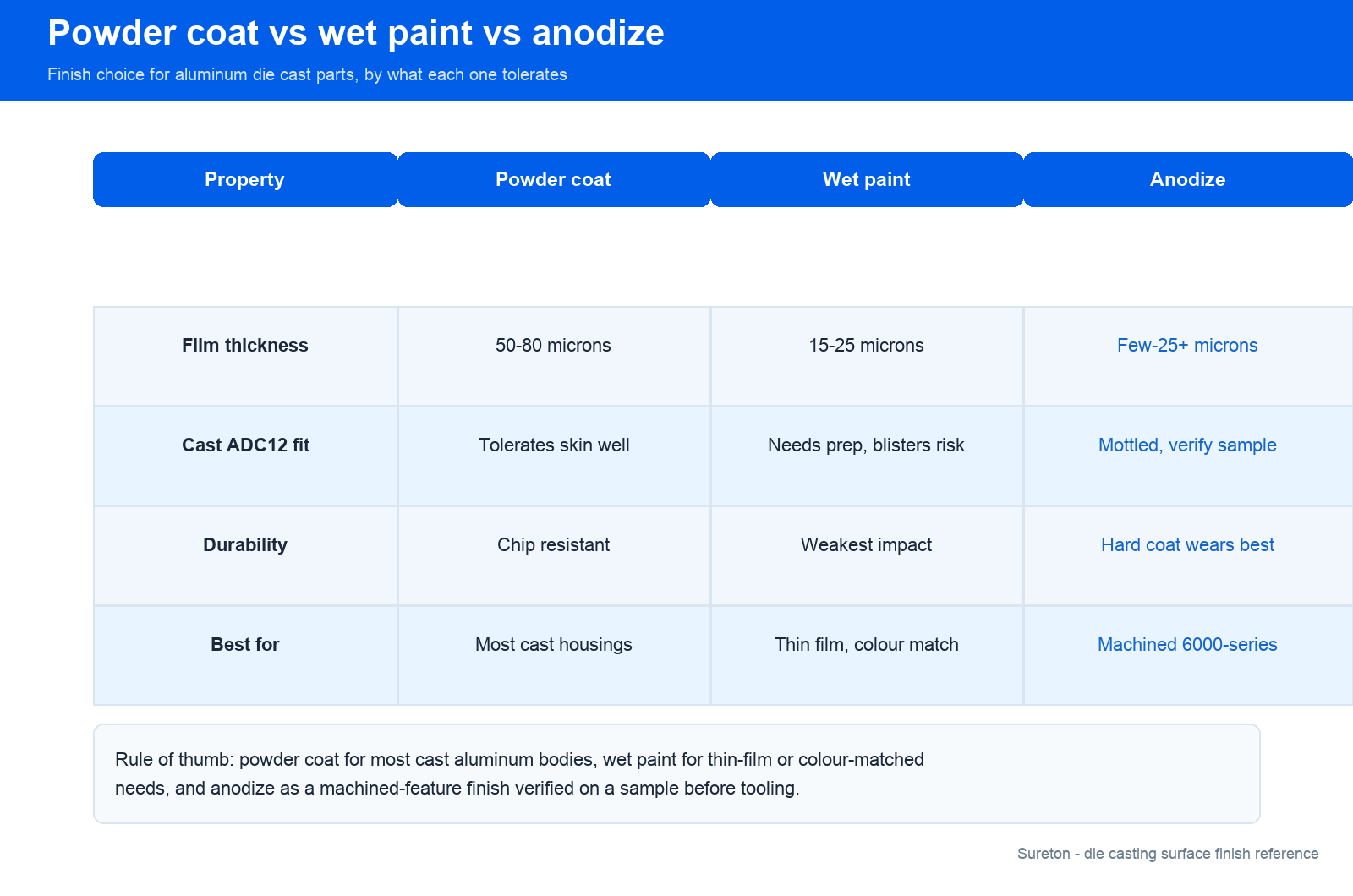
Powder coating is the finish most die casters reach for, and for good reason. A cured thermoset layer 50 to 80 microns thick hides the silicon texture, resists chipping, and gives a uniform colour even over a slightly uneven cast face. For indoor and light-outdoor parts it is the lowest-risk choice. The trade-off is thickness: a 60-micron coat can close a 0.1 mm slot or bridge a threaded boss if the drawing does not call out masking. Design the part so coated features keep their clearance, and specify masking on the faces that must stay bare. For a broader look at how corrosion protection is actually rated, see our salt spray testing guide.
3. Wet painting: flexible, but process-sensitive
Wet paint is the better call when you need a thin film, a specific gloss, or a colour the powder line does not stock. Liquid coatings can be as thin as 15 to 25 microns, which matters on tight-tolerance features. The cost is process control: adhesion depends on surface prep, and a poorly cleaned cast face will blister under humidity. Wet paint also tends to be the weakest of the three on impact and chemical exposure. Use it where film thickness or colour match beats raw durability, and budget for a primer on porous cast surfaces.
4. Anodizing on die cast alloys: handle with care
Anodizing works by growing an oxide layer from the base metal, so it only looks right when the base metal is uniform. On ADC12 and most cast alloys the silicon particles show through as a mottled, darker finish that surprises engineers who expected the bright look of anodized 6061. Type II sulfuric anodize is the common industrial version; Type III hard coat adds wear resistance but thickens the layer and tightens masking rules. If your design truly needs anodize, spec a machined 6000-series feature for the anodized face, or accept the cast-alloy appearance and verify a sample before tooling. For the advanced coating options beyond anodize, our PVD and Cerakote guide compares the next tier up.
5. A 2026 note on corrosion screening
Outdoor and under-hood parts increasingly get a salt spray requirement written into the purchase order. Our routine qualification for powder coated, electrocoated and plated die cast parts is continuous neutral salt spray (NSS) to ASTM B117 / ISO 9227 with no white rust: 480 h for Standard grade and 720 h or more for Premium grade. Those hours are a coating and pretreatment result, not a die casting result: trivalent chromate conversion plus a sealed powder or e-coat is what earns it, and cross-cut adhesion to ISO 2409 / ASTM D3359 backs the system. Sureton qualifies these finishes for 5-year (Standard) and 10-year (Premium) outdoor and UV service, and backs them with a matching warranty. The test method standard is ASTM B117, and the anodizing specifications sit under MIL-A-8625 and the anodizing association guides.
6. How to specify the finish on a drawing
Write the finish as a measurable callout, not a noun. State the process, the film thickness range, the colour or spec, and the test the part must pass. “Powder coat, RAL 9005, 60 to 80 microns, 480 h NSS per ASTM B117 / ISO 9227, no white rust, 5-year outdoor service” tells a shop what to do; “make it black and tough” does not. If masking is required, mark the masked zones on the drawing, because a line that does not say so gets coated. The same discipline applies to the casting itself: our introduction to die casting explains how the process limits what a finish can rescue.
A 2026 note on finishing chemistry for export
When the part ships into the European Union, the finish choice also has to clear a chemical bar that sits next to the corrosion bar. Where RoHS applies, trivalent chromium conversion coatings such as TCP or SurTec 650 systems have taken the place of hexavalent chromium, and TGIC-free powder grades are now the common default for exterior cast aluminium. These are supplier-side process norms documented on overseas finishing house pages, not a Sureton specification. We treat them as part of the finish callout: name the chemical system on the drawing so the part clears the border and the salt spray screen at the same time.
The takeaway
The finish does not fix a bad substrate choice. Pick powder coat for most cast aluminum parts, reserve wet paint for thin-film or colour-matched needs, and treat anodize on ADC12 as a special case that needs a sample first. Send the drawing with a measurable finish callout and the installation environment, and we will recommend a process route that the part can actually support.
Related guides in this topic
Authoritative references
Independent third-party standards and industry bodies, provided for further reading. Sureton is not responsible for third-party content.


