
1. Why porosity limits conventional high-pressure die casting
High-pressure die casting (HPDC) has earned its place as the default route for high-volume aluminium and zinc parts because it is fast and repeatable. When an application demands structural integrity, though, the physics of the process can get in the way. To fill a complex cavity quickly, HPDC shoots fully molten metal at high velocity. That turbulent flow traps air, and the result is microscopic porosity. For many parts that is acceptable, but it can block solution heat treatment, weaken welds, or limit pressure tightness. Semi-solid metal casting, usually called rheocasting, is the route engineers reach for when those limits matter.
2. Liquid metal versus semi-solid slurry
The difference is the state of the alloy at the moment it enters the die.
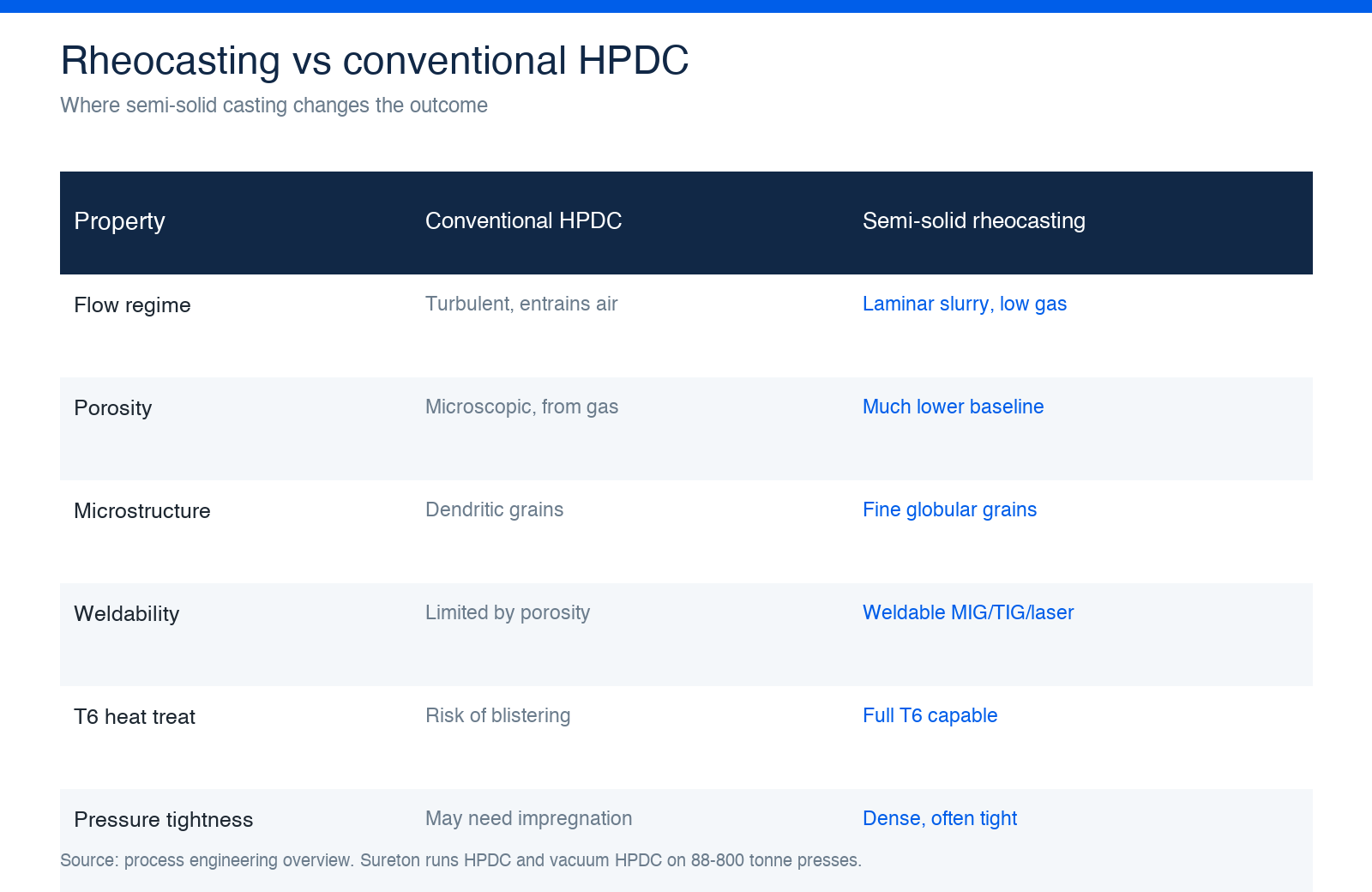
Conventional HPDC injects fully liquid metal. At high speed it behaves like a low-viscosity fluid and fills the cavity in a turbulent front that drags in gas.
Rheocasting cools the alloy into a slurry of roughly spherical solid particles suspended in liquid, typically up to about 50 percent solid fraction. That slurry is thixotropic: it flows more like a paste than water.
Because the slurry moves in a more laminar, front-to-back way, it entrains far less air. Less trapped gas means less porosity to begin with.
3. Microstructure: dendrites versus globules
Metal that freezes from a fully liquid state grows dendritic, tree-like grains. Those interlocking branches act as stress concentrators and drag down ductility. Rheocasting shears the semi-solid slurry as it forms, which promotes a fine, globular primary phase. Rounded grains are less prone to crack initiation and let the part absorb more energy before failure.
4. What the refined structure unlocks
Weldability. With gas content cut down, rheocast parts can be welded by MIG, TIG or laser without porosity blowing back into the weld. That lets a cast node join a larger fabricated assembly.
Full T6 heat treatment. Low internal gas means the part will not blister during the high-temperature solution step, so you can heat treat to peak strength.
Pressure tightness. The dense, uniform structure suits hydraulic manifolds, pneumatic valves and other parts that must seal against fluid or gas, often without impregnation.
5. Rheocasting in 2026: where the equipment and adoption are heading
As of 2026, semi-solid casting is well past the laboratory. Equipment makers are scaling the process up: a 2,500-tonne semi-solid injection press was delivered to North America in 2025-2026 aimed at large EV and automotive structural parts, according to an equipment-maker release (overseas signal, not a Sureton claim). Automotive use keeps widening for suspension and structural nodes where weldability and heat-treatability matter. For context, Sureton runs conventional HPDC and vacuum HPDC on presses from 88 to 800 tonnes, so very large structural castings are outside our machine envelope by design.
6. When to choose rheocasting, and when not to
Rheocasting needs tighter feedstock control and thermal management than standard HPDC, so it costs more and usually carries a longer lead time. It is a specialist route, not a wholesale replacement.
Choose conventional HPDC for high-volume, cost-driven parts where standard properties are enough and porosity is not the limiting factor, such as housings, brackets and covers.
Consider rheocasting when a part needs casting’s shape freedom and thin-wall capability together with weldability, T6 capability or pressure integrity that approach a forged component.
7. The practical takeaway
If a component is pushing what standard die casting can reliably deliver, semi-solid casting deserves a serious look. Send us the drawing and we will weigh casting route, tolerance and volume against the property targets. Two related reads: our guide to vacuum die casting for porosity control and the overview of how die casting works cover the more common routes we run every day. For a cost view, see our notes on die casting tooling cost and break-even volume.
Further reading on this topic: how die casting works, from process to production · vacuum die casting for porosity control · hybrid manufacturing, casting plus CNC.
Related guides in this topic
Authoritative references
Independent third-party standards and industry bodies, provided for further reading. Sureton is not responsible for third-party content.


