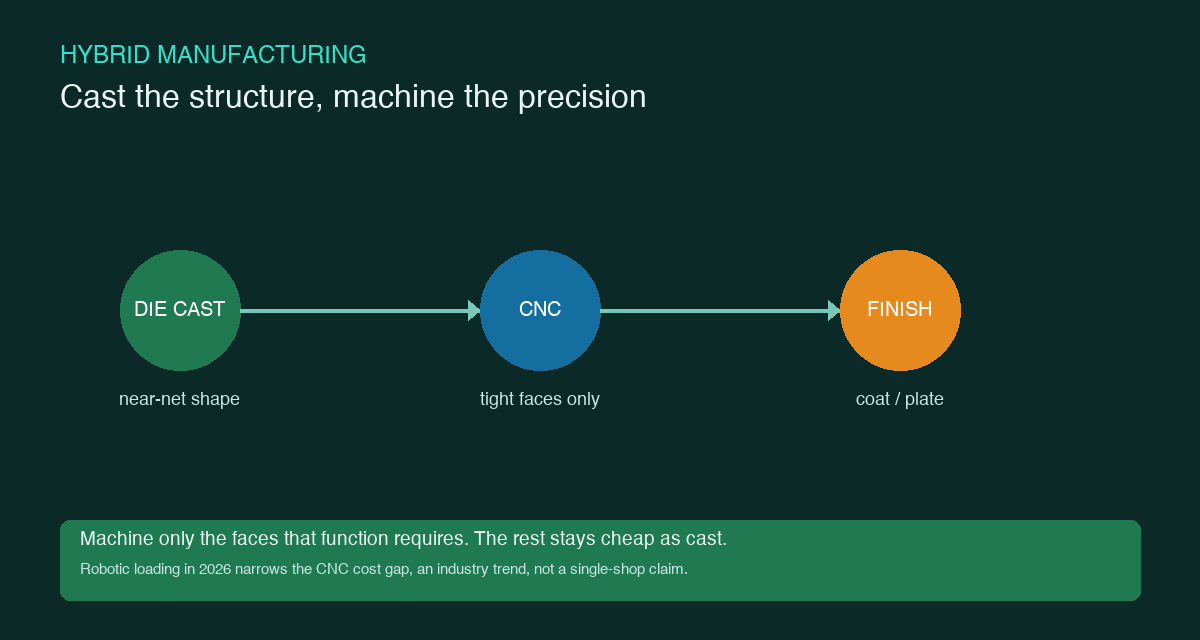
Hybrid manufacturing is the obvious answer to a question many buyers ask too late: why pay to machine a shape you could almost cast, or pay to cast a tolerance you could almost hold. The hybrid approach casts the structure and machines the precision, so each process does what it is good at.
This guide explains where the split sits, what it costs, and how to decide which faces earn CNC time and which do not.
1. Near-net shape does most of the work
Die casting delivers a near-net part in seconds: thin walls, complex contours, and most of the volume already at final shape. What it does not deliver is the plus or minus 0.01 millimetre seat, the threaded hole, or the flat reference face a downstream assembly depends on. Machining those specific features after casting captures most of the cost saving of casting while reaching the accuracy machining alone would cost far more to deliver.
2. Where CNC earns its place
The rule is simple: machine only what function requires. Cast the body, then bring CNC to the faces that seal, locate, or bear load. A part that needs five machined features out of fifty surfaces is a hybrid win. A part that needs forty of fifty machined was probably better as straight CNC or a redesigned casting. Our process comparison shows the cost crossover.
3. Fixturing and reference faces
Hybrid lives or dies on the first operation. A cast part needs a stable, repeatable locating scheme so the CNC step lands within tolerance every time. That means designing cast reference pads and datums into the tool, not hoping the raw casting indexes cleanly. The DFA and datum guidance applies at the casting stage as much as at assembly.
4. Automation is changing the economics
Industry reporting in 2026 points to robotic loading and pallet pools pushing CNC toward lights-out running, which narrows the cost gap on the machining step and makes hybrid more attractive for mixed, lower-volume programs. That is an industry trend in how shops run, not a claim about any single supplier, and it matters because it lowers the penalty for keeping a CNC step in the flow.
5. When hybrid is the wrong call
Very low volume. The die cost dwarfs the saving if you will never reach break-even.
Mostly machined geometry. If the part is mostly precision features, casting adds a step without adding value.
Frequent redesign. Every tool change resets the equation.
6. A decision checklist
Count the machined features. Few functional faces, lots of shape, is the hybrid sweet spot.
Design the datums in. Cast references make the CNC step repeatable.
Check the volume. Past the break-even band, casting plus CNC beats straight machining.
For the cost mechanics behind the tooling step, see our tooling cost and break-even guide and the 5-axis CNC write-up. Send the drawing and we will mark which faces to cast and which to machine.
Related guides in this topic
Authoritative references
Independent third-party standards and industry bodies, provided for further reading. Sureton is not responsible for third-party content.