Fifth-generation radio, especially mmWave, packs more processing into a smaller box and runs hotter while doing it. The two problems arrive together: the electronics generate heat that throttles performance, and the high-frequency signals are easy to disturb. An enclosure that mishandles either one fails in the field.
For outdoor telecom equipment, remote radio units, and small cells, aluminium die casting has become the default answer because one part satisfies the mechanical, thermal, and electrical requirements at once.
1. The natural Faraday cage
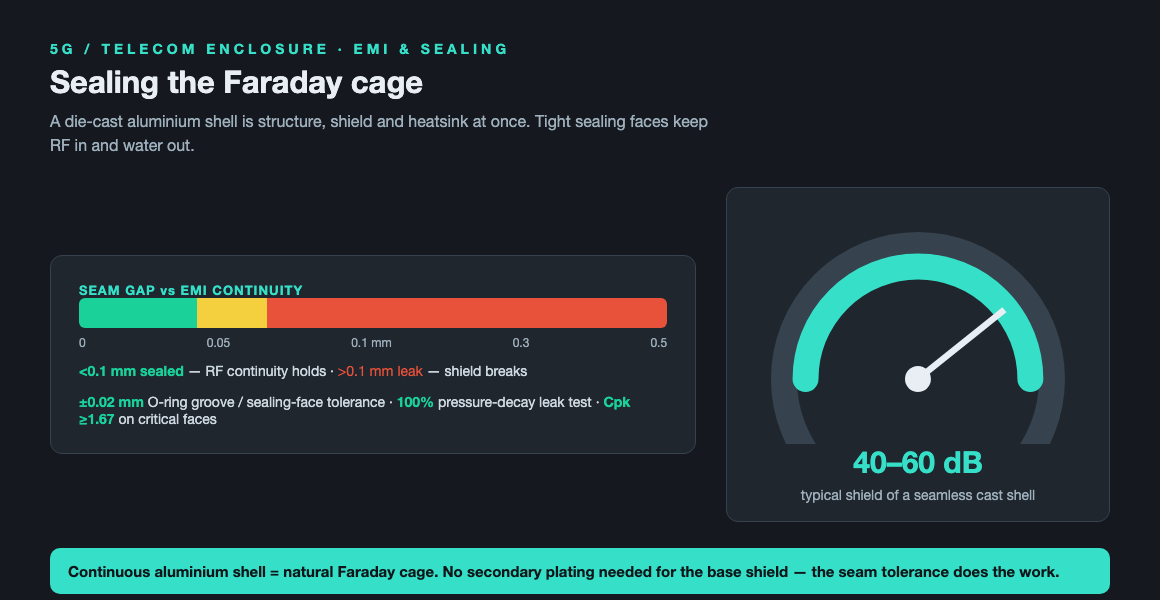
Plastics and composites are transparent to electromagnetic waves. To shield them you add conductive paint, metal liners, or plating, each a cost and a reliability risk if the coating wears or lifts. Aluminium is already a conductor. A die-cast enclosure is a continuous, seamless metal shell, which is exactly the geometry that contains RF interference.
For most 5G enclosure work the base shield comes from the metal itself. Secondary conductive finishing is added where the spec demands higher attenuation, not as a workaround for a non-conductive part.
2. Thermal management: the housing is the heatsink
Power density in radio and compute hardware keeps climbing. In AI data-center optics, 800G modules draw roughly 12 to 18 W each and 1.6T modules about 22 to 30 W, and one market report puts liquid cooling at around half of new AI data-center builds in 2026. The thermal logic is the same everywhere: the enclosure and its fins move heat out before the silicon throttles.
Die casting lets the heatsink be part of the housing wall rather than a separate piece bolted on. Fins, pin arrays, and thermal planes are formed in the die, which cuts joints and assembly steps. For a radio mounted on a tower or a switch in a rack, that integration is the difference between a stable unit and one that derates under load.
3. Corrosion protection that keeps conductivity
Outdoor units live in weather. The challenge is protecting the aluminium without killing the shield. Chromate-free conversion coatings such as SurTec 650, anodizing, and selective plating can protect the surface while preserving the electrical continuity the enclosure needs.
The choice depends on the environment and the contact surfaces. A coating that is great for corrosion but insulates a gasket seam defeats the purpose, so the finish plan has to be read against the EMI and sealing plan, not picked in isolation.
4. Weight for tower loading
Every kilogram on a mast changes the structural load and the install cost. Aluminium die casting trims mass versus steel assemblies and versus bolted multi-part aluminium builds, and it does so without sacrificing the stiffness the radio needs to hold alignment.
5. Sealing faces and tolerances
A shield is only as good as its seams. Gasket grooves and sealing faces on a die-cast enclosure are held to about plus or minus 0.02 mm so an O-ring or gasket seats evenly, which is what gets you to IP67 or IP68. The sealing features are pressure-decay leak tested, typically 100 percent on critical units, and the capable suppliers track critical features at Cpk 1.67.
Those numbers are industry capability targets, not a Sureton guarantee, but they describe the tolerance band a telecom enclosure program is judged on.
Related reading: die-cast heatsink design, automotive LED heatsinks, and DFM for electronics enclosures. For surface options see PVD, Cerakote, and anodizing, and start at how die casting works.