
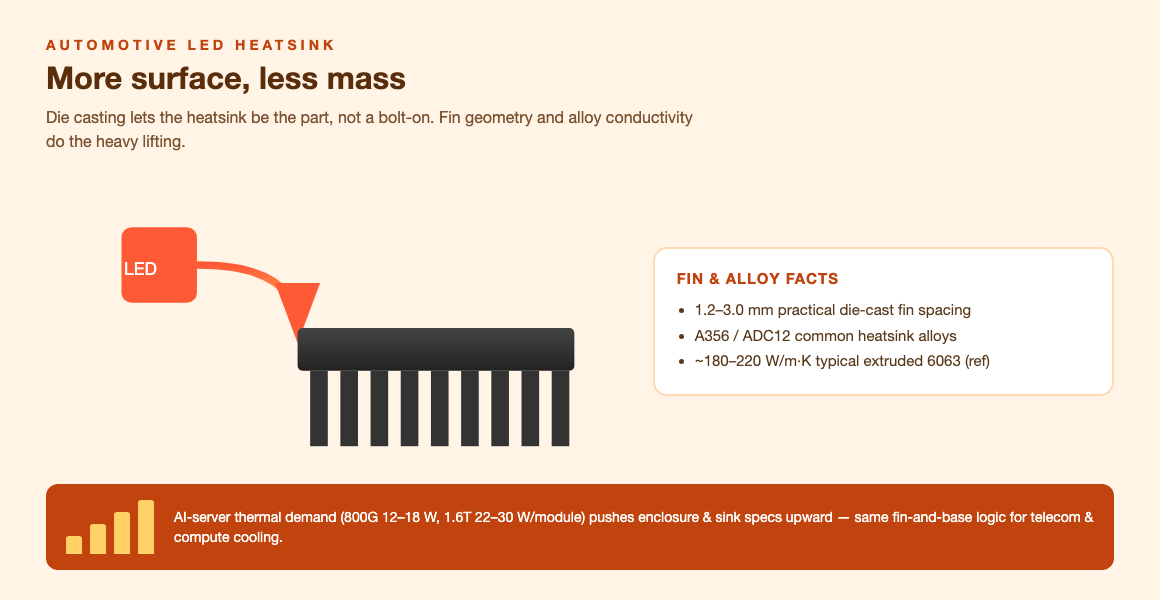
An LED headlight or tail-light module is a small thermal system. The emitter makes light and heat in the same spot, and the heat has to go somewhere or the device derates and ages. The heatsink is not an accessory to the optical design; it is part of it.
Die casting is a natural fit because it lets the heatsink be integral to the housing rather than a separate block bolted on. The fins, the base, and the mounting features can all come out of one tool. That integration is what keeps automotive lighting compact and affordable.
1. Fin geometry is the real lever
Thermal performance comes from surface area and airflow, not from the mass of metal. For die-cast aluminium the practical fin spacing lands around 1.2 to 3.0 mm: tight enough to multiply surface area, open enough that the die fills cleanly and the fins do not fuse. Below that band the casting fights you; above it you leave performance on the table.
Fin height and count matter more than alloy choice for most lighting modules. A well-shaped die-cast fin stack beats a heavier block with flat walls, and it does so at lower mass, which matters for the vehicle.
2. Material and what the numbers mean
The common heatsink casting alloys are A356 and ADC12. Their thermal conductivity sits in the aluminium die-casting range, roughly 90 to 110 W/mK, against about 180 to 220 W/mK for extruded 6063 used as a reference. That gap is real, but extrusion cannot give you the integral housing, the bosses, and the optical mounts in one piece the way casting can.
The right comparison is system level: a cast fin-and-housing that bolts directly to the board, with no interface gap and no fasteners, often outperforms a higher-conductivity block that has to be joined and aligned.
3. Why 2026 thermal demand is pushing specs upward
Automotive lighting is not the only place this matters. AI-server and optical-module thermal demand is climbing fast. In data-center optics, 800G modules draw roughly 12 to 18 W each and 1.6T modules about 22 to 30 W, and one market report puts liquid cooling at around half of new AI data-center builds in 2026. The same fin-and-base logic that cools a headlight now cools a compute enclosure, and the spec bar keeps rising.
We are not saying every AI chassis is a die casting. The transferable point is that enclosure and sink design is being pulled toward more surface, less mass, and tighter integration, exactly where die casting is strong.
4. Machining and tolerance where it counts
A die-cast heatsink needs machining only at the interfaces: the mating face to the board or emitter, and any locating features. Holding those faces flat and the standoffs to position is what makes the thermal path repeatable. The casting does the volume; the CNC does the precision.
For lighting this is usually a light machining pass on a near-net casting, not a fully machined part. That split is where the cost advantage lives.
5. What Sureton makes for thermal parts
Within our 88 to 800 tonne die casting range we produce automotive LED heatsinks and related thermal housings with integrated fins, plus the CNC finishing that makes the mating face flat and the standoffs locate. We do not run giga-casting presses.
If you are scoping a thermal part, send the thermal budget and the package. We will tell you the fin spacing we can hold, where machining is needed, and whether casting the sink into the housing beats a separate block for your module.
Related reading: the die-cast heatsink design guide, our take on 5G enclosures where thermal and shielding meet, and how die casting and CNC combine. For finishing see PVD, Cerakote, and anodizing and start at how die casting works.
Related guides in this topic
Authoritative references
Independent third-party standards and industry bodies, provided for further reading. Sureton is not responsible for third-party content.


