
1. The handpiece: where CNC machining leads
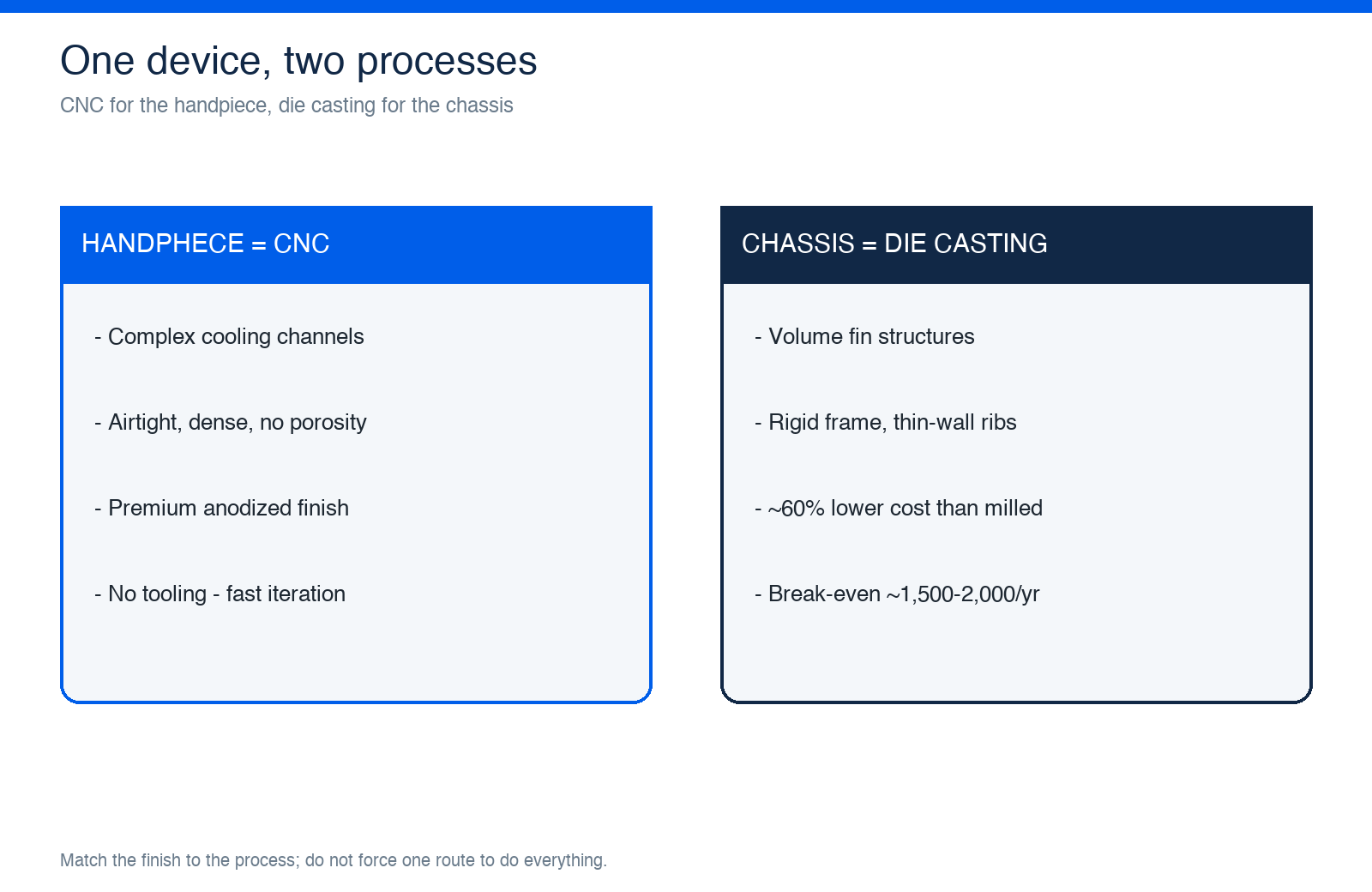
For optoelectronic medical-aesthetic systems, whether IPL, diode laser, RF or HIFU, the handpiece is the part that touches the patient and carries the cooling and optics. For that component CNC machining is almost always the stronger choice. The handpiece often needs complex three-dimensional cooling channels to support sapphire cooling, and five-axis CNC mills those flow paths straight out of solid 6061 aluminium or 316 stainless, with no dead zones. A cast part starts from a porous structure and carries a leakage risk under high-pressure water circulation that a solid-billet part simply does not have. CNC also needs no tooling, so new wavelengths and form factors can be validated in weeks rather than months. Our five-axis CNC guide covers the machining side in detail, and our medical-device CNC notes cover the quality expectations.
2. The main chassis: where die casting scales
Once a device has passed certification and reached volume production, high-pressure die casting becomes the efficient choice for the chassis. Machining large heat sinks from solid block is slow and wasteful; aluminium die casting moulds dense fin structures in seconds. ADC12 has a lower thermal conductivity than 6061, around 96 against 167 watts per metre kelvin, but a well-structured design meets system cooling needs at roughly 60 percent lower cost. Die casting also gives consistent stiffness for articulated arms and screen hinges, with thin-wall ribs that keep the device from becoming top-heavy. Our die cast heatsink guide goes deeper on thermal structure.
3. Surface finish: the premium look
Aesthetic devices must resist coupling gel and alcohol while looking premium. CNC parts, being dense, take Type II or III anodizing for that matte, blasted finish. Standard die castings, with their silicon content and flow marks, do not anodize cleanly and tend to come out blotchy, so for a premium chassis we recommend powder coat or wet paint, or vacuum die casting to lift surface density. The choice is about matching the finish to the process, not forcing one route to do everything.
4. The engineer’s verdict
Core handpiece and tip. CNC machining, for airtight reliability, complex water channels and a premium anodized finish.
Internal heat sinks. Die casting, for cost-efficient volume and complex fin geometry.
Screen bezels and trim. CNC at low volume, die casting above the break-even point of roughly 1,500 to 2,000 units.
Articulated arms. Die casting plus CNC, combining cast stiffness with CNC-bored precision holes.
The break-even is a tooling question first, and our die casting tooling cost guide helps size it. As of 2026, aesthetic-device OEMs keep splitting handpieces from high-volume chassis for exactly these reasons. Send us your STEP files and we will give DFM feedback that optimises the build for both prototyping and global launch, so manufacturing limits never compromise the design.
Further reading on this topic: how to calculate CNC machining costs · CNC machining for medical devices.
Related guides in this topic
Authoritative references
Independent third-party standards and industry bodies, provided for further reading. Sureton is not responsible for third-party content.


