
From titanium implants to PEEK surgical guides, precision in medical parts is not a sales point. It is a patient-safety requirement. A loose tolerance or a microscopic burr that would be a nuisance in an industrial bracket can cause a surgical failure, an infection, or an injury.
At Sureton, we machine medical and diagnostic components for global MedTech teams as part of our CNC machining services. That work runs on a different discipline than general engineering: documented materials, controlled processes, and inspection records that travel with the part. Here is how we handle the materials and failure modes that make medical machining hard.
1. Titanium and stainless: machining the biocompatible metals
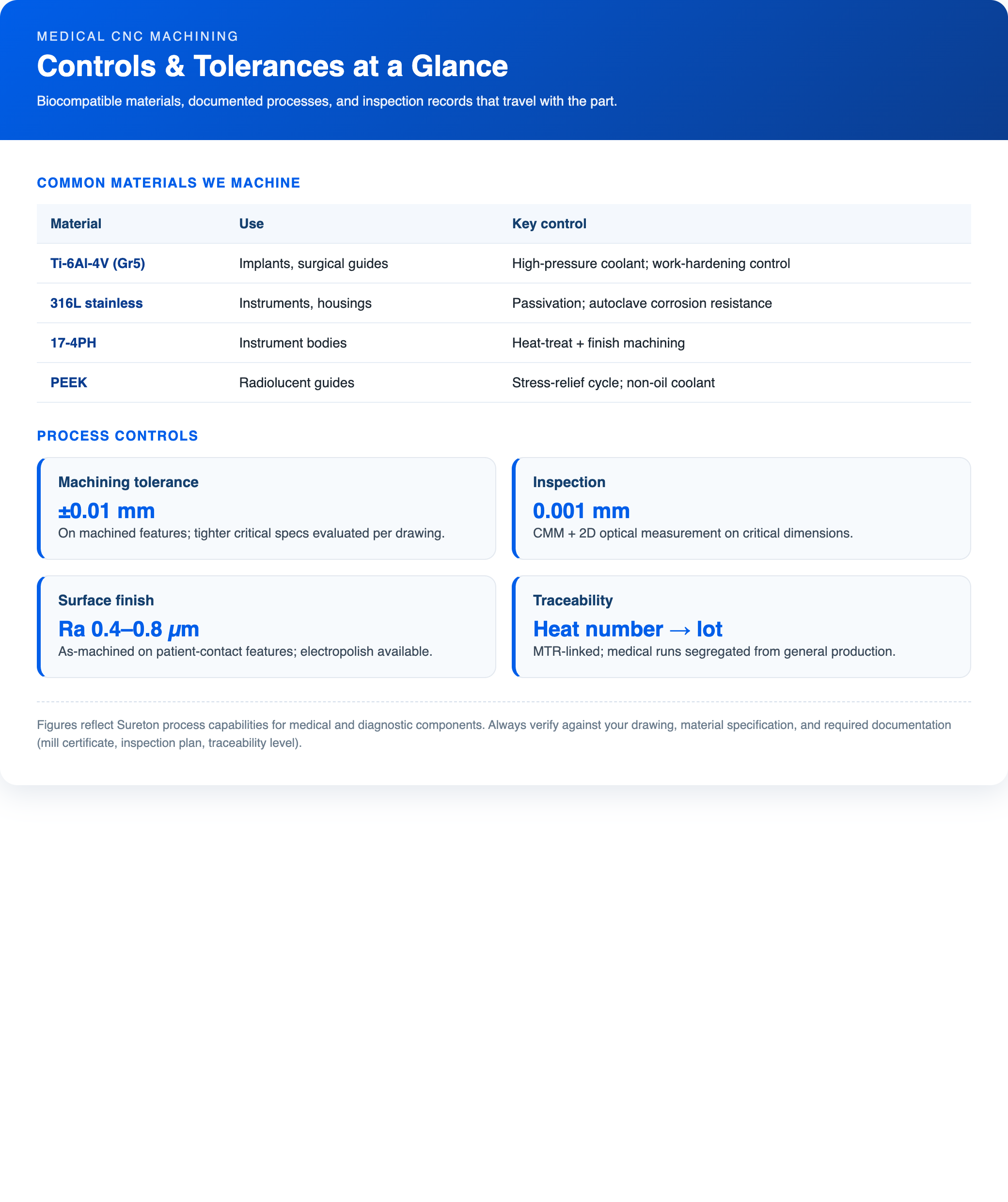
Medical engineers reach for Titanium (Ti-6Al-4V) for its biocompatibility and strength-to-weight ratio. Machinists reach for coolant, because titanium has low thermal conductivity: heat stays in the cutting zone instead of leaving through the chip, which invites work hardening and tool damage.
What we do:
Heat control: We run high-pressure through-tool coolant to pull heat out of the cut and keep the surface intact, which is the standard defense against titanium work hardening.
Tooling and tolerance: Variable-helix carbide end mills tuned for titanium cut chatter down, and we hold ±0.01 mm on machined features. Every critical dimension is verified on CMM and 2D optical measurement at 0.001 mm resolution.
Stainless (17-4PH and 316L): For surgical instruments we control passivation so the chromium-oxide layer forms correctly and the part resists rust through repeated autoclave cycles.
2. PEEK: machining soft plastic is the hard part
PEEK (polyetheretherketone) is the usual choice for radiolucent implants and surgical guides. It is also unforgiving: as you remove material, internal stress releases and the part can warp hours later, measuring perfect on the machine and out of spec by the next inspection.
What we do:
Stress-relief cycle: Rather than machining in one pass, we rough, relieve stress with a heat-treatment step, then finish machine.
Coolant control: We use non-oil coolants so the medical-grade plastic is not chemically contaminated during cutting.
3. Micro-burrs: the invisible failure mode
In a fluidic diagnostic chip or a catheter connector, a folded-over burr that standard tumbling leaves behind can detach inside a patient. We treat burr control as a first-order requirement, not a finishing touch.
Tool-path strategy: Entry and exit moves are programmed to push burrs away from critical edges.
Microscope inspection: Medical batches are checked under 20x to 40x magnification, not just by feel.
Edge finishing: For internal geometries tools cannot reach, we use electropolishing or thermal methods to clear microscopic burrs without changing critical dimensions.
4. Surface finish and bio-burden
Bacteria collect on rough surfaces, so the as-machined Ra matters for cleanability and sterilization. A typical industrial finish of Ra 1.6 to 3.2 µm is usually not enough for patient-contact parts.
Fine machining: We target an as-machined finish of Ra 0.4 to 0.8 µm on patient-contact features.
Electropolishing: Where the application calls for it, electropolishing smooths the microscopic peaks so the surface is easier to sterilize and resists bacterial adhesion. See our notes on surface roughness and Ra/Rz cost control.
5. Traceability: the paperwork is part of the part
In medical manufacturing, if you cannot prove where the material came from, the part is scrap. We keep a chain of custody that ties the raw bar to the finished lot.
Heat numbers: Every material bar is tagged, and the heat number on the Material Test Report (MTR) links to the lot number of your finished parts.
Segregated runs: Medical production is kept separate from general industrial work to avoid cross-contamination, for example copper or grinding dust reaching titanium.
6. What medical buyers ask for in 2026
As of 2026, procurement and quality teams screen suppliers on a consistent checklist before they discuss price. The points below reflect common industry and regulatory expectations (sources: 2026 medical-device sourcing guides and supplier disclosures), not a claim about any single shop:
Quality system: ISO 13485 is the medical-device baseline many OEMs require; an ISO 9001-controlled system with medical-specific procedures is the minimum credible starting point.
Material certification: Mill certificates (EN 10204 3.1 / MTR) with heat-number traceability back to the melt are now standard requests, not exceptions.
Controlled environment: For sterile-path parts, suppliers increasingly specify clean or controlled processing, commonly around ISO Class 8, to limit particulate contamination.
Verification discipline: In-machine probing and statistically tracked processes (Cpk) are the norm for critical dimensions on medical runs.
Sureton supports medical projects with an ISO 9001 quality system and in-house 5-axis machining, CMM and 2D optical inspection at 0.001 mm, MTR and heat-number traceability, and batch segregation. The regulatory responsibility for the finished device stays with the device manufacturer; we supply the component, the documentation, and the records behind it. For complex turned-milled parts, our mill-turn capability keeps setups and tolerances in one chucking, and our automated inspection backs every batch with measured data.
Work with a machining partner who documents everything
Sourcing precision CNC machining for medical components is as much about discipline as equipment. Send us your drawings and specification, and we return a feasibility review, a process plan, and the inspection records to back it up.
Have a critical part to machine?
Contact Sureton with your drawings and User Requirement Specification (URS), and we will discuss how to build safety into every part.
Further reading on this topic: how to calculate CNC machining costs · CNC machining vs die casting for medical devices.
Related guides in this topic
Authoritative references
Independent third-party standards and industry bodies, provided for further reading. Sureton is not responsible for third-party content.


