
5-axis CNC machining lets a cutting tool reach a die cast part from almost any angle in one setup. For aluminum and zinc die cast components, a process we cover in our guide to how die casting works, that means fewer fixtures, less handling, and tighter control over the features that casting alone cannot hold. This guide covers what 5-axis machining does after the part leaves the die casting machine, the tolerances it can hold, and how 2026 automation trends are changing cycle-time control on the shop floor.
1. What 5-axis CNC machining is
Traditional 3-axis milling moves the cutter along X, Y and Z. A 5-axis centre adds two rotary axes, so the spindle or table can tilt and rotate while cutting. That lets the tool stay normal to the surface on curved or angled features, holding a consistent cutting angle instead of stretching a long tool into a hard-to-reach pocket.
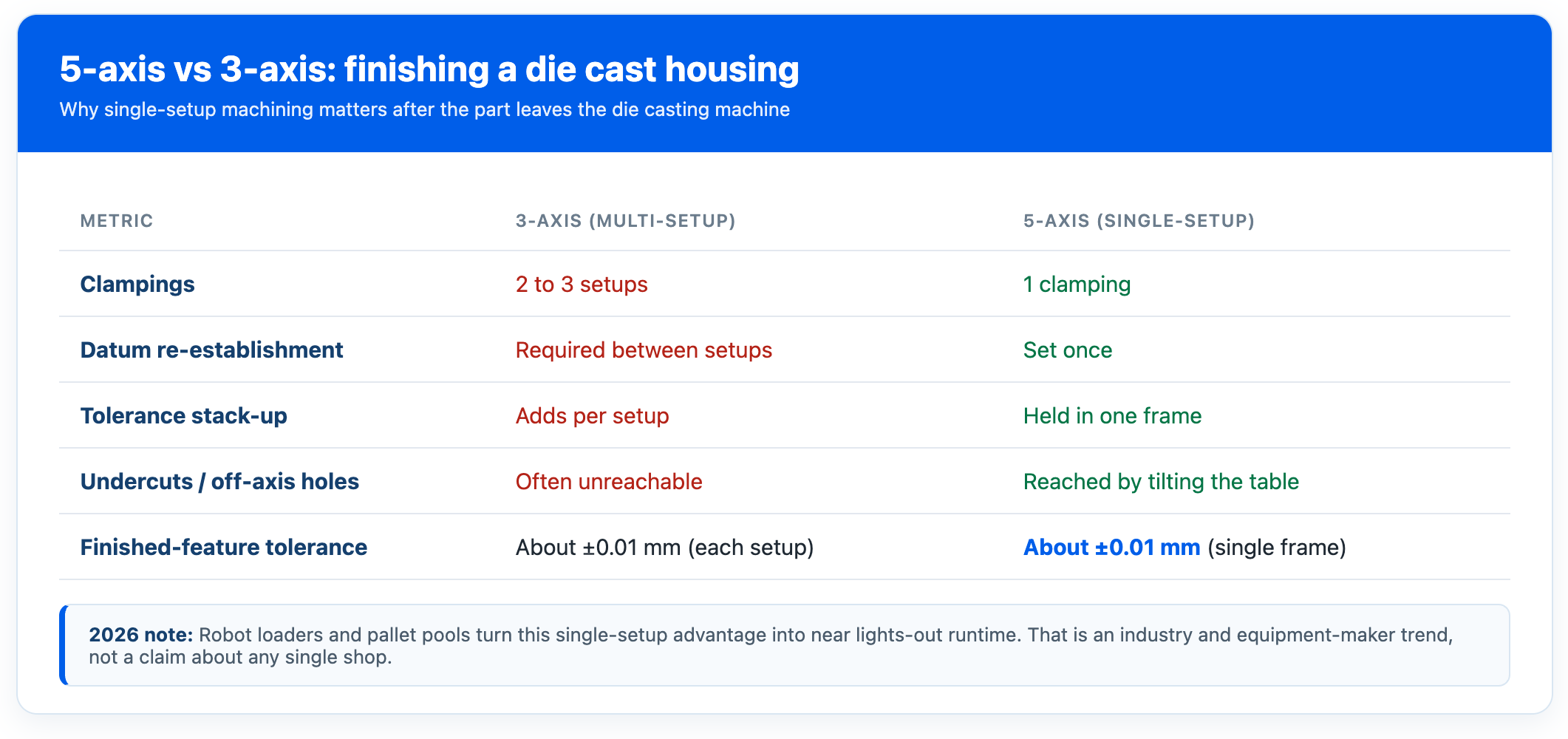
For die cast parts, the practical payoff is reaching cored holes, angled bosses and undercut faces that would otherwise need a second or third setup on a 3-axis machine. Fewer setups means fewer datums to re-establish and less tolerance stack-up between operations.
2. What 5-axis adds after die casting
Die casting forms the near-net shape; machining finishes the features that need it. On a 5-axis centre, three jobs collapse into one clamping:
Single-setup machining: Five faces of a bracket or housing can be machined in one clamping, removing the repositioning errors that come with moving a part between fixtures.
Tighter tolerances on finished features: As-cast dimensions follow die-cast tolerances near ±0.05 mm, while 5-axis finish machining brings locating bores, sealing faces and threaded features to about ±0.01 mm.
Complex contours: Deep cavities, undercuts and off-axis holes that a 3-axis tool cannot reach become straightforward when the table can tilt to the feature.
3. Where it pays off
5-axis machining earns its keep wherever a part combines a cast shape with tight, multi-sided features:
Automotive and mobility: Brackets, sensor housings and LED heatsink bodies that need flat sealing faces plus angled mounting features.
Medical devices: Instrument bodies and enclosures where a clean cast form is finished to a documented tolerance; see our notes on CNC for medical components.
Electronics and enclosures: Thin-wall zinc and aluminum shells where surface finish and feature accuracy matter more than raw material removal.
When the volume is low and the geometry is awkward, a hybrid route (die cast the structure, CNC the precision) often beats machining the whole part from solid stock.
4. Holding tolerances and surface finish
Two numbers frame the work. Cast tolerances sit near ±0.05 mm on as-cast features; CNC finishing of critical features reaches about ±0.01 mm. Between those two sits the real engineering decision: which features must be machined, and which can stay as-cast.
Surface finish follows the same logic. A shorter, stiffer tool in a 5-axis head vibrates less, so finishes in the Ra 0.8 to 1.6 µm range are practical without long polishing loops. Tool life and chatter control decide whether that holds across a batch, which is why chatter, warpage and tool-life planning belong in the process up front, not after first articles fail.
5. 5-Axis CNC in 2026: AI-driven automation and takt-time control
The 2026 constraint on many CNC cells is no longer the machine. Industry analysis from the 2026 planning cycle points to handling and process control (loading, inspection, tool changes, shift coverage) as the real limit on spindle time, with automation upgrades moving ahead of new-machine purchases where capacity already exists. (Source: Global Trade Insights / Longze, 2026 industry analysis.)
What that looks like on the floor:
Robotic tending and pallet pools: A 5-axis centre paired with a robot loader and a pallet system can run nights and weekends with minimal attendance, recovering spindle time lost to manual loading. One automation vendor’s 2026 illustration puts a 5-minute cycle losing about 60 seconds (roughly 20%) to manual load and unload. (Source: Automation World, 2026.)
AI as an auxiliary, not a replacement: At AMB Stuttgart 2026 and MACH 2026, machine-tool builders showed 5-axis centres with 12-pallet pools and robot loaders running unattended. The AI on show was process monitoring, predictive tool-wear and in-machine probing, used to shorten cycle time and catch drift before a batch scraps. (Source: trade-show observation, 2026.)
Closed-loop gauging: In-machine probing measures a feature, compares it to target and applies a verified offset, tightening the loop between machining and inspection instead of finding errors at the end. (Source: Siemens NX and industry reporting, 2026.)
These are industry and equipment-maker trends, not a claim about any single shop’s current line. The takeaway for a buyer is to ask a supplier how a part would actually be fixtured, probed and tended, and what unattended runtime their cell supports.
6. What to ask a machining supplier
Before sending a die cast part to 5-axis finishing, a few questions sort capable shops from generic ones:
Setup strategy: How many clampings does the quoted process need, and which features drive that count?
Measurement: Is first-article and in-process gauging documented, and can they show the datum scheme?
Automation fit: For recurring volumes, can the part run on a pallet or robot cell, or does it need an operator at every door open?
Robotic inspection and consistent process control are where automated quality control now lines up with 5-axis machining, closing the loop between cutting and checking.
7. Talk to our engineering team
Send us your die cast part drawing and the features that must stay tight. We will review the casting and machining route, flag which dimensions can stay as-cast, and tell you whether 5-axis finishing or a hybrid route fits your volume.
Share your drawings for a feasibility and process recommendation.
Further reading on this topic: how to calculate CNC machining costs · 3-axis vs 5-axis CNC cost and ROI.
Related guides in this topic
Authoritative references
- Mazak VARIAXIS 5-axis machining centre (equipment reference)
- Overview of 5-axis machining: 3+2 indexing vs simultaneous
Independent third-party standards and industry bodies, provided for further reading. Sureton is not responsible for third-party content.


