
Die cast heatsink design is a thermal management problem solved with geometry, not magic. When a part needs more than a flat plate: 3D fins, mounting bosses, and an integrated housing, aluminum or zinc die casting earns its place. In 2026 the pressure is sharper than ever, as AI servers and 800G to 1.6T optical modules push power density into territory air cooling alone struggles to handle.
In power electronics, whether a 5G base station, an EV inverter, or a high-bay LED fixture, heat is the enemy of reliability. The familiar default is extruded aluminum for its high conductivity, but extrusion is locked to 2D profiles. When the enclosure itself must shed heat, you reach for aluminum die casting and design around the material you actually get.
1. Why choose die casting for a heatsink
Die casting wins on form, not on raw thermal conductivity. Use it when the part is more than a fin stack:
Net-shape 3D geometry: fins, channels, and stand-offs come out of the die in one shot instead of being machined later.
Integrated housing: the heatsink and the enclosure become one part, cutting joints and contact resistance.
Cost at volume: once tooling is paid for, per-part cost drops well below CNC or extrude-and-machine routes.
Thin walls: aluminum dies hold around 1.0 mm walls, letting you pack more fins into the same footprint.
For alloy choice between the two common die-cast aluminum families, see our ADC12 vs A380 selection guide.
2. The material trade-off: conductivity versus shape
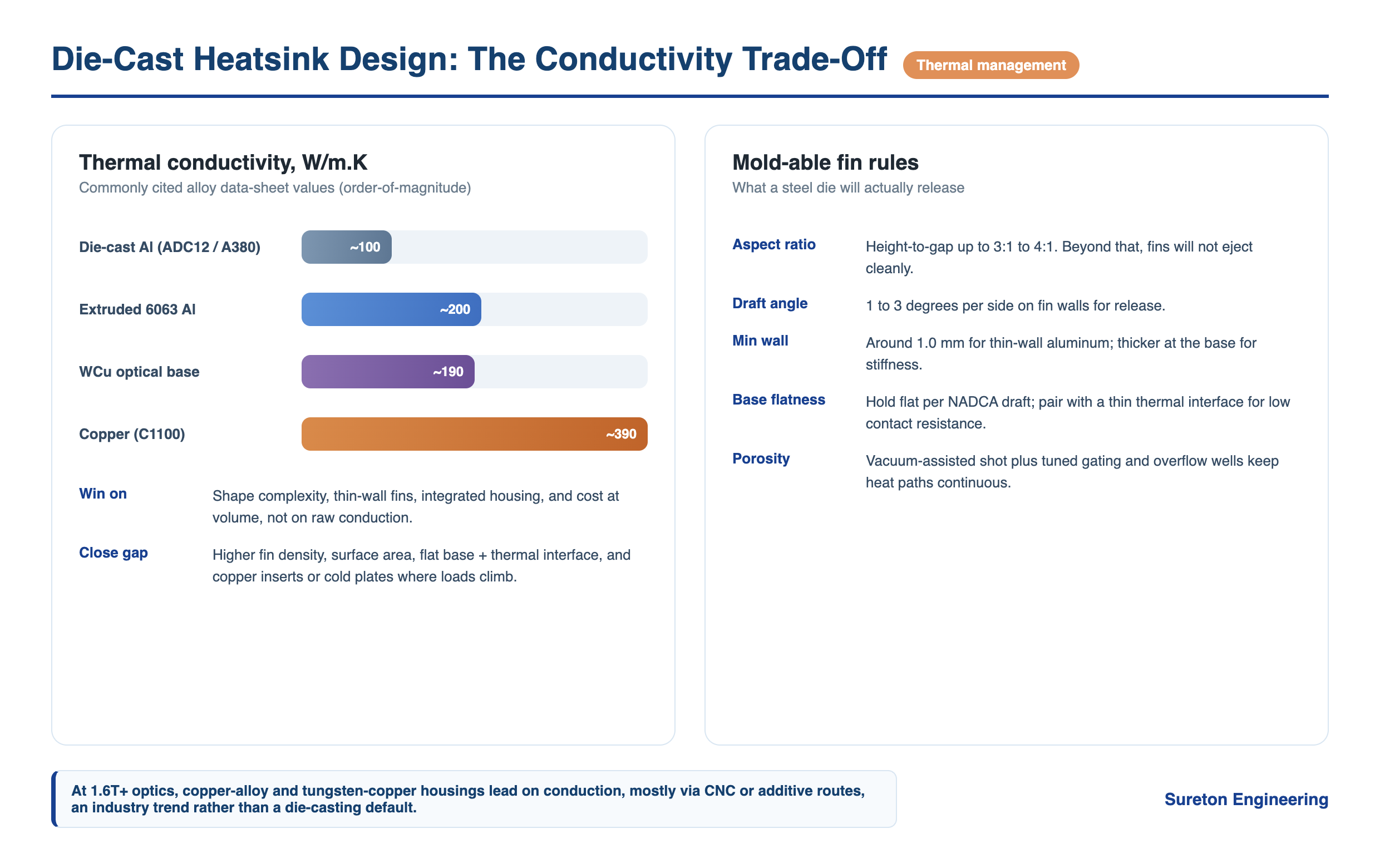
The honest starting point is that die-cast aluminum conducts less heat than extruded or machined stock. Numbers below are commonly cited alloy data-sheet values, and the exact figure depends on alloy and process:
Die-cast aluminum (ADC12, A380): roughly 90 to 110 W/m.K.
Extruded 6063 aluminum: roughly 180 to 220 W/m.K.
Copper (C1100): roughly 385 to 400 W/m.K.
Tungsten-copper optical base (400G to 1.6T): roughly 180 to 200 W/m.K with a matched low expansion.
So a die-cast fin will never beat a solid copper spreader on conduction. You close the gap with geometry: more fin surface area, tighter fin spacing that the mold can still release, a flat base, and a good thermal interface. Where loads climb past what aluminum fins can move, designers add copper inserts or bolt on a cold plate rather than switch the whole part to CNC.
3. Fin geometry rules that survive the mold
Because the steel die must pull clear between the fins, die-cast fin design follows rules extrusion does not.
Aspect ratio and draft
Height-to-gap ratio: keep fins near 3:1 to 4:1. Taller, tighter fins look better on paper and break in the die.
Draft angle: give fin walls 1 to 3 degrees per side so they release without sticking or scoring.
Tip thickness: avoid knife edges; a small radius at the fin tip improves fill and eases ejection.
Base flatness and the interface
The base meets the device through a thermal interface material, so flatness and surface finish matter more than fin count. Hold the base flat to a NADCA-class draft, then let a thin pad or paste carry the heat across the joint. A rough or warped base simply widens the air gap the interface has to fill.
4. Controlling porosity in thermal parts
A heatsink full of gas pores has broken heat paths. Porosity comes from trapped air and shrinkage, and it shows up as local hot spots. Control it at the source:
Vacuum-assisted shot: evacuating the cavity before fill pulls trapped air out, the same method we cover in vacuum die casting.
Gating and venting: direct metal along the fins and let air escape through vents and overflow wells.
Impregnation: for leak or pressure paths, vacuum impregnation seals the voids after casting.
5. Die cast heatsinks in 2026: AI servers and optical modules
The cooling load is moving fast. Industry analysts (TrendForce, cited in 2026 trade press) project liquid cooling reaching about 53 percent of AI chips in 2026, up from roughly a third in 2025, as accelerators and 800G to 1.6T optical modules pack more watts into the same slot. Some forward specifications already target 100 W per transceiver module. Where die casting fits:
Where die casting earns the job
400G and below, plus enclosures: die-cast aluminum and zinc housings stay the practical, cost-effective shell for most modules and for 5G and server enclosures that need both shielding and conduction.
Small precision parts: zinc die casting and precision small parts suit housings and brackets where tight tolerances matter.
Hybrid air-liquid: the die-cast structure carries fins and mounting while a cold plate or heat pipe does the heavy transfer.
One caveat worth stating plainly: at 1.6T and above, copper-alloy and tungsten-copper housings lead on conduction, and those are mostly made by CNC or additive routes today. That is an industry trend to watch, not a die-casting default, and not a claim about our own shop.
6. Checklist before you send the drawing
Confirm the heat path: source, spreader, fin field, and interface, in that order.
Set fin limits: 3:1 to 4:1 aspect, 1 to 3 degree draft, wall near 1.0 mm.
Specify flatness: base flatness and surface finish, not just fin dimensions.
Plan porosity control: vacuum shot, gating, vents, and impregnation if it must seal.
Pick the process: die cast for shape and volume, CNC or a copper insert where conduction dominates.
Our automotive LED heatsink work shows how the same thermal logic applies when the part is machined instead of cast.
Ready to turn your thermal spec into a castable part?
Send us your drawings for a feasibility and process check. We will flag draft, fin, and porosity risks before tooling starts, so the first shot already moves heat the way your device needs.
nBrowse all guides in this topic
Authoritative references
- NADCA die casting standards & product specifications
- NADCA — Product Design for Die Casting (design manual)
- Aluminum alloy typical properties (NADCA datasheet, third-party host)
- ISO 9001 - Quality management systems (ISO)
- IATF 16949 - Automotive quality management scheme (IATF)
Independent third-party standards and industry bodies, provided for further reading. Sureton is not responsible for third-party content.


