
Porosity is the one defect that quietly wrecks aluminum die castings, and vacuum die casting is the most reliable way to keep it out. Here is how standard HPDC traps air, what vacuum (and the newer high-vacuum variants buyers now ask for) actually changes, and when specifying it is worth the added tooling cost.
You machine a die-cast housing that looked perfect, then hit a void two millimeters below the surface. The part is scrap, the tool may have taken a hit, and your yield drops. That is the daily risk on a standard high-pressure die casting (HPDC) line, and it is why some parts should never be run without vacuum assist.
A small amount of porosity is normal even in good castings. The gap between a commercial-grade part and a leak-tight structural one usually comes down to whether the mold cavity was evacuated before the shot. That is the whole point of vacuum die casting.
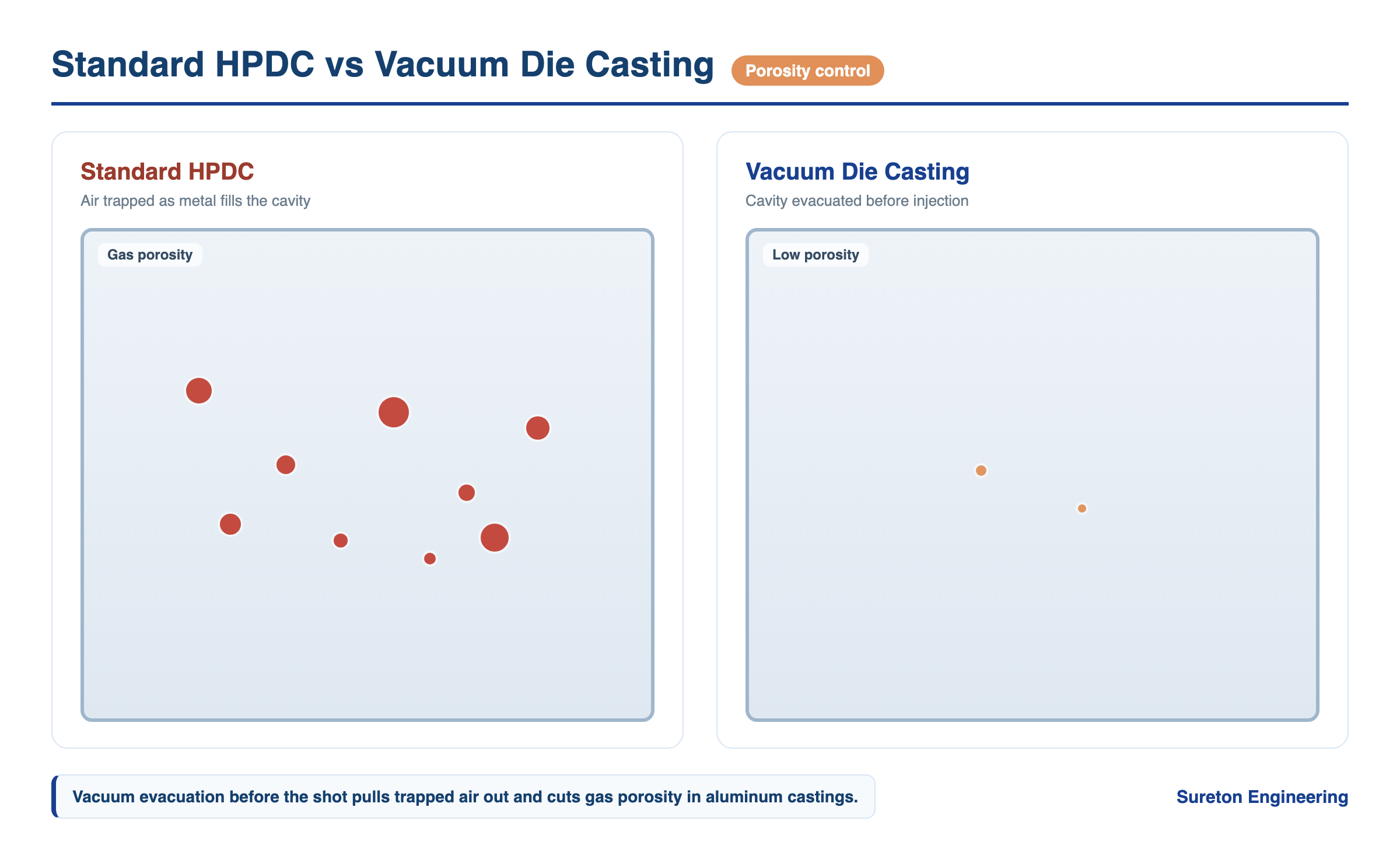
1. Why porosity happens in the first place
In standard HPDC, molten aluminum is driven into a steel cavity at speeds up to about 100 m/s. The cavity is full of air. As metal rushes in it stirs that air into turbulence, and any air that cannot clear the vents before solidification gets pinned in place as gas porosity.
The symptom: small round voids that only show up when you machine into the part or X-ray it.
The result: leaks under pressure, blistering during heat treatment or powder coating, and a weaker section where you least want one.
If you want the longer version of how the process traps and releases that air, see our guide to controlling porosity through gating and venting.
2. What vacuum die casting actually does
Standard venting is passive. It relies on the metal pushing air out through overflow gaps, and on complex geometries that is often not enough. Vacuum die casting is active: a vacuum pump is tied into the mold and pulls air out of the cavity and shot sleeve in the milliseconds before injection.
The technical payoff:
Lower backpressure. Metal enters a near-evacuated space, so it meets less resistance.
Calmer fill. With little air to shove aside, the flow stays predictable and approaches laminar conditions instead of splashing.
Denser parts. Gas content drops, so the casting is tighter and stronger through its cross-section.
3. High-vacuum die casting in 2026
The phrase buyers use has shifted. A few years ago vacuum was a nice-to-have; in 2026, on structural and leak-tight parts, specifying high-vacuum (V-HPDC) is becoming the default ask.
Penetration is real, not hype. In China’s precision die-casting mix, high-vacuum process penetration reached about 29.4% in 2026 (industry market report, 2026), up from a small base, with semi-solid casting tracking at 17.8% the same year.
Share of automotive aluminum is climbing. The International Aluminium Institute (IAI, 2025 outlook) put high-vacuum share of automotive aluminum content at 28% in 2025, projected above 32% by the end of 2026.
It is now written into standards. China’s 2026 group standard T/ZJVITIA 02 (2026) recommends high-vacuum HPDC for Class-A structural body components. Buyers citing that spec are no longer early adopters.
Hardware caught up. Two-stage vacuum systems now pull cavities to roughly 10 mbar, with high-end cells below 5 mbar, completing evacuation in the 0.3 to 0.5 s before the shot (equipment maker specifications, 2026).
None of these are Sureton production numbers. They describe where the market and the spec sheets have moved, which is why we treat vacuum as a standard process option rather than a specialty add-on.
One nuance buyers should hold onto: vacuum removes gas porosity, not shrinkage. Supplier capability pages report high-vacuum cutting gas-related pores by roughly 60 to 80 percent, while shrinkage voids still depend on gate design and mold-temperature control, where closing the temperature spread across the die face does more than any pump setting. The practical bar for a leak-tight face stays below about 1 percent volumetric porosity, and the relevant inspection reference remains ASTM E505 for radiographic rating. None of these are Sureton production numbers; they describe what the spec sheets and supplier data now treat as the working target.
4. When you should specify vacuum
As a practical vacuum die casting supplier, the honest answer is that not every part needs it. It adds tooling and process cost. Specify vacuum when your part fits one of these:
Pressure-tight or leak-proof parts
Pump housings, valve bodies, and fluid connectors fail functionally if they leak. Vacuum casting is the dependable way to pass IP67 or high-pressure leak tests consistently.
Heavy post-machining
If you cut deep into the casting you remove the dense outer skin and expose the core, where standard porosity hides. Vacuum casting keeps density uniform, so CNC milling and boring do not open air pockets. Our overview of the die casting process covers why that skin forms in the first place.
Surface finishing
Chrome plating or PTFE coating heats the part and expands any trapped gas, so the surface bubbles or blisters. Vacuum casting strips most of that gas out and gives a cleaner cosmetic finish.
Thin-walled structural parts
Large thin parts, such as telecom housings or EV battery trays, need metal to travel far before freezing. Vacuum draws metal into blind ribs and thin sections that shot pressure alone cannot fill. See our thin-wall die casting design guide for wall-thickness limits.
5. Where vacuum die casting earns its keep
The demand is no longer just traditional hydraulics. Three adjacent markets now treat low-porosity aluminum as a baseline requirement:
EV battery trays and structural castings. A liquid-cooled tray has to be both leak-tight and crash-structural, exactly the combination vacuum serves. We cover the design and safety trade-offs in our EV battery tray die casting guide.
Electrification and lightweighting. Larger thin-wall sections that replace stamped-and-welded assemblies depend on a clean fill. Our EV lightweighting write-up shows where vacuum fits the part-consolidation case.
Leak-path components. Where a casting must seal without secondary impregnation, vacuum is the first line of defense; our leak-proof die casting article explains when vacuum alone is enough and when vacuum impregnation is still needed.
6. How Sureton runs vacuum casting
Owning a vacuum machine and using it well are different problems. We pair vacuum with mold-flow simulation before any steel is cut. The sim shows where air is likely to trap, and we place vacuum valves at those last-to-fill locations rather than guessing.
For parts that need it, the result is a measurable drop in scrap against the 5 to 8% scrap band typical of standard HPDC runs (industry-reported range), plus consistent density for downstream CNC machining and a steadier supply for OEM programs. We do not quote a fixed scrap number up front; the achievable figure depends on geometry, alloy, and how early simulation enters the program.
7. Talk to an engineer before you spec the tool
If porosity has been biting your aluminum parts, send the 3D files and we will tell you straight whether vacuum die casting is worth it for your application, or whether a standard process will do. Contact Sureton and we will review the drawing.
nFurther reading on this topic: how die casting works, from process to production · gating system design for porosity control · vacuum impregnation for leak-proof castings.
Related guides in this topic
Authoritative references
Independent third-party standards and industry bodies, provided for further reading. Sureton is not responsible for third-party content.


