A quote arrives at five dollars per unit and the product lands at seven and a half. The unit price did not lie, but it was never the price. The gap is made of freight, duty, inspection documents, corrosion protection, tooling support and carbon certificates, and each of those is a line you can name, cost and negotiate.
This guide walks through the cost drivers that sit outside the ex-works number, what each one actually costs, and how to build them into a sourcing budget before the first container moves.
1. The Cost of Quality Documentation
When a supplier quotes “inspection included”, it is worth finding out what that covers.
The common baseline is AQL sampling with hand tools. That is appropriate for non-critical features and inadequate for safety-related or tightly toleranced components.
The additions worth naming are specific and each one consumes real quality engineering time:
First article inspection reports with measured dimensional data against the drawing
PPAP documentation at the level your customer actually requires
Material certificates traceable to the melt, not just to the shipment
100 percent inspection on critical dimensions or cosmetic surfaces
Radiographic or leak testing where internal integrity governs the application
Put these in the RFQ. A supplier who quotes an all-inclusive price against a clear documentation list is quoting a real number. A supplier who quotes a basic figure and adds later is pricing uncertainty into the relationship, and that uncertainty is usually more expensive than the documentation itself. Our guide to calculating machining costs covers how the second operation on a casting is usually costed.
2. Packaging and Logistics
For metal parts crossing oceans, packaging is not a commodity line. It is insurance against a specific set of failures.
The baseline problem: standard bulk packaging suits short-term storage or domestic transport. On an ocean route, parts meet salt air, humidity swings and temperature cycling. Condensation forms inside the container, and parts that touch each other corrode or mark each other. The failure surfaces at goods receipt, when sorting and rework are already your problem.
The adequate answer usually includes:
Volatile corrosion inhibitor packaging for ferrous and sensitive alloys
Anti-static and barrier bags for finished surfaces
Custom layer pads or dividers preventing part-on-part contact
ISPM 15 compliant heat-treated pallets, which many destination countries now require by default
This typically adds a modest per-part figure that depends on part size and complexity. Set against the cost of sorting, rework and scrap on arrival, it is one of the cheapest lines in the whole budget. Our export packaging guide covers the specific corrosion risks for cast aluminium and zinc parts.
3. Non-Recurring Engineering: The Tools Behind the Tool
The die or mould is the largest NRE item, and it is the one everybody negotiates. The supporting equipment around it is the item that gets bundled.
Custom machining fixtures: holding the raw casting securely and repeatably in the CNC for each operation. Without one, every operator re-sets the part by hand, and the variation shows up in your critical dimensions.
Quality assurance fixtures: dedicated holding fixtures for CMM inspection, functional test jigs, and custom go/no-go gauges for fast in-line checks.
Ask for these to be quoted as separate lines. A bundled figure hides the cost and makes it impossible to decide whether a cheaper fixture would do. Tooling cost itself has its own logic, which our tooling cost and break-even guide covers in detail. The same applies to any mould that will be shared or transferred later, where tooling ownership becomes part of the landed cost conversation.
4. Duties and Trade Measures: The Layer That Moves
The part of landed cost that changed most in 2025 and 2026 is the trade layer, and it moves independently of anything you negotiated with your supplier.
United States. Aluminium articles are subject to Section 232 tariffs at 25 percent on full value. A separate Section 301 action on forced-labour-related goods applies to other categories, though aluminium articles are currently exempt from it and the two measures do not stack. Classification and origin decide which lines apply, and both are checked against the actual product rather than the description on an invoice. Classification and origin questions deserve their own conversation before you commit a program, and our guide to reading a die casting quotation covers what to ask on the commercial side while this is settled.
European Union. CBAM adds a carbon layer to the landed cost of aluminium goods. Since 1 January 2026 the mechanism runs in its definitive regime, and importers surrender certificates against the embedded emissions of what they bring in. When a supplier cannot supply verified installation-level data, the EU default value applies, and the difference between the default and the real figure for secondary aluminium runs from roughly fifteen to thirty times. That difference is priced into your next negotiation whether or not you raise it. Our sustainable aluminium sourcing guide sets out how the mechanism works and what documentation to request.
United Kingdom. The UK’s own version of the carbon border mechanism starts on 1 January 2027, so British buyers will run the same calculation a year later on the same shipments.
A 2026 update: the trade layer kept moving
The trade measures in this section shifted again after the 2026 reviews. The USMCA was not renewed on its original 1 July 2026 term; instead it moves to year by year review through 2036, so the zero tariff assumption between the US, Mexico and Canada is now something to check each program year rather than bank on. Mexico separately applies its own tariff lines to aluminium goods, with rates reported across a five to fifty percent band depending on the product. And Proclamation 11032, issued in June 2026, puts a 25 percent charge on the non-US content of certain USMCA-qualified mobile industrial equipment, with a 15 percent floor. None of this is a Sureton legal opinion; it is the reason a dual-source plan is no longer an edge case but a line item in the landed cost model.
5. The Reshoring Arithmetic Nobody Puts in the Spreadsheet
Domestic sourcing conversations usually stop at the unit price comparison, which flatters the offshore quote and then quietly misleads. The useful comparison is landed cost plus the cost of carrying the decision.
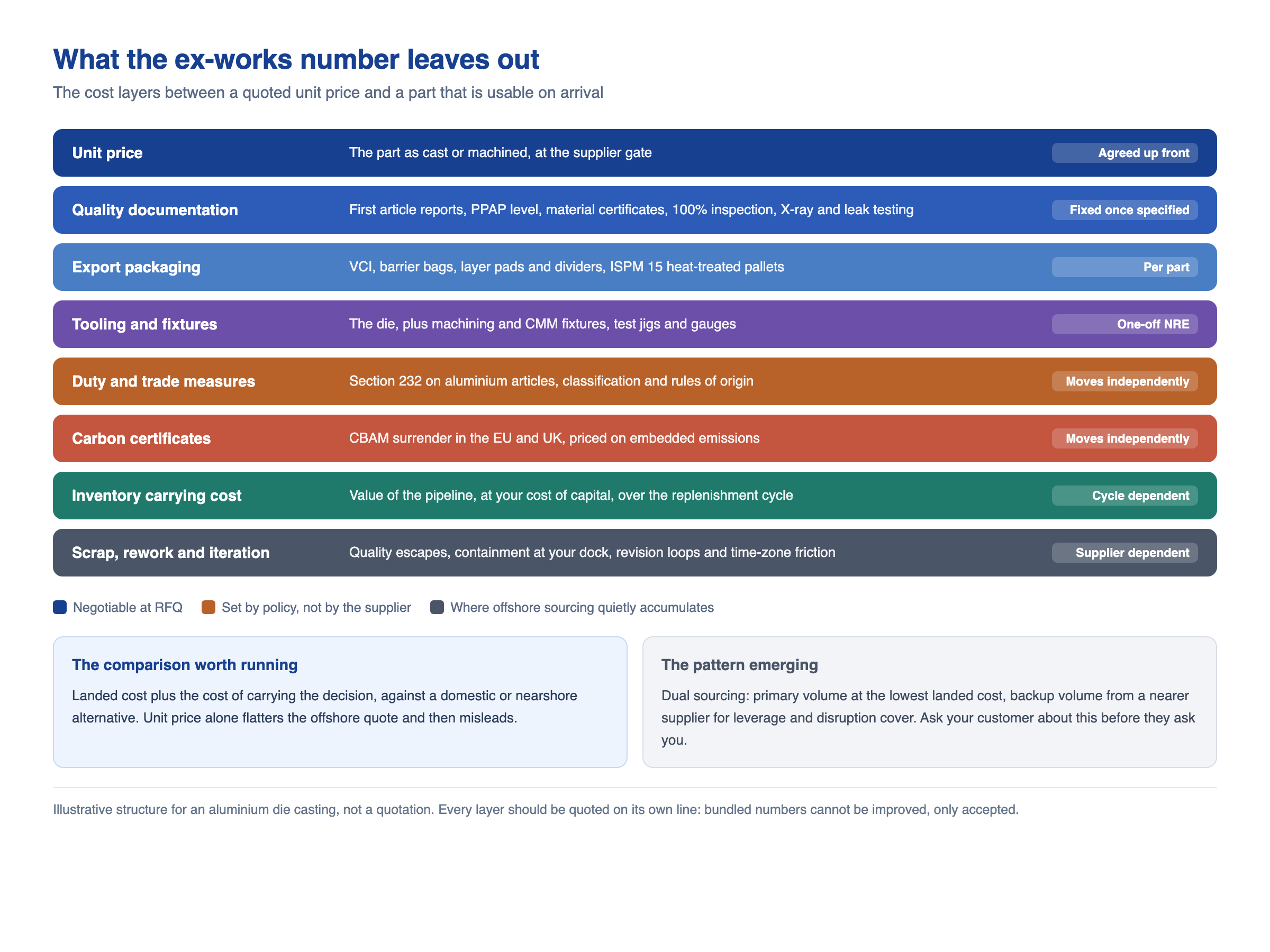
A worked structure for an aluminium die casting, using illustrative figures rather than a quote:
Unit price: the ex-works number plus the processing operations the drawing requires
Logistics: ocean freight, insurance, port and inland handling
Duty and trade measures: whatever applies to your classification and origin
Carbon certificates: where the destination levies CBAM
Inventory carrying cost: the value of the pipeline, at your cost of capital, over the replenishment cycle
Scrap and rework: a percentage that varies far more between suppliers than unit price does
Engineering iteration cost: revision loops and time-zone friction on every change
The last two are where offshore sourcing quietly accumulates. A longer replenishment window ties up working capital in transit. Feedback loops stretch when a dimensional question takes two days to answer. And when a quality escape happens, containment happens at your dock rather than at your supplier’s.
Supply-chain planning has shifted accordingly. Recent industry survey work put OEM reshoring activity at 36 percent in 2026, up from 29 percent a year earlier, with 63 percent planning capital investment through 2027, and tariff cost cited as the leading reason. A common pattern among the buyers who have moved is deliberate dual sourcing: primary volume from the lowest landed cost, secondary or backup volume from a nearer supplier to hold negotiating leverage and cover disruption.
That pattern is worth understanding even if you never reshore. It is what a customer will propose to you, and being able to talk about it with numbers rather than adjectives makes the difference in whether you keep the program.
6. Building the Landed Cost Model
Put the model together before the RFQ goes out, not after the first quote arrives. Four practices make it work:
Separate unit price from the rest of the quote. Tooling, fixtures, documentation, packaging and freight belong on their own lines. Bundled numbers cannot be improved, only accepted.
Get the classification question answered early. Duty depends on the product and its origin, and it can move faster than your annual contract. Our guide to reading a die casting quotation covers which questions to ask about the quote structure itself.
Model the duty layer as variable. Ask what happens to your landed cost if the rate moves. A supply chain that survives a 25 percent rate change is more robust than one that only works at today’s rate.
Price the carbon layer where it applies. If you ship into the EU or UK, the certificate cost is part of the part. Ask your supplier for the emissions figure, and treat a default value as an unanswered question rather than a fact.
Once the model is built, the comparison stops being a debate about unit price and becomes a comparison of supply chains. That is a much better place to be when a supplier’s quote has to be defended internally.
Want a landed cost model built on your actual part?
Send us the drawing, the annual volume and the destination market, and we will build the full cost breakdown with every line named.
You will get a written quotation showing ex-works, tooling, fixtures, documentation, packaging and the trade and carbon layers for your specific shipment.
Further reading on this topic: how to read a die casting quotation · die casting tooling cost and ROI.
Related guides in this topic
Authoritative references
- USTR - Section 301 tariff actions and exclusion process
- European Commission - Carbon Border Adjustment Mechanism (CBAM)
- Commission Implementing Regulation (EU) 2026/1740 - CBAM definitive regime (EUR-Lex)
Independent third-party standards and industry bodies, provided for further reading. Sureton is not responsible for third-party content.