
A collaborative robot arm has to be light enough to move fast yet rigid enough to repeat its position within a fraction of a millimetre. Those two demands pull against each other, and the way the arm is made decides which one wins. Die casting is often the answer once a design leaves the prototype bay and enters volume.
This article covers where cast aluminium earns its place in a robot limb, where a lighter alloy enters, and what the 2026 humanoid and cobot demand means for component sourcing.
1. Why die casting beats machining at volume
For the first ten prototypes, arms are usually machined from solid aluminium billet. They look right and they are strong, but the buy-to-fly ratio is brutal and the cost per part stays high. At production volume the economics flip.
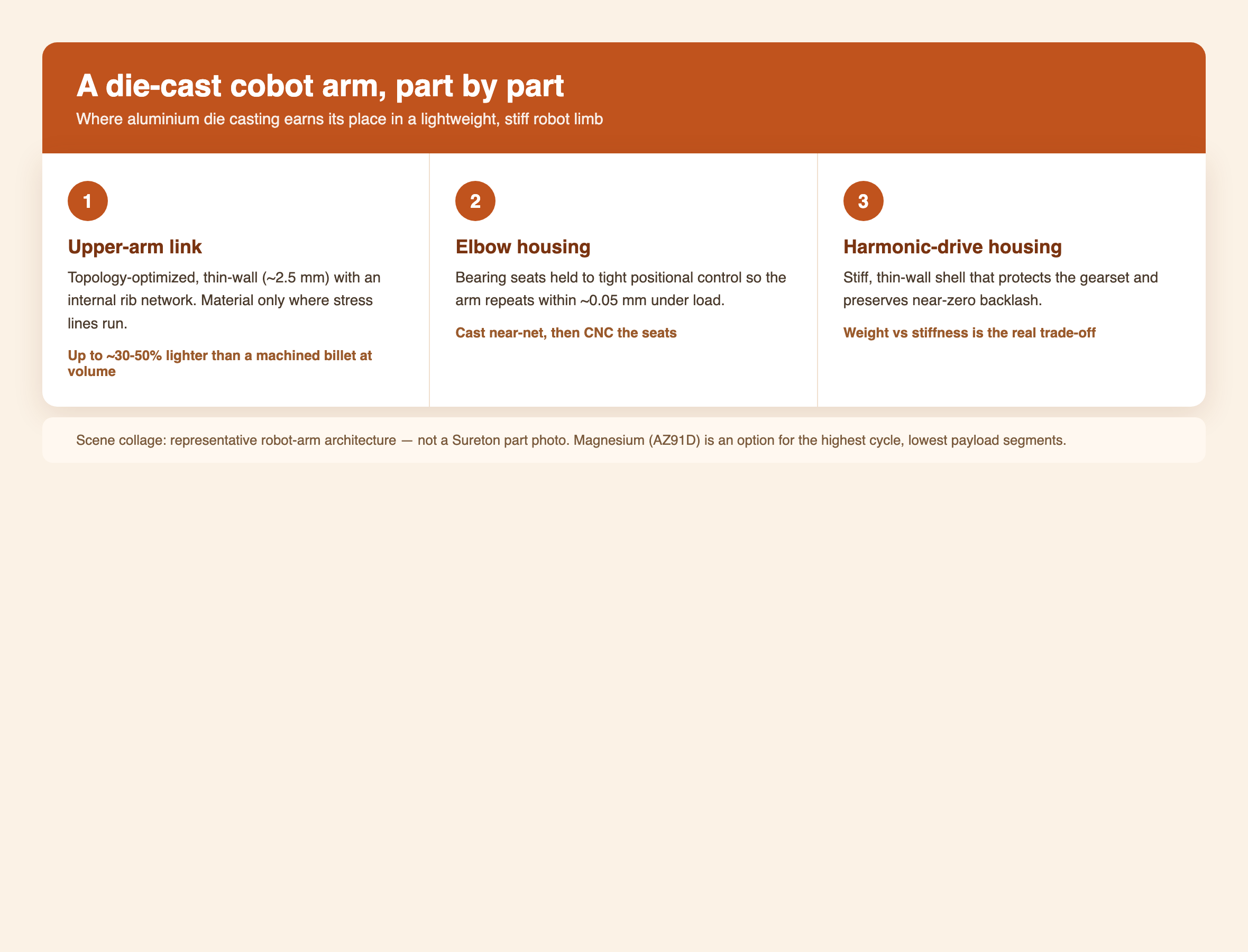
Die casting lets you place material only along the stress lines and leave the rest empty. A thin wall around 2.5 mm with an internal rib network can reach a stiffness close to a solid section at a much lower mass. Industry benchmarks for aluminium die casting versus machining from solid commonly land in the range of 30 to 50 percent lighter and 60 to 80 percent lower per-part cost once volumes pass roughly 10,000 units. Those are engineering reference points, not a quote, and they depend entirely on geometry and annual volume.
2. The bearing and harmonic-drive challenge
Lightness is only half the problem. The arm has to hold bearing seats and gearbox bores to tight positional control so it repeats within about 0.05 mm under load, and it has to preserve the near-zero backlash of a harmonic drive.
The practical route is to cast the part near-net and then machine only the faces that must be exact. As-cast tolerances around plus or minus 0.05 mm are typical for die casting, and the machined seats are finished to around plus or minus 0.01 mm. The casting gives you the shape and the mass; the machining gives you the datums.
3. Humanoid and cobot demand in 2026
The robotics market is broadening from fixed industrial arms into cobots and humanoid platforms, and both want more cast structural parts. Industry observers such as casting-campus note that joint housings, hip and knee structures, and lightweight links are a growing non-automotive casting application. Suppliers have signalled volume commitments too: Minth Group announced a Serbian humanoid-component line in August 2026 at around 20,000 sets per year.
For a mid-size caster this is a demand signal, not a capability claim. The parts are thin-wall aluminium housings where weight and stiffness matter more than raw strength, and they suit an 88 to 800 tonne machine range rather than a mega-press.
4. A sourcing checklist
Which surfaces are machined, and to what position tolerance?
Is the part cast near-net, and how much material is removed after?
If a lighter alloy is in play, what corrosion-protection sequence, and is it validated?
What is the realistic annual volume, because that decides whether casting beats machining?
5. Where a mid-size caster fits
Sureton runs die casting and CNC under one roof at 88 to 800 tonnes, with ISO 9001 in place and IATF 16949 where the program is automotive. We take a CAD model from the envelope stage, run a design-for-manufacture review, and tell you honestly whether the arm link should be cast, machined, or a hybrid of the two.
For the cost side, our die casting tooling cost guide explains when the tool pays back. The design-for-assembly guide covers part consolidation, and our magnesium versus aluminium comparison lays out the weight and stiffness trade-off in detail. Start from how die casting works if you are new to the process.


