
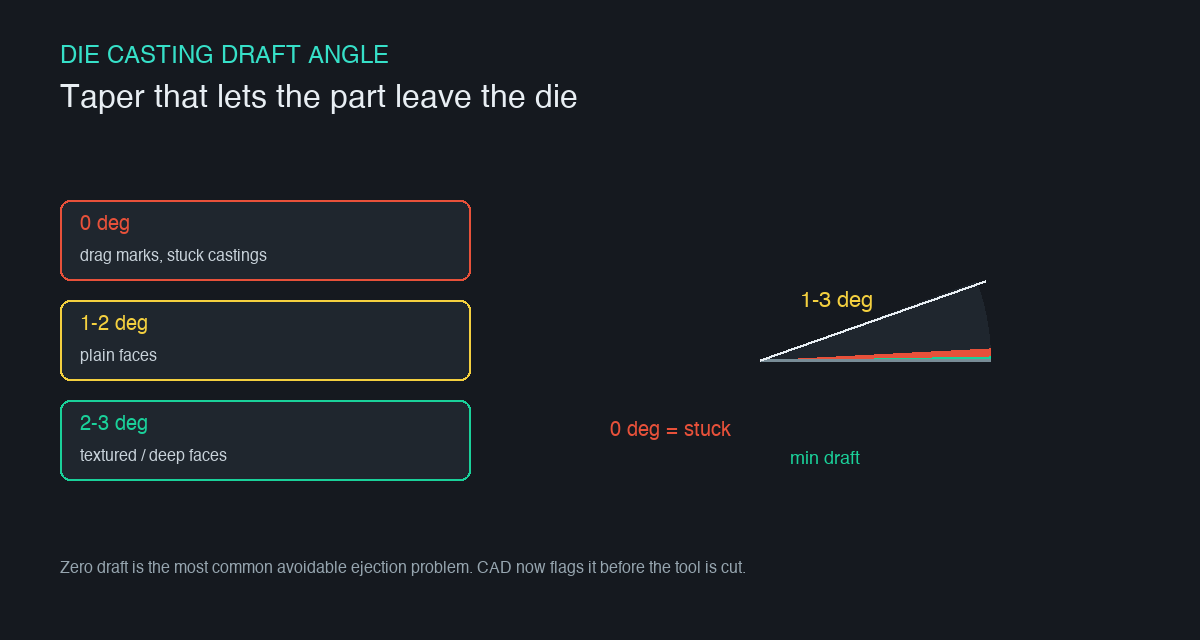
Draft angle is the taper cut into a die casting wall so the part can leave the mould. It is one of the cheapest things to get right and one of the most expensive to get wrong. A part designed with no draft either drags on ejection or refuses to come out at all, and both outcomes cost more than the angle would have.
This guide explains why draft exists, how to choose it, and what happens when a feature cannot have it.
1. Why draft matters
After the metal solidifies, the part grips the die. The cavity side pulls one way, the core side pulls the other, and without taper the wall scrapes as it moves. Draft converts that scrape into a clean slide. More draft means easier ejection, less wear on the tool, and fewer stuck or scuffed parts.
2. How much draft to use
General guidance puts a practical minimum around 1 degree on a plain face and 2 to 3 degrees on deeper or textured surfaces. Bead-blasted or patterned tooling needs more because the texture increases grip, commonly 3 degrees or beyond on the affected faces. These are starting points, not hard limits; the exact value depends on depth, texture, and alloy.
3. Where draft is hardest to give
Undercuts. A feature that reverses direction traps the part and needs a slide or a loose core.
Textured faces. Grip from the texture demands extra draft or the finish scuffs.
Snap-fit or tight-tolerance walls. The dimension may not tolerate the taper, so the draft has to come from the tool geometry instead.
4. Designing around zero draft
When a face truly cannot carry taper, move the draft to an adjacent feature, split the die so the part releases along a different axis, or accept a slide. The worst outcome is designing the part flat and discovering at the first shot that it will not eject. Our DFA guide and draft guidance cover the surrounding decisions, and the process comparison explains when a different process avoids the problem.
5. Draft and tolerance interact
Draft changes a wall from parallel to tapered, which changes the dimension along the draw. If a feature must hold a tight size, the draft has to be accounted for in the drawing or the part will measure out of spec at the deep end. Pair the draft callout with the tolerance so the toolmaker and the inspector read the same part. Our tolerance guide shows how dimension and finish interact.
6. Draft checking in 2026
Modern CAD checkers flag insufficient draft automatically and foundry simulation predicts ejection before steel is cut, so the zero-draft surprise is easier to avoid than it used to be. The discipline still has to start at the drawing.
7. A draft checklist
1 to 3 degrees minimum. More on textured or deep faces.
Check undercuts early. They need a slide or a core, not a hope.
Pair draft with tolerance. Tapered walls measure differently along the draw.
Send the drawing and we will mark where draft is missing and where a feature needs a slide instead of a flat wall.
Further reading on this topic: how die casting works, from process to production · thin wall die casting design · die casting tooling cost and ROI.
Related guides in this topic
Authoritative references
- NADCA die casting standards & product specifications
- NADCA — Product Design for Die Casting (design manual)
Independent third-party standards and industry bodies, provided for further reading. Sureton is not responsible for third-party content.


