
Three processes make metal parts, and buyers ask which one to choose as if there were a single answer. There is not. 3D printing, CNC machining, and die casting each win at a different point on the volume curve, and the wrong pick quietly drains margin for the whole program.
This guide compares the three on the numbers that matter: unit cost, lead time, and how far each scales. The crossover points are ranges, not rules, because part size, alloy, and tolerance move them.
1. The break-even question
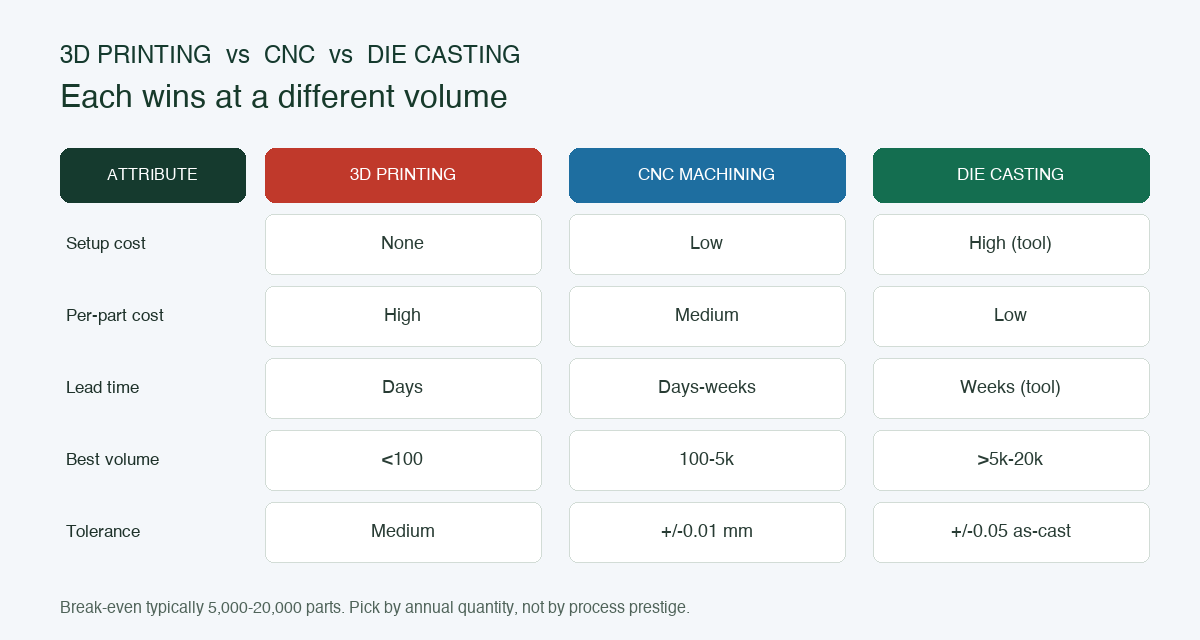
Every comparison comes down to one trade. 3D printing and CNC spend almost nothing to set up and a lot per part. Die casting spends a great deal to set up and very little per part. The break-even volume, where casting overtakes machining, typically lands somewhere between 5,000 and 20,000 pieces, but it only appears once tooling is amortized across the real annual quantity.
2. 3D printing: fastest to first part, slow at scale
Additive needs no tool and no fixture. The first good part can ship in days, which is why it owns the prototype and bridge-production window. The catch is throughput: build time scales with the part, not the batch, so unit cost stays high and lead time stretches as quantities climb. For low volumes with complex internal geometry it is hard to beat. Beyond a few hundred parts it usually loses on cost.
3. CNC machining: precise, flexible, material-hungry
CNC starts from a solid block and removes what it does not need. That makes it fast to set up and exceptionally capable on tolerance and finish, with plus or minus 0.01 millimetre achievable on a single setup. The cost is buy-to-fly ratio: much of the stock becomes chips. For medium volumes and parts that must hold tight dimensions or thin features, machining stays competitive, and it pairs naturally with casting as the finishing step. Our CNC cost guide breaks the hourly math down.
4. Die casting: tool up front, cheapest by the thousand
High-pressure die casting pours molten aluminium or zinc into a reusable steel die. The die is the cost and the lead time, often several weeks, but once it is running each shot is seconds and the per-part cost falls to a fraction of machining. Wall thickness can reach as thin as 0.5 millimetre in aluminium and 0.4 millimetre in zinc, and near-net shape means little stock to remove. The trade is flexibility: change the part and you change the tool.
5. Choosing by production volume
A practical way to read the choice: under roughly 100 parts, 3D printing or CNC wins on speed; from a few hundred to a few thousand, CNC holds the middle; beyond the break-even band, die casting takes over on unit cost. The decision is rarely about which process is best in the abstract. It is about where your annual quantity sits and how often the design will change.
6. Where hybrid wins
Hybrid manufacturing casts the structure and machines the precision. A die-cast near-net body gets CNC work only on the faces and holes that must hold tight tolerance, keeping most of the cost advantage of casting while reaching the accuracy machining alone would cost far more to deliver. Our hybrid manufacturing guide covers how the split is decided part by part.
7. A decision checklist
Quantity. Where does your annual volume sit against the 5k to 20k break-even band.
Geometry. Deep internal channels favor additive; thin walls and high volume favor casting.
Tolerance. Tight functional seats need machining, whether standalone or as a cast plus CNC step.
Change rate. A design that will move several times argues for low setup cost over low piece cost.
Start from the prototype with our prototype to production roadmap and the DFA principles that keep the later stages cheap. Send the drawing and we will tell you which process, or which hybrid, fits the volume you are actually buying.
Related guides in this topic
Authoritative references
Independent third-party standards and industry bodies, provided for further reading. Sureton is not responsible for third-party content.


