Precision zinc alloy die casting is the workhorse for small, detailed metal parts. For components roughly the size of a connector, a sensor body, or a housing clip, forcing molten zinc into a steel mold under high pressure fills features that would take many milling passes to produce. The result comes out close to final shape, so most parts need little secondary machining. In 2026 this process is getting a second look as AI data centers pull demand for compact optical and connector hardware.
At Sureton we run hot-chamber zinc die casting alongside our aluminum and magnesium lines, with in-house tooling and inspection. This page covers what zinc does well for small parts, how it is made, where the 2026 demand is coming from, and the design and quality points that matter when you spec a part.
1. Why zinc fits small, precise parts
Net-shape detail with little machining
Zinc has high fluidity. It fills fine ribs, small bosses, and sharp corners that aluminum would struggle to reach. That lets a single cavity produce a part that would otherwise need several machining operations. Lower post-casting work also means fewer setups and a steadier dimension from part to part. For a comparison of how zinc and aluminum behave on the same job, see our zinc versus aluminum guide for electronics.
Thin walls and tight tolerances
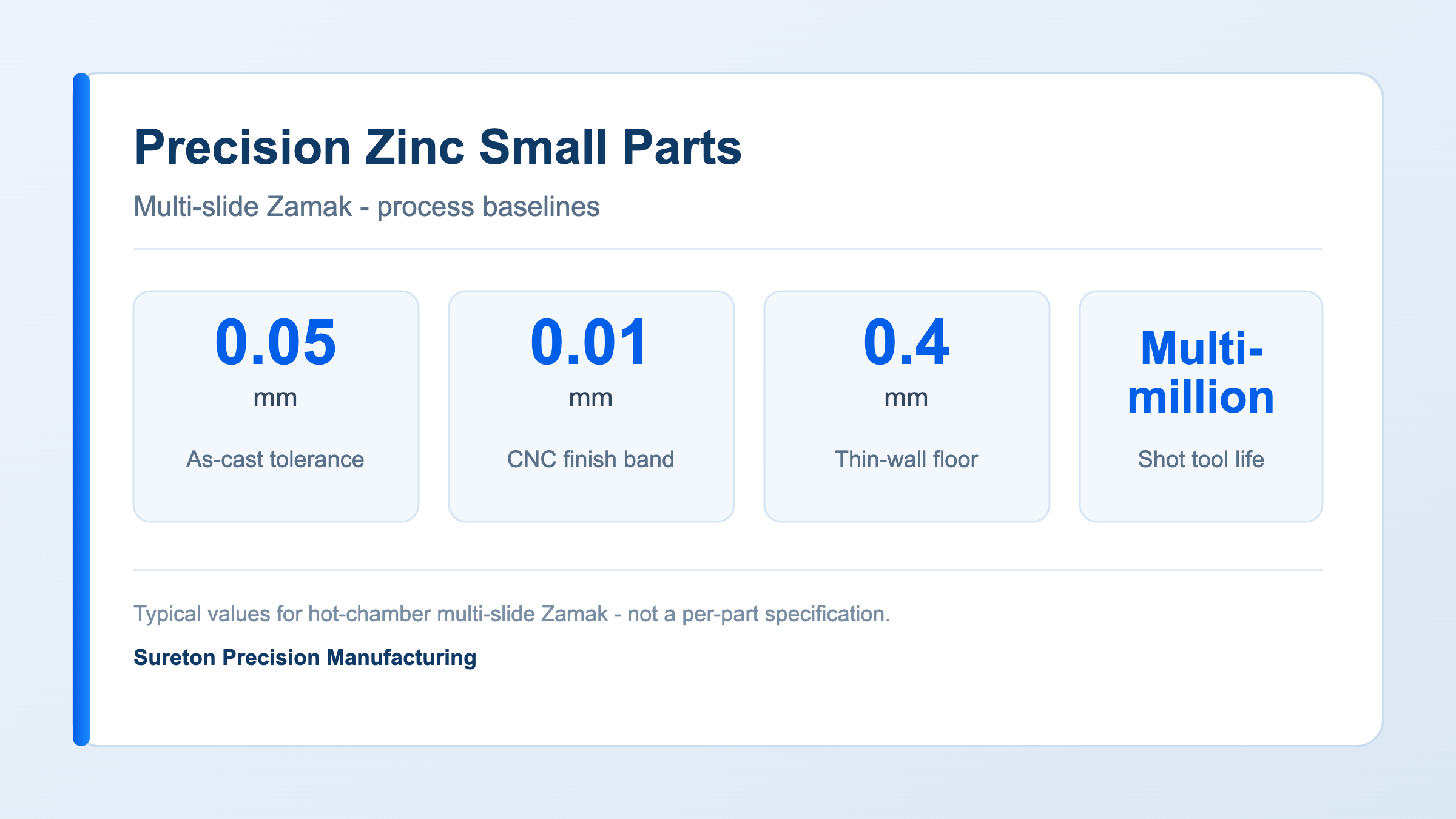
On multi-slide tooling, Zamak parts are produced with walls around 0.4 mm and as-cast tolerances near ±0.05 mm. When a feature must hold a tighter band, finishing that spot with CNC brings it to about ±0.01 mm. The practical numbers depend on part size, gating, and how the cavity is built, so treat ±0.05 mm as a casting baseline rather than a promise for every geometry. Our tooling cost guide explains how volume and tolerance interact with tooling investment.
Plating, EMI shielding, and tool life
Zinc is the easiest die-cast metal to plate, which matters for connectors and enclosures that need a cosmetic or conductive finish. It also shields against EMI and RFI, so a cast zinc shell can double as a shielding part. Because zinc is cast at a lower temperature than aluminum, the steel mold sees less thermal shock and lasts far longer. That long tool life is one of the reasons zinc stays competitive on small, high-volume runs.
2. How small zinc parts are made: hot-chamber and multi-slide
Small zinc parts use the hot-chamber process. The injection mechanism sits in the molten bath, so cycles are fast and repeatable. For a precision component this can mean well over ten shots per minute. For a walk-through of the broader process, our complete die casting guide covers machine types and material flow.
Mold design: We build molds with controlled draft and tuned gating, using H13 tool steel and multi-slide tooling for parts that need external threads, undercuts, or zero-draft walls without secondary operations.
Melt control: Zinc is prone to intermetallic sludge if the bath runs hot or dirty. We hold the melt in a tight window and verify composition so the alloy keeps its properties batch to batch.
Injection: High injection speed pushes the metal into the finest features before it freezes, giving sharp edges and a clean surface.
Cooling and ejection: Zinc solidifies quickly, so ejection is fast. We use cooling simulation up front to keep warpage down and dimensions stable.
3. Zinc in 2026: optical transceivers and AI data centers
A clear new demand signal for precision zinc is the AI data center optical transceiver. These modules pack a laser engine, driver, and connector body into a small shell that must shield, ground, and shed heat. Contract manufacturers report moving some of this work from machined aluminum to multi-slide Zamak 3, which lands closer to net shape and needs less CNC. One North American supplier documents a transceiver housing program built this way, citing multi-million-shot tool life and tight as-cast detail.
The market behind it is real. Industry trackers size the optical transceiver housing segment around USD 14.7 billion in 2025, growing toward roughly USD 27.6 billion by 2033 (about 8 percent CAGR), with 400G and 800G modules leading volume. These are third-party market figures and supplier case studies, not Sureton production data. Sureton does not claim to supply these specific programs. For context on zinc selection in electronics, see our zinc for consumer electronics guide.
4. A material shift to watch: 1.6T+ and copper alloys
As module speeds climb past 1.6T, the heat path changes. Tungsten-copper and copper alloy bases take over the chip mount because they pair high thermal conductivity with a low expansion rate that matches the chip. Those parts are mostly machined, sintered, or additively built rather than die cast, so they are a different process family, not a zinc replacement at the shell level. We note it here so buyers scoping a 1.6T+ program do not assume one material covers both the housing and the heat sink. Our heat sink design guide covers where die-cast aluminum fits in thermal management.
5. Quality checks that matter for small parts
Small parts live or die on consistency, so the checks are built into the run rather than added at the end.
Material verification: We verify each batch of Zamak ingot by spectrometry so impurities stay out of the alloy.
Dimensional inspection: Automated gauging checks critical dimensions against the drawing. Features that need the tightest band are finished and measured by CNC.
Surface inspection: Cosmetic parts get visual inspection under controlled light to catch flow marks or pits before finishing.
Selected non-destructive evaluation: On designated structural parts we run targeted internal inspection. We scope this per program with the customer rather than as a blanket claim.
6. Design tips to get the most from zinc
A few choices early on save cost later. Keep walls uniform so the part freezes evenly, hold draft where the tool allows easy ejection, and place ribs and bosses to avoid thick spots that would shrink. If you are weighing zinc against aluminum on cost, our total-cost comparison walks through tooling, volume, and alloy surcharge. For a structured approach, our design-for-assembly guide lists the questions worth asking before tooling.
Talk to a zinc die casting partner
Small precision zinc parts reward good upfront design. Send us your drawing and we will review it for manufacturability and suggest a process and alloy that fit your volume.
Contact Sureton for a DFM review
Share your part drawing and we will tell you how we would make it.
Related guides in this topic
Authoritative references
Independent third-party standards and industry bodies, provided for further reading. Sureton is not responsible for third-party content.