In aerospace and unmanned systems, mass is the adversary. Every kilogram saved becomes extra range, more payload, or a smaller battery. Magnesium is the lightest structural metal in common use, and for UAV and eVTOL parts it has moved from specialist technique to a standard lightweight option. Used well, it is a direct contributor to flight time and payload.
1. The density advantage
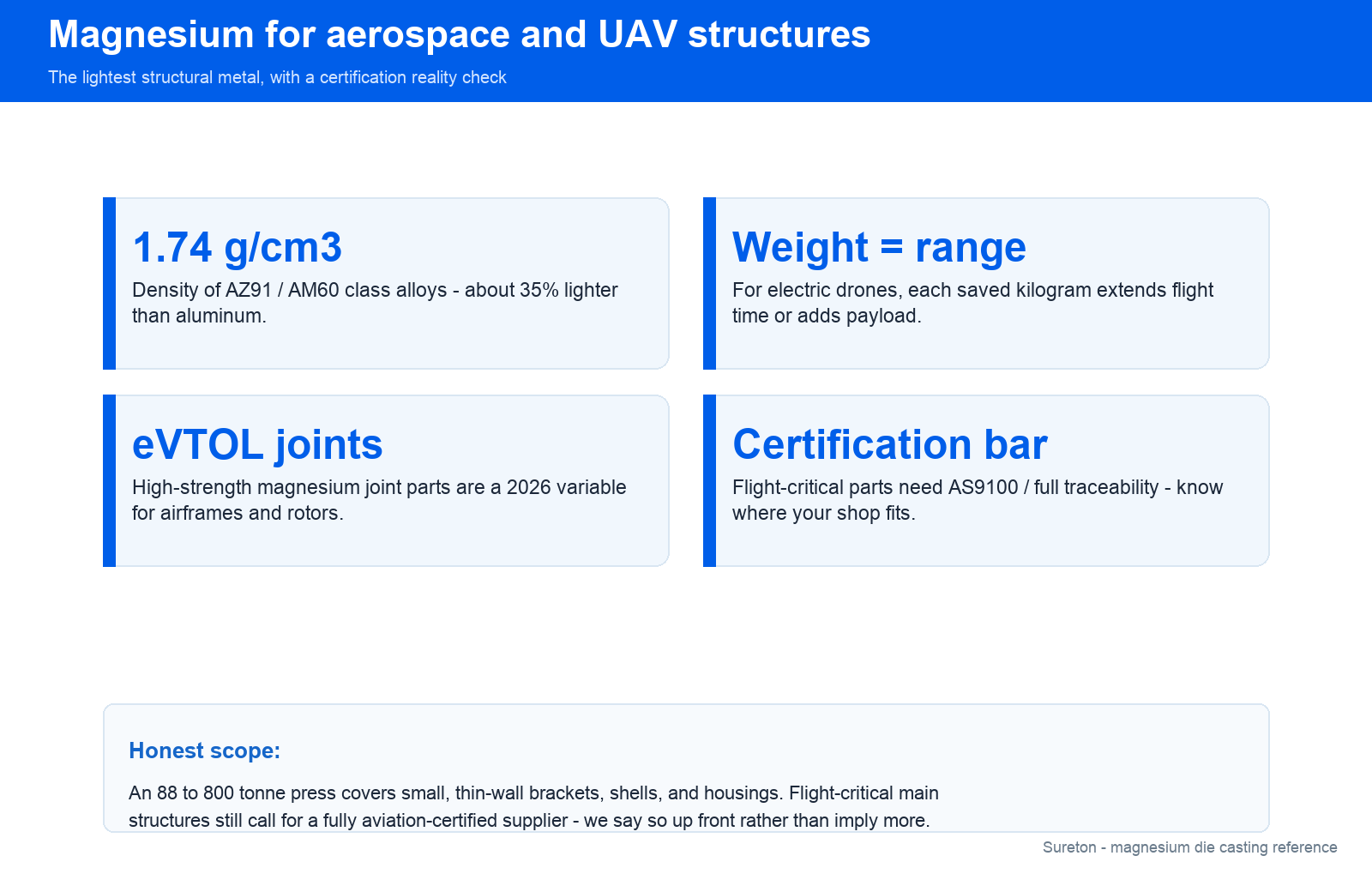
Magnesium alloys such as AZ91 and AM60 sit near 1.74 g/cm3. That is about 35 percent lighter than aluminum and roughly 75 percent lighter than steel for a comparable section. For an electric drone, a lighter structure is not a nice-to-have; it is the difference between a viable mission and one that falls short. The saving compounds across every bracket, housing, and cover on the airframe.
2. Where magnesium fits on an airframe
The natural home for magnesium is joints, brackets, sensor housings, and secondary structures rather than primary load paths. A 2026 industry analysis of eVTOL airframes points to high-strength magnesium joint parts as a new variable, citing wrought and cast magnesium grades in the 340 to 400 MPa yield range that also hold full-band EMI shielding and resist ignition at elevated temperature. Those are third-party figures, not a Sureton capacity claim; they show where magnesium is being specified, not what we build.
3. The certification bar is the real constraint
For anything that enters the airworthiness envelope, material batch traceability, process re-validation, first-article inspection, and destructive sampling are not optional extras. A shop that cannot show an aviation-grade quality system should not be quoting flight-critical structure. We are direct about this: our 88 to 800 tonne line is well suited to small, thin-wall brackets, shells, and housings, and to non-flight-critical components. Primary flight structures still belong with a fully aviation-certified supplier, and saying so up front avoids a problem neither side wants.
4. Magnesium and fire safety
Ignition behavior is the question every aerospace buyer asks, and it is the right question. Modern high-strength magnesium grades are developed with ignition resistance as a design target, but the safe answer is application-specific: the right alloy, coating, and fire-rule compliance have to be specified together. Treat it as an engineering requirement with a documented basis, not a marketing reassurance.
5. A 2026 market signal
Low-altitude mobility and eVTOL programs are pulling magnesium demand upward, with magnesium listed among the growth materials for UAV and eVTOL structural parts by industry suppliers. That is a demand-side trend, useful for sourcing planning, and it does not by itself qualify a part for flight. Our enclosure sealing and shielding guide and DFM for electronics enclosures explain how we handle magnesium parts that stay on the ground or in non-flight-critical roles.
The takeaway
Magnesium earns its place wherever grams decide the mission, but the certification boundary is non-negotiable. Tell us which parts are flight-critical and which are not, and we will scope the work to the right quality system instead of over-claiming a capability we do not hold.
Further reading on this topic: magnesium vs aluminum die casting · zinc vs aluminum total cost of ownership.
Related guides in this topic
Authoritative references
Independent third-party standards and industry bodies, provided for further reading. Sureton is not responsible for third-party content.