1. The engineering why: solve specific failure modes
Engineering is a constant trade between material properties: aluminium for light weight and complex shape, steel for strength and wear resistance. When a lightweight housing needs localised performance, such as a high-torque thread, a bearing seat or a thermal path, insert die casting lets you place a steel or brass component directly inside the aluminium body. At Sureton we treat this as giving the aluminium a local skeleton exactly where the load lands, rather than over-speccing the whole part.
2. Where cast-in inserts earn their keep
A. High-torque threads
A bolt that is removed and re-tightened often, say for maintenance access, will eventually strip an aluminium thread. The fix is a stainless or brass threaded bush placed in the die. The bolt now loads against hard steel while the part stays light aluminium, and the pull-out and torque resistance beat a pressed-in helical insert.
B. Wear surfaces
Aluminium is a poor bearing surface: it galls and wears. Casting a hardened steel sleeve or bronze bush directly into the housing gives a wear-resistant bore without the risk of the bush spinning or walking out under load.
3. The mechanical lock: it is not glue
The most common design error we see is assuming aluminium bonds to steel. It does not chemically bond. On cooling it shrinks onto the insert and grips it, but that grip alone will not stop rotation under torque. You must design a mechanical interlock.
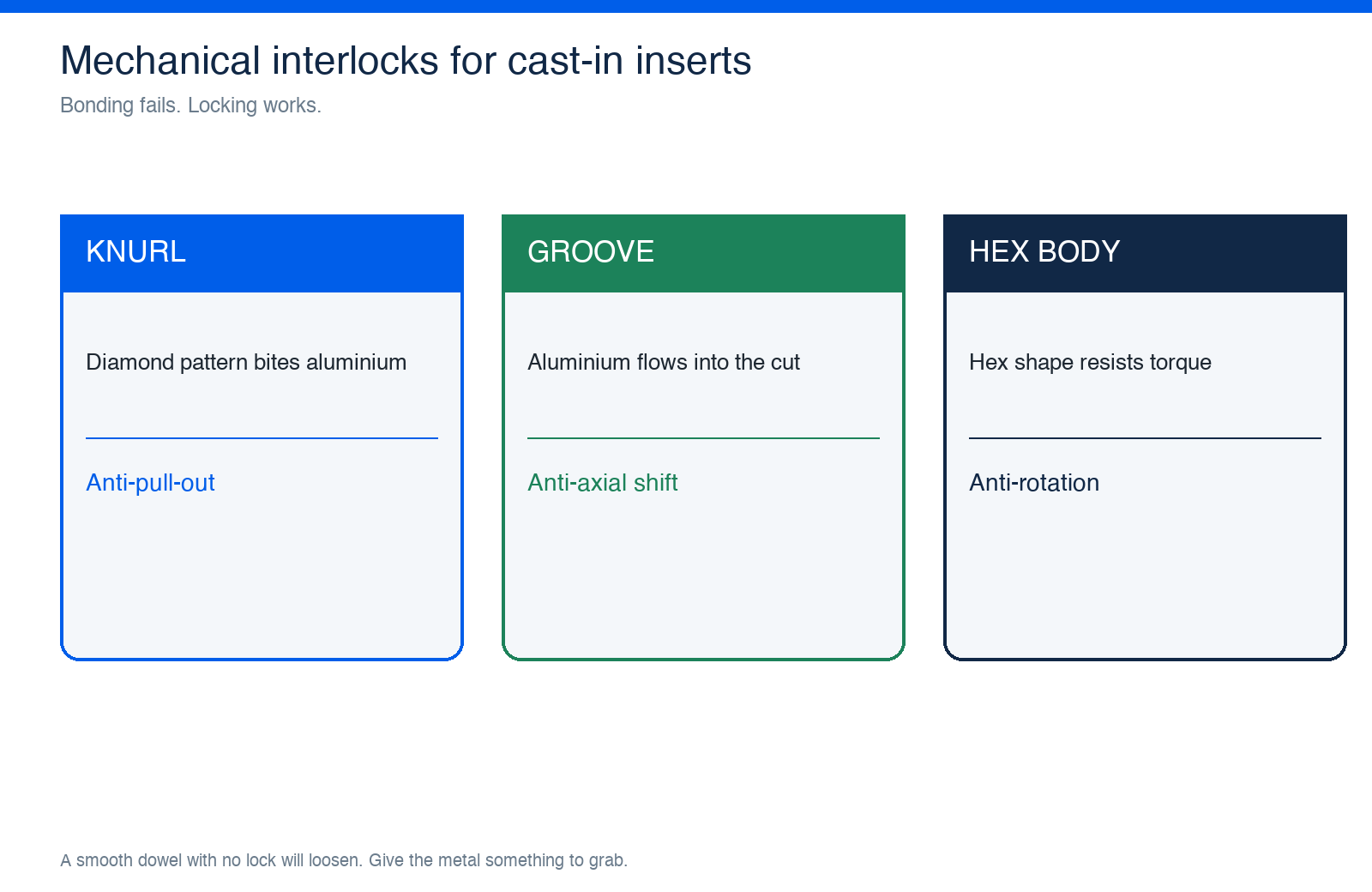
Knurls. A diamond knurl on a round insert bites into the aluminium.
Grooves and undercuts. A turned groove lets aluminium flow into the insert and lock it axially.
Hex body. A hexagonal insert instead of a round one is the strongest anti-rotation feature.
Do not send us a smooth dowel and ask us to overmould it. It will come loose. Give the metal something to grab.
4. Process control: preheating is not optional
You cannot drop a cold steel insert into a die and shoot molten aluminium around it. A cold insert is a heat sink that freezes the aluminium on contact, creating porosity and a weak interface. Any trace of moisture on the insert flashes to steam and can rupture the casting. At Sureton every insert is preheated, typically 150 to 300 degrees C depending on alloy and size, in a controlled oven, and the temperature is logged for traceability.
5. The long-term threat: galvanic corrosion
Put two dissimilar metals together with an electrolyte and you build a battery. Aluminium with passivated stainless is generally fine in mild air, but aluminium paired with brass, bronze or copper is high risk and needs mitigation outdoors or in harsh service.
Barrier plating. Nickel, tin or zinc plating isolates the insert from the aluminium.
Design and seal. Keep electrolyte from pooling at the interface; use sealants or drain paths.
Material choice. Pick insert materials close to aluminium in the galvanic series where the application allows.
6. Cost: what you pay and what you save
Insert moulding adds cost drivers. Someone, or a robot, places the insert every cycle, adding 10 to 20 seconds. You buy precision-machined inserts and add validation steps. The offset is that you remove secondary assembly, guarantee alignment, and gain reliability in one robust component. For a cost view of the wider tooling picture, see our notes on die casting tooling cost. Insert work also leans on the same surface-control discipline we describe in our surface roughness guide, and it is a close cousin of cast-in versus machined threads.
7. Build a robust hybrid
Material limits should not dictate your design performance. If stripped threads or worn bores are hurting an aluminium part, insert die casting is often the answer. Send us the assembly file and we will check galvanic compatibility and the locking features so the hybrid part performs for the life the application demands. Start from our overview of how die casting works if you are scoping the process.
Related guides in this topic
Authoritative references
- Aluminum alloy typical properties (NADCA datasheet, third-party host)
- Aluminium alloy designation system (3xx.x cast alloys)
Independent third-party standards and industry bodies, provided for further reading. Sureton is not responsible for third-party content.