Why do some earbuds and stylus pens feel expensive the moment you pick them up? Often it is the density of zinc. This guide walks through the haptic and plating advantages of zinc die casting, and how to choose between Zamak 3 and Zamak 5 for consumer electronics. It also maps where the same zinc die casting know-how is now being pulled into AI data center optics.
In consumer electronics, perceived value is set in the first second of handling a product. Weight and surface temperature do a lot of the talking before a single spec is read.
Light and warm: Reads as cheap plastic.
Heavy and cool: Reads as premium metal.
This is why high-end electronics (TWS earbuds, smart wearables, stylus pens) keep leaning on zinc alloy (Zamak) even as automotive chases lightweighting. At Sureton we run custom zinc and aluminum die casting for brands that will not compromise on that in-hand feel. Here is the engineering logic behind picking zinc over aluminum for a housing.
1. The Density Factor: Zinc Brings the Heft
The most immediate difference is physical density.
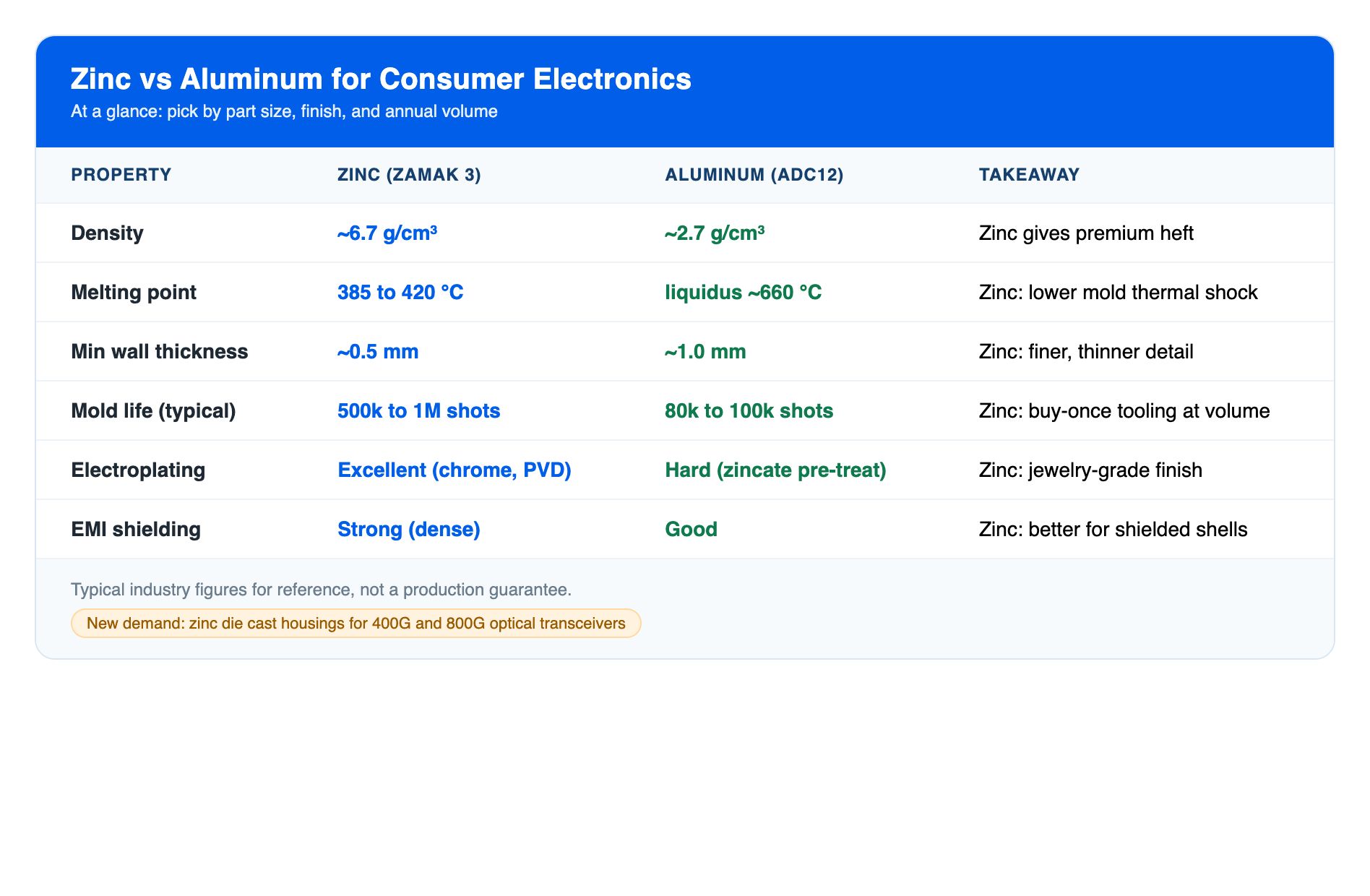
Aluminum (ADC12): about 2.7 g/cm³
Zinc (Zamak 3): about 6.7 g/cm³
Zinc is roughly 2.5 times denser than aluminum. For a small part such as a Bluetooth earbud hinge or a USB drive shell, aluminum can feel hollow, almost like plastic. Zinc delivers the solid weight buyers associate with a considered product. See how ADC12 compares with A380 and A383 when the part moves up in size.
Design tip: For a small handheld item, use zinc to add gravitas. For a large handheld item such as a tablet, stay on aluminum or magnesium to avoid user fatigue.
2. The Jewelry Finish: Plating on Zinc
This is zinc’s standout property. Aluminum resists electroplating and needs zincate pre-treatments that still blister or pit. Zinc takes plating readily.
Mirror chrome or black nickel: Zinc accepts a flawless, mirror-like finish that is hard to reach on aluminum and impossible on plastic.
PVD coatings: For high-wear items such as smartwatch bodies, PVD over the zinc base adds hardness and colors (gold, rose gold, gunmetal).
Touch feel: A plated zinc part stays cool to the touch, reinforcing the metallic read.
Sureton capability: We handle in-house polishing and work with Tier-1 plating lines to deliver cosmetic surfaces that pass 48-hour CASS (copper-accelerated acetic acid salt spray) testing. For a deeper look at finish options, see our guide to zinc die casting for consumer electronics: feel, haptics and acoustics.
3. Zamak 3 vs. Zamak 5: Which Alloy to Specify?
Zamak is a family of zinc die casting alloys. The two workhorses are Zamak 3 and Zamak 5. Picking the wrong one adds cost or risks a weak feature.
Zamak 3 (the default)
Composition: about 4% aluminum, about 0.04% magnesium, balance zinc.
Characteristics: Best dimensional stability and flow. It holds the tightest tolerances over time.
Best for: The majority of housings, connectors, and decorative trim. When unsure, start here.
Zamak 5 (the stronger sibling)
Composition: Same as Zamak 3, plus about 1% copper.
Characteristics: Copper lifts tensile strength and hardness, at a small cost to ductility.
Best for: Parts that take load or repeated torque: hinges, buckles, structural clips, molded-in threads.
Sureton advice: Unless you have a specific strength requirement, specify Zamak 3. It is cheaper, more available, and easier to plate.
4. Precision and Thin Walls: Net-Shape Casting
Zinc melts around 385 to 420°C and flows better than aluminum. That lower temperature and higher fluidity let us cast fine detail.
Wall thickness: Zinc walls down to about 0.5 mm are practical.
Zero draft: With 4-slide tooling we can cast internal features with no draft, removing secondary machining.
Molded threads: External threads can be cast directly.
This net-shape capability often makes the total part cost of zinc lower than aluminum, even though the raw material costs more per kilo, because CNC steps drop out. For very small precision items, our precision zinc die casting for small parts covers the same logic at higher volumes.
5. Tooling Economics: Shot Life That Pays Back
A point for the procurement team. Zinc melts far below aluminum (whose liquidus sits near 660°C), so the thermal shock on the steel mold is small.
Aluminum mold life: roughly 80,000 to 100,000 shots.
Zinc mold life: 500,000 to 1,000,000 shots.
A consumer product forecast at 500,000 units a year makes zinc tooling close to a buy-once investment. The same volume in aluminum would need several mold replacements. (These are typical industry figures for reference, not a Sureton guarantee on any specific program.)
6. A New Demand Signal: Zinc in AI Data Center Optics
The same zinc die casting properties that suit consumer electronics are now being pulled into a very different volume market: optical transceiver housings for AI data centers. As 400G and 800G modules scale, the housing needs low porosity, high density, tight EMI shielding, and thin or zero-draft walls produced in the millions.
Third-party work shows the fit. Dynacast documents a North American data center program that moved optical transceiver housings from machined aluminum to multi-slide Zamak 3, citing near-net precision around ±0.001 inch, cast-in thermal fins, and multi-million-shot tool life. Separately, coverage of China Diecasting 2026 noted that AI and data center demand for optical modules is driving zinc die casting, with the alloy’s low porosity, high density, and surface quality named as the draw.
These are industry and vendor observations, not Sureton production claims. Our role is the zinc and aluminum die cast housing, plus the machining and finishing around it.
Where copper and tungsten-copper take over at 1.6T+
One caveat worth stating plainly. As module speeds pass 1.6T, heat becomes the first constraint, and the heat-sink base or substrate often shifts to copper or tungsten-copper (WCu) for their high thermal conductivity and matched expansion. Those parts are typically CNC machined or made by powder metallurgy, not die cast. So the realistic map is: zinc and aluminum die cast housings stay mainstream at 400G and 800G, while the 1.6T+ thermal substrate is a material-upgrade step that sits outside conventional die casting.
Specify the Right Alloy for Your Next Housing
Do not let the next product feel cheap. If you are designing wearables, audio gear, or EDC hardware, zinc alloy may be the property that separates it from the plastic field.
Share your drawings with Sureton for a DFM review and an alloy recommendation.
Request a Zamak 3 versus Zamak 5 sample kit and feel the difference before you commit tooling.
Contact Sureton to start the review.
nFurther reading on this topic: zinc vs aluminum total cost of ownership · precision zinc die casting for small parts · DFM for electronics enclosures.
Related guides in this topic
Authoritative references
- International Zinc Association — zinc die casting alloy families
- Zinc & ZA alloy typical properties (NADCA datasheet, third-party host)
Independent third-party standards and industry bodies, provided for further reading. Sureton is not responsible for third-party content.