Two alloys get called the same part on drawings from different countries. The American standard says A380, the Japanese standard says ADC12, and a European buyer will write EN AC-46000 or BS 1490 LM24 for the same metal. Buyers in the United Kingdom, Europe and Australia more often write “aluminium die casting” where the United States writes “aluminum die casting”, and both spellings describe the same alloy family covered here. Meanwhile the mechanical property callouts are not identical, and that is where sourcing decisions quietly go wrong.
This guide sorts out which designations actually refer to the same alloy, which ones are close but not equal, and how to write a specification that removes the argument entirely.
1. The Chemistry of Aluminium and Aluminum Die Casting: What Is Actually Inside
Both A380 and ADC12 are aluminium-silicon-copper alloys. The family is the same; the ratios are not.
Silicon (Si): A380 sits at 7.5 to 9.5 percent, ADC12 at 9.6 to 12.0 percent. More silicon means better fluidity and better castability, which is why ADC12 fills thin ribs and intricate internal geometry more reliably.
Copper (Cu): A380 carries 3.0 to 4.0 percent, ADC12 1.5 to 3.5 percent. Copper buys strength, hardness and machinability, and it costs corrosion resistance and a clean bright anodised finish.
Iron (Fe): Both cap out at 1.3 percent. Iron is not a defect here. It is deliberately permitted because it stops the casting soldering itself to the die.
That is the whole difference. Higher silicon for fill, higher copper for strength, iron held in check for die life. Where the fill behaviour matters most is in thin sections, and our guide to reducing porosity in die casting shows how fluidity drives misruns and cold shuts.
2. Cross-Standard Designations: Which Name Means Which Metal
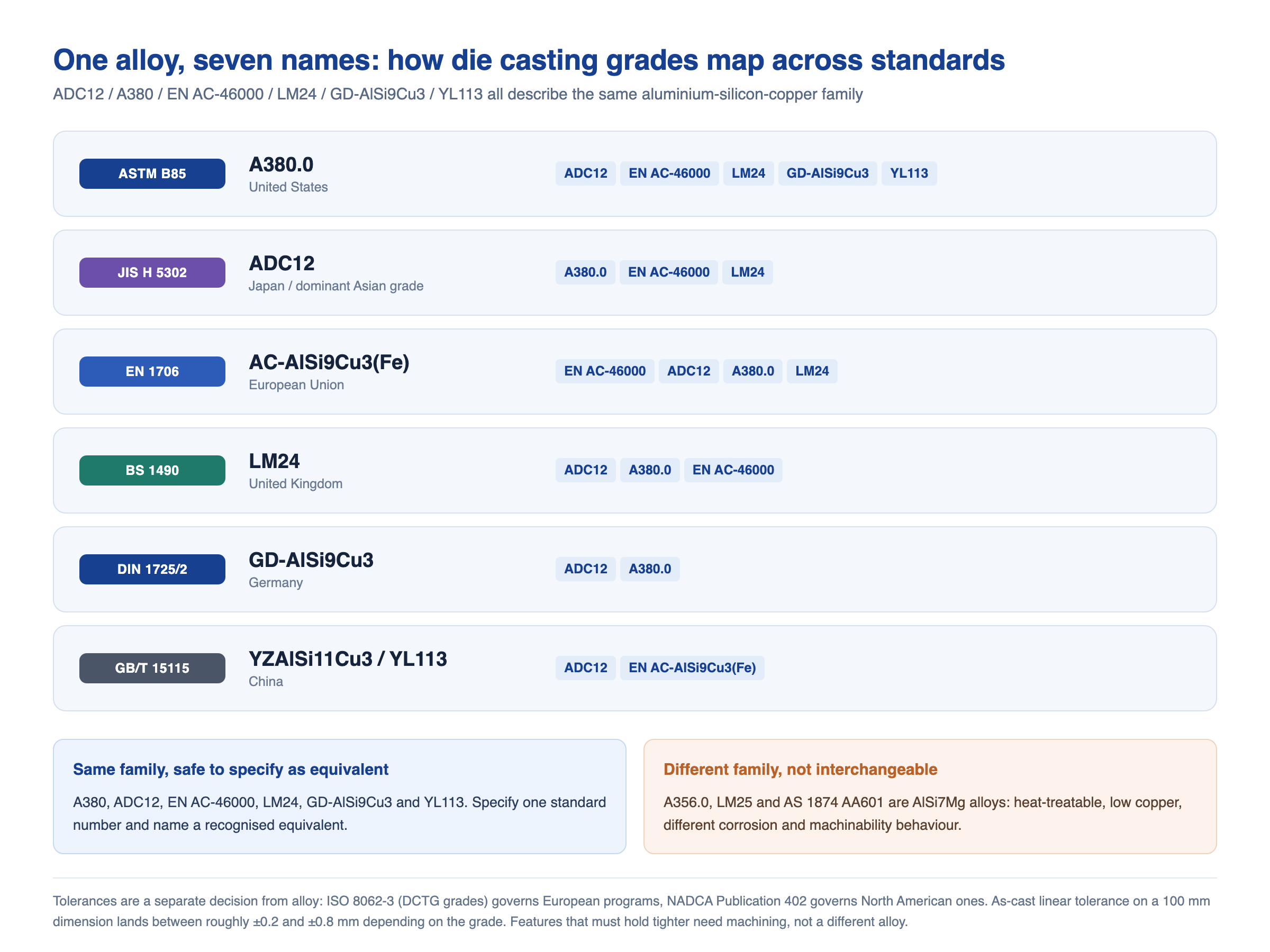
Buyers rarely search for “ADC12 versus A380”. They search for their own standard’s designation and expect a factory to understand it. The table below maps the designations you are most likely to receive on drawings from the United States, Europe, the United Kingdom, Japan, Germany and China.
| What your drawing says | Standard | Same alloy family | Notes |
| A380.0 | ASTM B85 | ADC12, AC-AlSi9Cu3(Fe), LM24, GD-AlSi9Cu3 | US and North American designation |
| ADC12 | JIS H 5302 | A380.0, AC-AlSi9Cu3(Fe), LM24 | Japanese and the dominant Asian grade |
| AC-AlSi9Cu3(Fe) (EN AC-46000) | EN 1706 | ADC12, A380.0, LM24 | European Union designation |
| LM24 | BS 1490 | ADC12, A380.0, AC-AlSi9Cu3(Fe) | United Kingdom designation |
| GD-AlSi9Cu3 | DIN 1725/2 | ADC12, A380.0 | German designation |
| YL113 | GB/T 15115 | ADC12, AC-AlSi9Cu3(Fe) | Chinese national designation |
| A356.0 / LM25 / AA601 | ASTM / BS 1490 / AS 1874 | AlSi7Mg family | Different family, not interchangeable with ADC12 |
Three points worth holding on to. First, A380 and ADC12 are the same alloy family under different names, so a supplier quoting either one is describing the same metal. Second, LM24, EN AC-46000 and GD-AlSi9Cu3 all point at that same family too, which is why European and British drawings do not require a different material discussion. Third, the A356 and LM25 row is a different family entirely. If a drawing calls for LM25, that is a lower-copper, magnesium-bearing, heat-treatable alloy, and it cannot be substituted with ADC12 on a like-for-like basis.
3. Where the Designations Overlap but the Numbers Do Not
Equivalence of alloy family does not mean equivalence of guaranteed properties. The published minimum values differ by standard, and this is where a substitution quietly changes the part.
A380.0 under ASTM B85 carries minimums of 320 MPa tensile, 160 MPa yield and 3.5 percent elongation.
ADC12 under JIS H 5302 is usually quoted around 310 MPa tensile and 150 MPa yield when read on the ASTM convention, while measured values on cast parts sit lower, commonly in the 228 MPa range with wide scatter.
The practical consequence runs in one direction. If your drawing specifies A380 and the factory pours ADC12, the delivered part may not meet the strength the drawing assumed. If your drawing specifies ADC12 and the factory pours A380, you are receiving a stronger, more machinable casting with the same dimensions and better corrosion behaviour, at a modest material cost.
Tensile strength is also only one number on a casting. A die cast part is graded on a separately cast test bar, and the standard allows the part itself to fall below that bar. Which is a good reason to specify what you need from the part rather than chasing a grade name.
4. The Wider Selection: Where A383, A360 and A413 Fit
A380 and ADC12 dominate drawings, but quotations in this family also carry three other grades, and knowing where each one sits saves a round of emails. All of them are aluminium-silicon alloys; what changes is how much of the silicon and copper budget each one spends.
| Grade | Character | Best suited to | Watch out for |
| A380.0 | Si 7.5 to 9.5, Cu 3.0 to 4.0 | General housings, brackets, gearbox and motor covers | Higher copper dulls a bright anodised finish |
| ADC12 | Si 9.6 to 12.0, Cu 1.5 to 3.5 | Thin ribs, intricate housings, high-volume Asian supply | Wide composition window, so ask for the analysis certificate per heat |
| A383 | Si 9.5 to 11.5, Cu 2.0 to 3.0 | Large thin-wall covers where filling is the hard part | Slightly softer and less strong than A380 |
| A360 | Si 9.0 to 10.0, Cu under 0.6 | Outdoor, marine and pressure-tight parts | Fills harder and cycles slower than the copper grades |
| A413 | Si 11.0 to 13.0, almost no Cu | Leak-critical hydraulics, manifolds, pneumatic cylinders | Poorest machinability of the group |
| A356.0 | AlSi7Mg, heat treatable | Structural parts needing T6, poured in permanent mould | Not a practical high-pressure die casting grade |
A note on the equivalence table in section 2: some references pair ADC12 with A383 rather than A380, because the ADC12 silicon window overlaps the A383 range more closely than the A380 range. Others list ADC12 as the A380 equivalent, following trade practice rather than chemistry. Both readings describe the same family territory, and the real differences sit inside the composition windows, not between the grade names. This is why the specification advice later in this guide asks you to name a standard and the properties you need, and to let the equivalent follow from those.
5. Round 1: Castability and Complex Geometry
Advantage: ADC12
The extra silicon pushes ADC12 closer to the eutectic point, so it flows like water where A380 crawls. That difference decides the outcome on thin ribs, deep pockets and heat sink fins, where the last of the metal to arrive decides whether you get a complete part or a cold shut.
Thin walls: ADC12 fills sections that A380 will struggle to reach, which directly reduces cold shuts and misruns in intricate features.
Cycle time: better fluidity generally means a shorter fill and a cleaner ejection.
Tool wear: higher silicon means more abrasive silicon in the melt. Machining allowances and die life need watching, and this is the trade-off that keeps A380 relevant for high-volume programs.
6. Round 2: Machinability and Secondary Operations
Advantage: A380, marginally
The extra copper in A380 forms harder intermetallic phases. Those give a slightly better machined surface and longer cutter life on heavily machined features, which matters when a housing needs tapped holes, faced bosses and bored bores in high volume.
At our own shop we machine ADC12 every day with adjusted feeds and carbide tooling. The cost difference shows up on programs with heavy secondary machining, and rarely anywhere else. How that machining is costed is covered in our guide to surface roughness and machining cost.
7. Round 3: Cost and Availability
Advantage: ADC12
ADC12 is the volume grade across Asia. Every local supplier stocks it, which keeps raw material pricing competitive and lead times short. A380 is a North American designation, so in Asia it is often mixed to order or purchased as a special grade, which shows up in both price and lead time.
The practical move is to write the drawing so the supplier can choose. “A380 or equivalent” gives the factory the freedom to pour the grade it has in stock while holding the properties your design needs. One point that matters more in 2026 than it did a few years ago: with aluminium prices moving the way they have, many established die casters now index a material surcharge to a published metals exchange price instead of folding it into a fixed unit price. When you compare quotations, ask how each one handles the alloy line, because two quotes on the same part can be built on different structures and neither number means much until you know that. When the choice also depends on what the part costs over its life, our zinc versus aluminium total cost comparison works through the tooling and unit economics side.
8. Die Casting Tolerances: ISO 8062-3 and NADCA Publication 402
Alloy is only half of a casting specification. The other half is how much variation the as-cast surface is allowed to have, and the two regions write this down differently.
ISO 8062-3 is the international standard for casting tolerances, used across European programs. Part 3 carries the dimensional casting tolerance grades, numbered DCTG 1 at the tightest through DCTG 15. The grades are read against the nominal size of the feature. On a 100 mm dimension, DCTG 6 allows about 0.78 mm total, or plus or minus 0.39 mm, and DCTG 8 about 1.60 mm total. The standard also sets the wall thickness rule: a wall is held one grade coarser than the general linear tolerance on the same casting.
NADCA Publication 402 is the die-casting-specific reference used across North America. It works on the same logic with its own die-casting grades, and the two systems land in comparable territory on a 100 mm dimension.
The same logic covers aluminium die casting tolerances, zinc die casting tolerances and gravity die casting tolerances, because the grade you name decides how tight the as-cast surface is allowed to be. Both frameworks tell the same story: as-cast linear tolerance on a 100 mm dimension lands in the region of plus or minus 0.2 to 0.8 mm, depending on which grade you specify. That is the nature of the process, not a supplier shortcoming. If a feature needs to hold plus or minus 0.01 mm, it needs to be machined, and the drawing should say so rather than hoping for a tighter casting.
This is also where the biggest cost disputes happen. A buyer and a factory can agree on the alloy and still argue for months over tolerances if nobody pinned down which standard and which grade the drawing means. Our guide to reading a die casting quotation covers how to make those numbers comparable before tooling starts.
9. How to Write the Specification
Three lines on a drawing remove most of the friction:
Name the alloy with its standard. For example “Aluminium EN AC-46000 (A380 / ADC12 equivalent)”. One standard number plus a recognised equivalent lets every factory quote the same metal.
State the properties you need, not just the grade. Minimum tensile, minimum yield, elongation and any hardness limit. That is what the drawing is really for, and it is what survives a supplier change.
Name the tolerance standard and grade. “ISO 8062-3 DCTG 8” for European programs, “NADCA Publication 402” for North American ones, or call out the critical features and their tolerance directly.
Add one note about corrosion if the part lives outdoors or near salt. A380 and ADC12 both carry 3 to 4 percent copper, and copper is what dulls a bright anodised finish and reduces salt spray performance. A360, with almost no copper, is the better answer for marine hardware and road salt exposure, and it is a change of alloy family rather than of grade name.
10. The Verdict
Keep A380 when the drawing is tied to a North American specification you cannot reopen, you have legacy test data on that exact grade, or you need the marginally better machinability and thermal behaviour of the higher copper content.
Specify ADC12, or a named equivalent, when the geometry is complex, the walls are thin, the part is machined lightly, or you want the most competitive material pricing. For most housings, brackets and enclosures this is the right answer, and the properties you care about are held either way.
Do not substitute across families. LM25 and A356 are not ADC12 with a different label. They are heat-treatable, lower-copper alloys with different corrosion and machinability behaviour, and they need a different process decision.
One more pointer before you leave the grade question. When the driver is corrosion or sealing rather than strength, the answer usually stays inside the family: A360 for salt and outdoor exposure, A413 for leak-critical hydraulic and pneumatic parts, A383 where thin walls need the extra silicon. The selection table above is the short version of that decision.
Need a material recommendation for your drawing?
Send us the drawing or the alloy designation on it, and our engineers will tell you which grade we would pour, what the closest standard equivalent is, and where the tolerance risk sits.
You will get a written recommendation and a quotation, with the alloy and tolerance standards named explicitly so nothing is left to interpretation.
Further reading on this topic: zinc vs aluminum total cost of ownership · how die casting works, from process to production · insert die casting with steel reinforcement.
Related guides in this topic
Authoritative references
- Aluminum alloy typical properties (NADCA datasheet, third-party host)
- Aluminium alloy designation system (3xx.x cast alloys)
Independent third-party standards and industry bodies, provided for further reading. Sureton is not responsible for third-party content.