In consumer electronics, the first impression is physical. Before a spec sheet is read, a buyer has already judged a device by how it feels in the hand. Weight, surface temperature, and texture do more to signal quality than most marketing copy. That is the quiet reason zinc alloy die casting has become a default choice for high-touch parts such as earbud cases, watch bodies, and connector shells.
1. Why density reads as quality
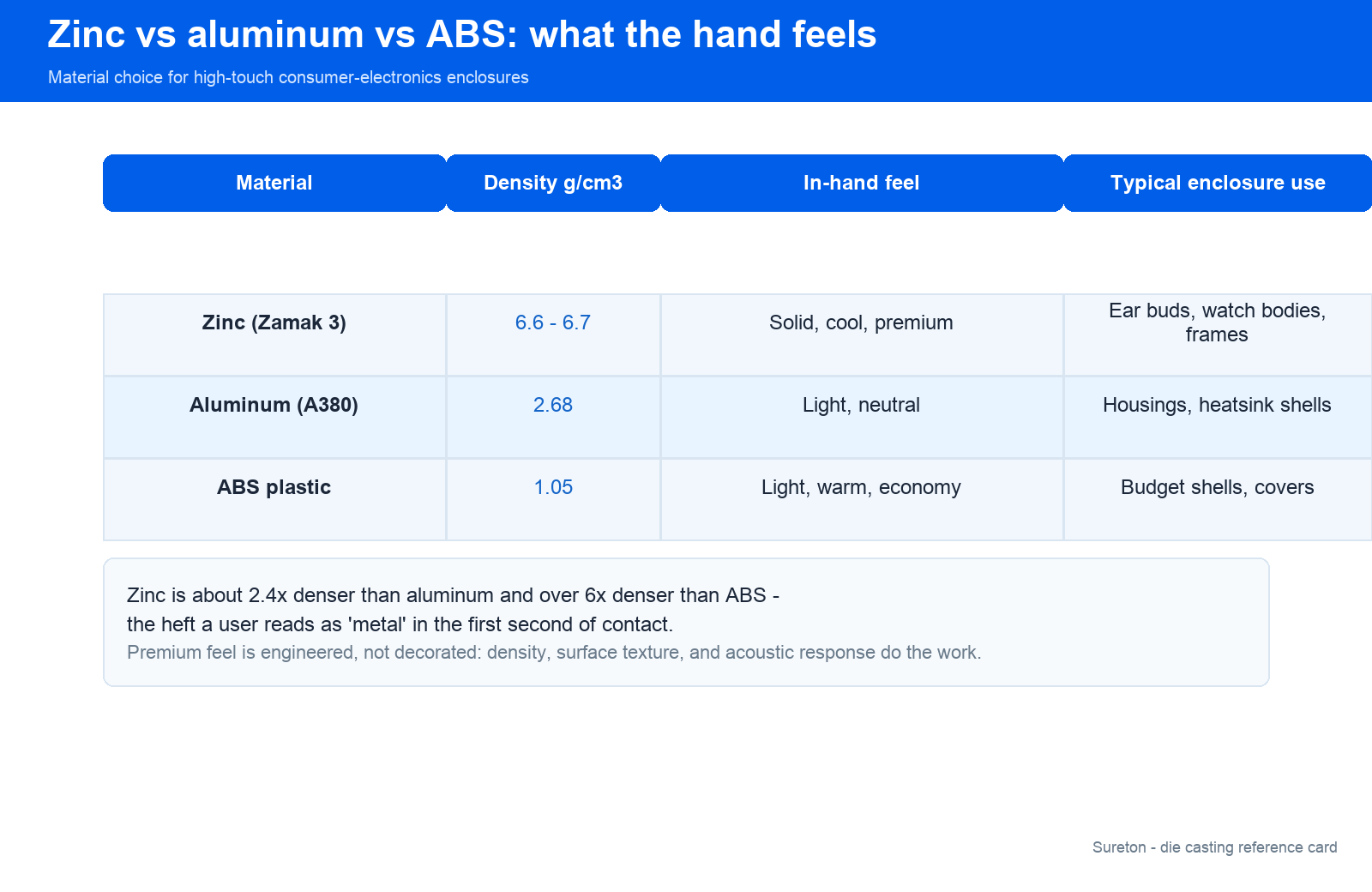
Zinc alloys such as Zamak 3 sit at about 6.6 to 6.7 g/cm3. That is roughly 2.4 times the density of aluminum and more than six times that of ABS plastic. When a user lifts a shell, that mass is read instantly as “metal” and, by association, as durable and considered. Plastic tends to read as economy; feather-light aluminum can read as hollow. The heft is not decoration, it is part of the product language.
2. Haptics you can design for
Feel is also about how parts fit and seat. Zinc’s low and predictable shrinkage lets you cast precise bosses, alignment features, and mounting faces directly into the housing. A USB-C or audio port that mates repeatably without secondary machining keeps a line build clean. Where fastener pull-out is a risk, cast-in inserts beat post-machined threads for consistency across high unit counts. These are decisions an engineer makes early, not after a tool is cut.
3. Acoustics and the premium impression
Sound is the third sensory input. Zinc damps vibration and resonance better than thin aluminum or plastic, so lids and covers close with a solid, controlled note instead of a rattle. For devices where the user opens and closes something daily, that acoustic signature is part of perceived build quality. It is a property of the material and the wall section, not a finish you add later.
4. Closing the shield at the seam
The opening around a connector is where an EMI gasket most often fails to seat. Casting the connector cavity with controlled flatness and pairing it with a conductive finish keeps the Faraday cage continuous at the one point it normally breaks. For the broader picture, our guide to sealing and shielding in enclosures goes deeper on tolerance and finish choices.
5. Heatsinks: let zinc carry the shell
Zinc conducts only modestly, so for a hot system-on-chip you still bond an aluminum or copper spreader. The advantage of zinc is that the shell can carry the mechanical registration and the cosmetic surface in one piece, while a bonded fin stack does the thermal work. If you are weighing process routes, our enclosure sealing and shielding guide covers what is practical at volume.
6. A 2026 demand signal: AI data center optics
One adjacent pull on zinc precision casting is optical transceiver housings for AI data centers. Industry tracking puts the optical transceiver market at roughly USD 13.8 billion in 2025, growing toward USD 32.4 billion by 2033, with 800G-and-above modules taking a rising shipment share through 2026. A documented North American case used multi-slide Zamak 3 to replace machined aluminum for transceiver housing sets, citing near-net tolerances and long tool life. This is a third-party example, not a Sureton capacity claim. Our DFM guide for electronics enclosures covers the same family of tight-tolerance, high-volume parts.
The takeaway
Choosing zinc for a consumer-electronics enclosure is a decision about perception and assembly, not just cost per gram. Weight, texture, acoustic damping, and cast-in precision together define how a product is judged in the first second. Share your drawings and we will tell you where zinc earns its place and where aluminum or a bonded heatsink is the better call.
Further reading on this topic: zinc vs aluminum total cost of ownership · precision zinc die casting for small parts · DFM for electronics enclosures.
Related guides in this topic
Authoritative references
Independent third-party standards and industry bodies, provided for further reading. Sureton is not responsible for third-party content.