Navigate the ‘Valley of Death‘ from first prototype to high-volume die casting. A proven roadmap through CNC, soft tooling, and hard tooling.
“Hardware is hard.” It’s a cliché for a reason.
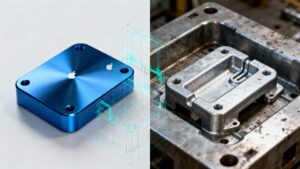
Designing a functional prototype is only 10% of the battle. The real challenge lies in the Scale-Up: taking a product that was machined from a solid block of aluminum for $200 and figuring out how to die-cast it for $5 without compromising quality.
Many startups and even established OEMs stumble in this “Valley of Death.” They lock in a design that works perfectly for CNC Machining but is impossible to Die Cast.
At Sureton, we are an OEM aluminum casting factory that specializes in the entire lifecycle. We don’t just want your order for 50 prototypes; we want to guide you to the 50,000-unit finish line.
Here is the strategic roadmap for scaling your production in China.
Phase 1: The “Look-Like, Work-Like” Prototype (Qty: 1 – 50)
Goal: Validation of form, fit, and function.
Process: CNC Machining from Solid Stock.
This phase is for de-risking design and function, not for capital investment in tooling. We use CNC to achieve this goal with zero tooling commitment.
We use 3-axis or 5-axis CNC machining to carve your part from a solid block of Aluminum 6061 or ABS plastic.
The Sureton Difference – Building a Path to Production: While machining your prototype, our engineers conduct a proactive Design for Manufacturability (DFM) review against die-casting constraints. We’ll advise on draft angles, uniform wall thickness, and feature consolidation during the prototyping phase. This ensures your validated design is already optimized for a scalable manufacturing future.
Phase 2: The “Bridge” / Pilot Run (Qty: 500 – 5,000)
Goal: Market testing and assembly line validation.
Process: Soft Tooling (Rapid Tooling).
This is the most misunderstood phase. You need more than a few prototypes, but you aren’t ready to drop $20,000 on a hardened steel mold.
Enter Soft Tooling.
The Material: We use P20 Steel or high-strength Aluminum (Alumold) for the mold base.
The Cost: Tooling investment is typically 30-50% lower than for full-scale production molds, dramatically reducing your upfront risk.
The Speed: T1 samples in 2-3 weeks.
Typical Production Run: Ideal for pilot runs of 500 to 5,000 units, allowing for market validation and initial sales without the commitment to full-scale production tooling.
This bridge tooling delivers true die-cast parts with near-production material properties and finish, enabling functional testing, regulatory certification, and early customer deliveries while you finalize market strategy.
Phase 3: Mass Production (Qty: 50,000+)
Goal: Unit cost optimization and consistency.
Process: Hard Tooling (H13 Steel) + Automation.
Once your design is frozen and orders are flowing, we switch to Class A Hard Tooling.
Multi-Cavity Production Molds: We invest in 4, 8, or even 16-cavity molds, based on a detailed analysis of part size, annual volume, and optimal machine utilization. This multiplies the output per machine cycle, dramatically reducing the cost per part and increasing weekly capacity.
Trim Dies: We build custom stamping dies to remove flash instantly, replacing manual deburring.
Dedicated CNC Fixtures: We build hydraulic fixtures that clamp multiple parts at once for secondary machining.
This is where our full turnkey service—encompassing tooling, casting, precision machining, finishing, and assembly—delivers maximum value by optimizing the entire production chain, not just individual steps.
The “Design Drift” Trap: Why Scaling Fails
The biggest risk in this roadmap is Design Drift.
A feature that works on a CNC machine (like a perfectly sharp 90-degree internal corner) causes stress concentrations and cracking in Die Casting. A thick wall that is trivial to machine can lead to internal shrinkage porosity and voids in die casting due to non-uniform solidification.
How We Prevent It:
We practice DFM (Design for Manufacturability) at every stage.
Before you move from Phase 1 to Phase 2, we sit down and say: “To cast this, we need to change this radius from R0.5 to R1.0. It won’t affect your assembly, but it will save you 10% on scrap rate.”
One Partner, One Thread
The danger of using a “Prototype Shop” for Phase 1 and a “Big Factory” for Phase 3 is the loss of knowledge. The big factory will look at your prototype and say, “We can’t make this.”
By partnering with Sureton from Day 1, the engineers who machined your prototype are the same ones designing your mass production mold. The knowledge transfer is seamless.
Planning your product launch?
Don’t just ask for a quote; ask for a Scale-Up Strategy. Contact Sureton today, and let’s map out your journey from the first chip to the millionth part.