1. The science: why zinc parts keep moving after casting
A zinc die casting is not finished the moment it drops from the die. Two separate size effects are at work, and anyone specifying tight tolerances needs to understand both before the part ever reaches inspection.
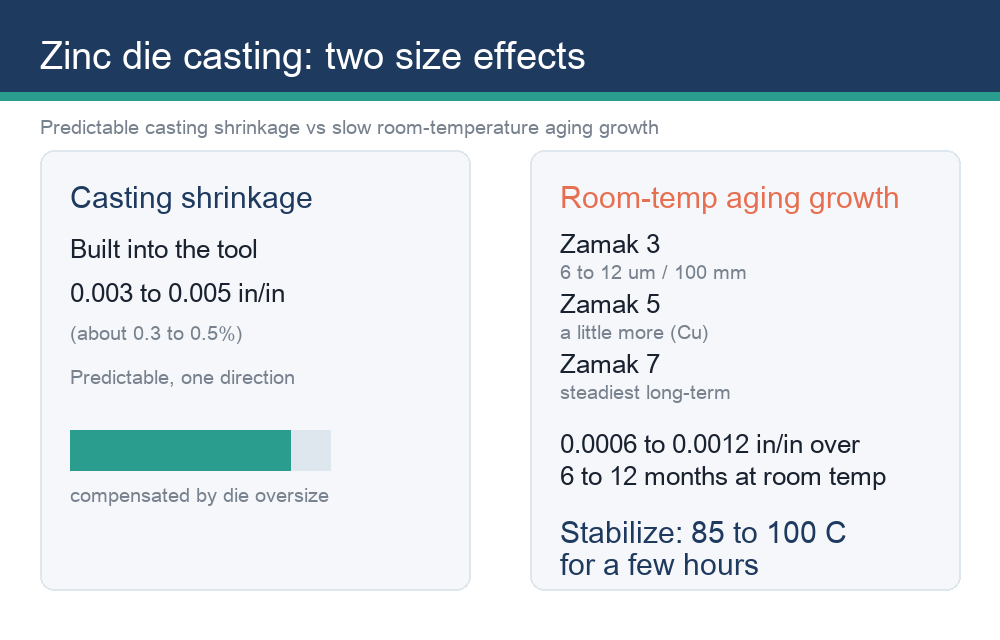
The first is casting and thermal shrinkage. Liquid zinc contracts as it solidifies and cools, just like any metal. Inside the steel cavity much of that contraction is restrained, so the as-cast part typically shrinks about 0.003 to 0.005 in/in (roughly 0.3 to 0.5 percent) rather than the free-shrink figure often quoted for sand casting. The die is cut oversize to compensate, which is why a good tooling partner asks for the tolerance band before cutting steel.
The second effect is specific to zinc alloys and far more dangerous for precision work: room-temperature aging. Zamak 3, 5 and 7 contain small amounts of aluminium and copper that keep reacting at ambient temperature. Over six to twelve months the part grows slightly as metastable phases settle. Growth of 0.0006 to 0.0012 in/in (6 to 12 µm per 100 mm) is typical for Zamak 3 stored at room temperature. That reads as nothing until you are holding a connector housing or a sensor bracket to ±0.05 mm.
2. The magnitude: what it means on a real part
For a 100 mm long Zamak 3 bracket left on the shelf for a year, dimensional growth of 6 to 12 µm is enough to push a feature that was just inside tolerance to just outside it. The shift is slow and one-directional, which is the worst kind: it passes first article inspection, then drifts out of spec at the customer’s line months later.
It is worth separating this from casting shrinkage, which is predictable and built into the tool. Aging growth is the variable. High-copper Zamak 5 grows a little more than Zamak 3; Zamak 7, with its lower copper, is the steadiest of the three for long-term stability. The choice between these alloys is therefore not only about strength but about how quiet the part stays.
3. The fix: artificial aging (stabilization)
The standard answer is to force the phase changes to happen on your schedule instead of the customer’s. Heating the casting to 85 to 100 °C for a few hours accelerates the reactions that would otherwise take a year. After stabilization the part is dimensionally quiet, and the size you measure at incoming inspection matches what the buyer measures twelve months later.
Artificial aging is cheap insurance for any zinc part that carries a tight tolerance or assembles with a mating component. It does add a process step and some energy cost, so it is normally reserved for precision parts rather than cosmetic or structural ones where 10 µm does not matter.
4. Alloy choice and process control
Zamak 3: the default for most die cast zinc. Good stability, but it still grows at room temperature and benefits from stabilization on tight-tolerance work.
Zamak 5: a little stronger and harder, slightly more aging growth because of the higher copper. Choose it when the added strength earns its keep.
Zamak 7: the steadiest of the three for long-term dimensional stability, often used where post-casting growth must stay minimal.
Zinc versus aluminium is a wider conversation, but on the narrow question of stability, zinc’s aging behaviour is the thing engineers forget to ask about.
5. Design for stability
If you need a zinc part to hold size, specify stabilization up front, keep wall sections uniform so cooling is even, and avoid letting a critical dimension land across a parting line where tooling wear is hardest to control. For guidance on the drawings side, our note on surface finish and Ra targets covers how tolerance and finish interact.
Build zinc parts that stay in spec
Tell your supplier the tolerance band before steel is cut, and ask whether artificial aging is part of the process for precision work. Send the drawing and we will flag the dimensions most likely to drift.
Further reading on this topic: zinc vs aluminum total cost of ownership · precision zinc die casting for small parts.
Related guides in this topic
Authoritative references
- International Zinc Association — zinc die casting alloy families
- Zinc & ZA alloy typical properties (NADCA datasheet, third-party host)
Independent third-party standards and industry bodies, provided for further reading. Sureton is not responsible for third-party content.