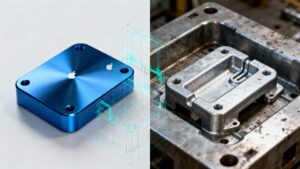
Pushing the limits of aluminum die casting geometry. We explore the physics of thin-wall casting (0.8mm-1.5mm), flow-to-thickness ratios, and the specific DFM strategies Sureton uses to prevent cold shuts in heatsinks and housings.
In the era of EV lightweighting and 5G thermal management, the directive from product designers is clear: “Make it lighter, make it smaller, but keep it strong.”
The easiest way to reduce weight and material cost is to reduce wall thickness. However, in Aluminum Die Casting, crossing the threshold from “Standard” (2.5mm – 3.5mm) to “Thin-Wall” (< 1.5mm) introduces a host of fluid dynamic challenges.
At Sureton, we regularly produce components with wall thicknesses down to 0.8mm. But this isn’t achieved by simply cranking up the pressure. It requires a fundamental rethinking of Alloy Selection, Mold Thermal Balance, and Venting.
Here is the engineering guide to designing thin-wall parts that can actually be manufactured.
The Physics Challenge: The “Freezing Time” Race
The core problem with thin-wall die casting is thermodynamics.
Molten aluminum (~660°C) loses heat to the mold steel at a drastically increased rate as the wall thickness decreases, due to the higher surface-area-to-volume ratio.. In a 1.0mm wall, the metal can solidify in tens of milliseconds, leaving an extremely narrow time window for complete cavity fill.
If the metal freezes before it completely fills the cavity, you get:
Cold Shuts (Cold Laps): Two metal fronts meet but are too cold to fuse, creating a crack-like defect.
Misruns: The metal simply stops, leaving a hole in the part.
To win this race against time, we must optimize the Flow-to-Thickness Ratio.
1. Material Selection: Why ADC12 is the Default Choice
If you are designing a thin-wall heatsink or shielding can, Material Selection is your first decision.
A380 (The Standard): While versatile, A380 has a lower silicon content (7.5-9.5%). It becomes sluggish in ultra-thin sections.
ADC12 (The Thin-Wall Specialist): With a significantly higher silicon content (9.6-12.0%) compared to A380, ADC12 offers superior fluidity, reduced hot tearing tendency, and better pressure tightness—all critical for filling andintegrity of thin sections.
Sureton’s Rule of Thumb: If your wall thickness is < 2.0mm, we strongly recommend switching from A380 to ADC12. It is the difference between a 5% scrap rate and a 20% scrap rate.
2. The “High-Speed” Injection Strategy
Thin walls require violence. We cannot gently push the metal in; we have to shoot it.
Gate Velocity: For standard parts, a gate velocity of 30-40 m/s is common. For thin-wall parts (e.g., Heat sink die casting design), we often push gate velocities to 60-80 m/s.
Fill Time: The entire thin-wall cavity often needs to be filled in under 40 milliseconds, sometimes as fast as 20-30 ms, to outrun solidification.
The Risk: The extreme velocity required can trap and compress air ahead of the metal front, creating fatal voids in thin sections. The Solution: This makes pre-shot cavity evacuation (Vacuum Assist) non-negotiable.
The Solution: This makes Vacuum Assist non-negotiable. By evacuating the cavity before injection, we remove the backpressure that fights against the incoming metal, allowing it to fill thin ribs instantly without air pockets.
3. DFM Guidelines for Thin-Wall Parts
When designing your part, keep these manufacturing constraints in mind to ensure success.
A. Rib Design & Draft Angles
Thin, deep ribs (common in heatsinks) are notoriously difficult to eject.
Draft Angle: Increase your draft angle. While 1° is standard, thin ribs often need 2° to 3° to prevent the part from sticking or dragging during ejection.
Fillets (Radii): Sharp corners impede metal flow. Add generous radii (R0.5mm minimum) at the base of ribs to help the metal turn the corner without turbulence.
B. Ejector Pin Placement
A 1.0mm wall is fragile. If an ejector pin pushes directly on a thin section, it will punch right through or deform the part.
Design Tip: Add “Ejector Bosses” or pads—small localized thickened areas—where the pins will strike. This distributes the force.
C. Thermal Balance (The Invisible Factor)
For thin walls, the mold temperature must be higher and more uniform. If the steel tool is cold, the aluminum freezes on contact.
At Sureton, we employ precise oil-temperature control systems to maintain a highly uniform and elevated die temperature (often 200°C+). This is critical for thin walls, as it prevents premature freezing at the metal front and ensures balanced flow throughout the entire cavity.
Case Study: 5G Base Station Heatsink
Challenge: A 120mm x 120mm heatsink with 40mm tall fins.
Wall Thickness: Fins tapered from 1.5mm at the base to 0.8mm at the tip.
Issue: The customer’s previous supplier faced a 30% rejection rate due to “non-fill” at the tips of the fins.
Sureton Solution:
Switched alloy to ADC12.
Implemented Vacuum Die Casting to remove backpressure in the deep fin cavities.
Added Overflows at the top of every fin to allow the “cold front” of the metal to exit the part, leaving only hot, dense metal in the fin.
Result: Sustained production yield exceeded 98%, achieving the target 15% weight reduction with consistent quality.
Push the Limits with Sureton
Don’t let a supplier tell you “it can’t be done” just because their machine isn’t tuned for it. Thin-wall die casting is an art that combines fluid dynamics, thermal control, and precise tooling.
Designing a lightweight component?
Send your 3D files to Sureton. Our engineering team will perform a Mold Flow Analysis to verify if your thin-wall design is manufacturable and suggest the necessary optimizations.