
Lithium battery packs now sit at the centre of two markets that rarely stood still: electric vehicles and stationary energy storage. The structural parts around the cells used to be treated as passive sheet metal. They are now active safety hardware, and the way they are made is shifting toward cast aluminium.
This guide walks through what changed in 2026, why a growing share of battery enclosures are die cast, and what to check when you source them.
1. From container to safety component
Modern packs connect hundreds or thousands of cells in series and parallel. The shell, top cover, and busbar supports are no longer just a box. They carry three jobs at once: keep the electrolyte contained and IP rated, absorb crash and thermal loads, and help shed heat from the cells.
That raises the bar on dimensional control. A warped cover or a mislocated busbar seat is a safety event, not a cosmetic one. Buyers have moved from asking about price per kilogram to asking about leak rate, flatness, and traceability.
2. What the 2026 demand actually looks like
Global battery demand keeps climbing on two fronts. S&P Global Commodity Insights projects energy storage demand growing at more than 15 percent a year through 2028, pulled by renewables and grid firming outside the traditional auto heartlands. On the vehicle side, analysts such as SNE Research and others tracking cell shipments point to the power and storage battery market heading past several terawatt hours by 2030.
The practical effect for a component supplier is volume and variety at the same time. Prismatic cells, large-format pouches, and cylindrical formats each want a different enclosure geometry, and none of them tolerate a leaky seam.
One shift worth watching is solid-state cells moving from pilot lines into early production. They push enclosure design harder on two fronts: sealed housings must hold against higher internal pressure, and the cells reward thinner, lighter packs that leave less wall thickness to absorb load. Third-party industry trackers put research and development across the battery sector at about 22 percent of revenue, a signal that a large share of that spend is going into chemistry and packaging rather than just capacity. These are industry analysis figures, not Sureton production data.
3. Battery enclosure die casting in 2026
Enclosure manufacturing is consolidating around fewer, larger parts. Instead of stamping dozens of plates and laser welding them into a tray, more programs cast a single aluminium housing and machine only the sealing faces and busbar mounts. The draw is simple: one continuous wall means one continuous leak path that is far easier to validate.
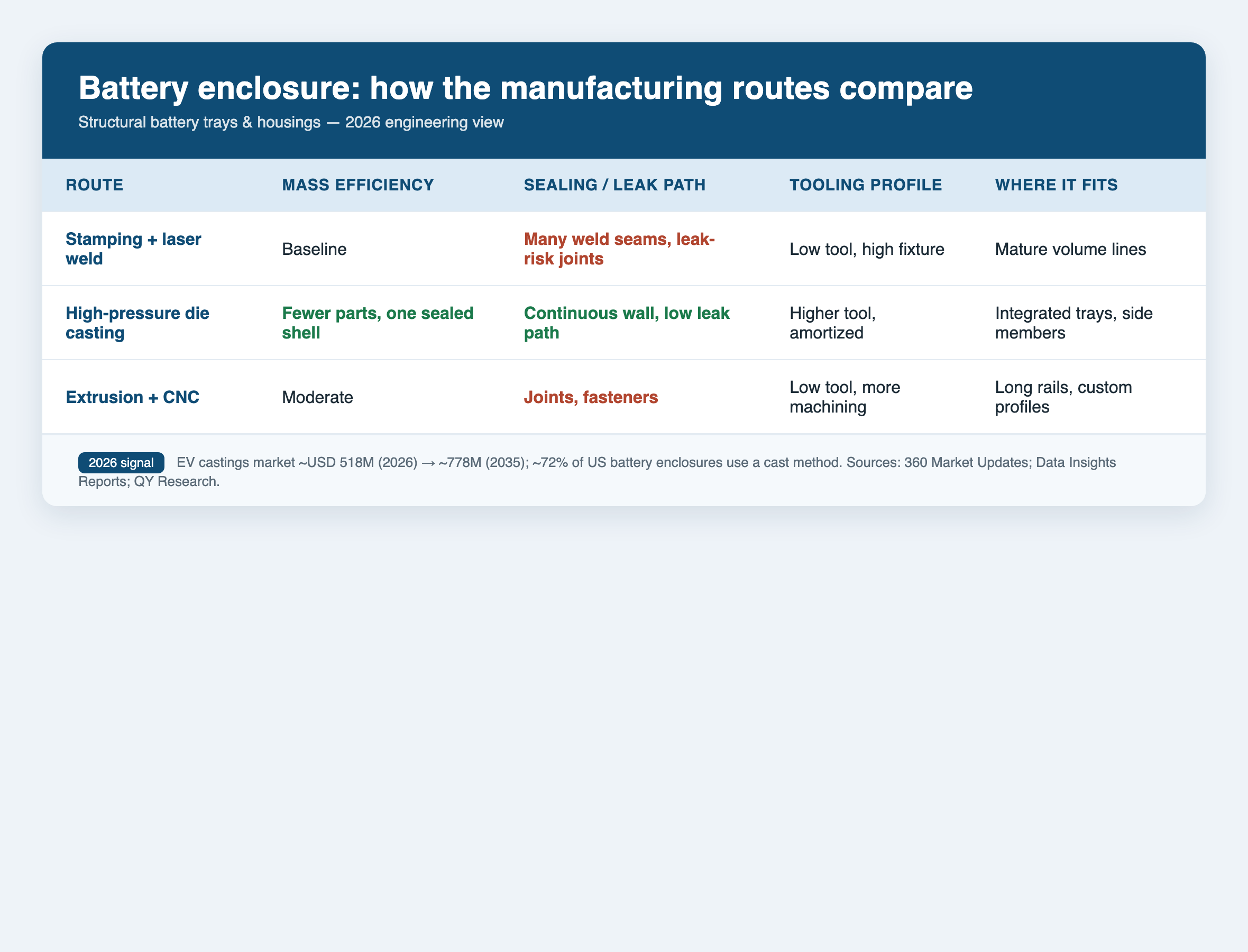
Market trackers size the EV casting segment around USD 518 million in 2026, growing toward roughly USD 778 million by 2035 (360 Market Updates; Data Insights Reports; QY Research). In North America, where USMCA localisation pushes pack assembly closer to the buyer, a large share of enclosures already use a cast method, with cell-to-pack and cell-to-chassis integration raising the casting content per vehicle.
A note on scale: integrated underbody and structural tray work at the giga scale (six- to sixteen-thousand-tonne presses) is an industry trend led by OEMs and large Tier 1s. Sureton runs 88 to 800 tonne machines, which covers thestructural components, brackets, housings, and mounting seats around the pack rather than the mega-cast underbody itself.
4. Material and process choices that matter
Most enclosures are aluminium, and most of those are high-pressure die cast. Two process points decide whether the part is trustworthy:
Porosity control. Vacuum-assisted HPDC pulls the air out before fill, cutting the gas porosity that later shows up as a leak path. As-cast tolerances around plus or minus 0.05 mm are typical for die casting, with the sealing and bearing faces finished by CNC to around plus or minus 0.01 mm.
Surface protection. An enclosure lives in a corrosive environment. Conversion coating, powder, or e-coat systems are validated against salt spray exposure, and many buyer specs now ask for a defined exposure window with no white corrosion.
Recycled aluminium is increasingly part of the conversation, because the embedded carbon of cast vs primary metal feeds directly into aEuropean buyer’s carbon questionnaire. That is a sourcing decision, not a performance one, and the two can be specified independently.
5. A sourcing checklist
When you ask a supplier to quote an enclosure or its sub-parts, the useful questions are concrete:
Which faces are machined, and to what flatness and position tolerance?
Is porosity controlled by vacuum, and how is it verified (X-ray sampling, pressure decay)?
What is the salt spray exposure the finish is validated against?
Can the alloy be specified as recycled content, and is that documented per heat?
6. Where a mid-size caster fits
Not every program needs a mega-press. A large share of enclosure programs need thestructural components, covers, and mounting structures around the main tray, and those are a comfortable fit for an 88 to 800 tonne die casting cell plus in-house machining and finishing. The honest question to ask any supplier is which parts they actually run, and which they would hand to a partner.
Sureton holds ISO 9001 and works to IATF 16949 where the program is automotive. We take drawings from the envelope stage, run feasibility and process recommendation, and machine the faces that have to be tight. We do not quote blind, and we will tell you when a part is better stamped or extruded than cast.
For the broader EV structural picture, see our notes on structural aluminium die casting for EV lightweighting and on EV battery tray design and thermal management. On sealing leaky porous castings, our vacuum impregnation guide covers when impregnation beats redesign.
Related guides in this topic
Authoritative references
Independent third-party standards and industry bodies, provided for further reading. Sureton is not responsible for third-party content.


