For every hardware engineer and product manager, there is a critical transition point: moving from the “proof-of-concept” prototype to scalable, reliable, and cost-effective mass production.
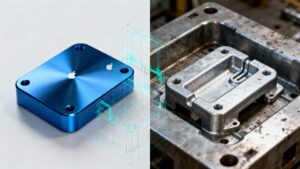
While CNC machining excels at prototypes, it scales poorly for volume. 3D printing offers agility but often compromises on material properties and structural integrity. When the requirement shifts to “making one million,” High-Pressure Die Casting (HPDC) becomes the indispensable engineering solution. Coupled with precision post-processing, it transforms raw metal into the high-integrity components that power modern industry.
However, navigating the global supply chain—especially the vast Chinese manufacturing landscape—can be opaque. At Sureton, we believe in clarity. This guide strips away the mystery, presenting the engineering realities, market dynamics, and strategic considerations you need to make an informed partnership decision.
1. Demystifying the Terms: Casting vs. Precision Manufacturing
To grasp the full value proposition, we must distinguish between the forming process and the refining process.
High-Pressure Die Casting (HPDC): The Foundation of Form
Think of HPDC as “injection molding for metal.” Molten alloy—primarily Aluminum, Magnesium, or Zinc—is injected under intense pressure (up to 100 MPa) into a precision steel mold.
The Advantage: It transforms raw ingots into near-net-shape parts in seconds. Its intrinsic value is making complexity economical; internal ribs, bosses, and intricate geometries add negligible cost once the mold is created.
Precision Manufacturing: The Art of Refinement
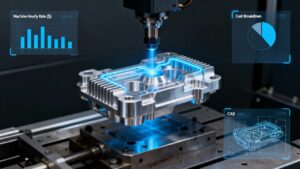
A raw casting is just the starting point. Precision Manufacturing is the value-adding layer that follows. It encompasses the secondary processes—5-Axis CNC machining, advanced surface finishing, and rigorous metrology (CMM inspection)—that refine a raw casting with inherent tolerances (e.g., ±0.1mm) into a functional component held to exacting specifications (e.g., ±0.005mm).
- In essence: HPDC provides the optimal shape. Precision manufacturing delivers the guaranteed function.
2. The Core Logic: What Strategic Problems Does This Solve?
Why do leading industries choose this integrated approach? It addresses three fundamental challenges in product development.
A. Resolving the “Complexity-Cost” Paradox
In subtractive manufacturing (like CNC machining), complexity directly increases cost through longer machining times and more tool changes. In die casting, the majority of the cost is in the mold. Once built, casting a complex, multi-feature housing costs roughly the same as a simple block. This liberates designers to consolidate assemblies into single, stronger, lighter units, reducing assembly time, fasteners, and potential failure points.
B. Enabling True Scalability and TCO Advantage
A single HPDC cell can produce tens to hundreds of parts per hour with remarkable consistency. For annual volumes ranging from 10,000 to millions of units, HPDC combined with automated post-processing offers the lowest Total Cost of Ownership (TCO). This is driven by high throughput, efficient material use, and reduced labor content compared to machining or fabricated alternatives.
C. Facilitating Advanced Lightweighting
The pursuit of lightweighting, crucial for electric vehicle (EV) range and portable electronics, is a key driver for HPDC. The process enables thin-wall designs previously unattainable: down to 1.2mm for aluminum (with vacuum assist) and 0.5mm for zinc. Newer technologies like high-vacuum die casting further enhance this by reducing porosity, allowing castings to achieve higher mechanical properties and even be heat-treated.
3. Who Needs It? Applications Driving the Industry
If your product requires metal components that are structurally complex, volume-sensitive, and weight-critical, you are a prime candidate.
| Industry | Key Applications & Rationale |
| Automotive & EV | Battery Trays & Housings: Require structural integrity, seal-ability, and thermal management.<br>Structural Components: The trend toward “Gigacasting” integrates dozens of parts into massive castings, dramatically reducing weight and assembly complexity. |
| Telecommunications | 5G Base Station Heatsinks: Aluminum’s excellent thermal conductivity makes it ideal for dissipating heat from high-power amplifiers. |
| Medical Devices | Surgical Tool Handles, Imaging Chassis: Demands high precision, cleanability, and durability. Zinc die casting is often chosen for its superior density, smooth “as-cast” finish, and plating capability for a premium feel. |
| Industrial Automation | Robot Arm Components, Gearbox Housings: Require the “precision manufacturing” aspect—tight-tolerance bearing bores, precise mounting faces, and dimensional stability under load. |
4. Navigating the Landscape: The Stratified Chinese Market
China is undeniably the world’s largest die casting hub, home to a vast and highly stratified ecosystem. Finding a supplier is simple; finding the right partner is the critical challenge. The market is typically segmented into three tiers:
| Tier | Typical Profile | Capabilities & Focus | Engagement Model |
| Tier 3 | “Hardware Shops” | Focus on low-cost, low-precision components (e.g., simple brackets). Often lack formal engineering support, advanced process control, or international certifications. | Transactional. Builds to provided print with limited feedback. |
| Tier 2 | Established “Processors” | Possess decent equipment and can achieve good basic quality. Capability is often process-focused rather than engineering-led. May execute a flawed design without challenge. | Build-to-Print. Reliable for defined tasks but offers limited value-added engineering. |
| Tier 1 | Integrated “Solution Providers” | Combines advanced manufacturing (Vacuum HPDC, 5-Axis CNC) with Engineering Services (DFM, Mold Flow). Invests in R&D and partners with clients from concept to mass production. This is Sureton’s domain. | Partnership. Acts as an extension of your engineering team. |
The Strategic Reality: The primary challenge for global OEMs is not finding a factory, but identifying a partner who deeply understands Western quality standards (e.g., IATF 16949, VDA), robust project management, and the paramount importance of Intellectual Property (IP) protection.
5. The Sureton Position: Your Precision Manufacturing Partner
We are not the largest foundry in China, nor are we a low-cost workshop. Sureton is positioned as a Precision Manufacturing Partner for global OEMs and innovators for whom failure is not an option.
Integrated, Full-Service Capability: We bridge the gap between raw foundry and finished assembly. Our vertical integration covers precision die casting, multi-axis CNC machining, advanced surface finishing, and sub-assembly. This control over the entire value chain ensures seamless quality flow, reduces logistical complexity, and accelerates time-to-market.
Engineering-First Mindset: We speak the language of design. Our engineering team engages early to review your GD&T, suggest material optimizations (e.g., ADC12 vs. A380), and simulate the entire process via Mold Flow Analysis before a single tool is cut. We don’t just build what you draw; we help you draw what will build best.
Commitment to Reliability: Our systems are governed by ISO 9001 and IATF 16949 automotive-quality disciplines. This rigorous framework is applied to every project, ensuring traceability, consistency, and reliability whether your order is for 500 pilot parts or 5 million production units.
Conclusion: The Future is Engineered
Modern die casting is more than melting metal—it is a sophisticated synergy of thermal dynamics, fluid mechanics, materials science, and digital precision engineering.
As supply chains evolve toward resilience and sustainability, the key question shifts from “Who can make this?” to “Who can make this consistently, efficiently, and as a true extension of our engineering team?”
At Sureton, we are built to answer that question. We combine the scalability of China’s manufacturing ecosystem with the precision, accountability, and partnership approach demanded by the world’s most innovative companies.