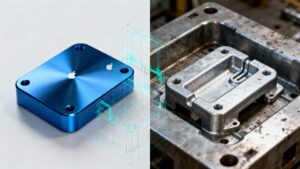
The era of “it’s just a machine part” is over. We explore the trend of Industrial Consumerism, how to achieve Cosmetic Die Casting quality on an industrial budget, and the secrets of hiding defects with VDI textures.
Twenty years ago, if you were designing a housing for a heavy-duty water pump or a CNC controller, the design brief was simple:
“Make it strong. Make it cheap. Paint it grey.”
Nobody cared if it had flow marks. Nobody cared if the parting line was visible. It was a tool, not a toy.
That era is dead.
Today, we see a massive shift in the RFQs landing at Sureton.
Medical devices, warehouse robots, and even handheld power tools now feature sleek curves, matte finishes, and tight gaps that rival a high-end laptop.
This is “Industrial Consumerism.” The user of your $50,000 machine also owns an iPhone. Their standard for “Quality” is visual. If your machine looks rough and cheap, they assume the engineering inside is cheap too.
But here is the conflict: You want Apple aesthetics, but you have a John Deere budget.
How do you bridge that gap? Here is the manufacturing guide to making industrial parts beautiful without breaking the bank.
1. The “Cosmetic” Die Casting Challenge
Standard Industrial design manufacturing focuses on porosity and dimensions.
Cosmetic Die Casting focuses on the skin.
Aluminum die casting is a violent process. Molten metal freezes in milliseconds. This naturally creates:
Flow Marks: Swirls where the metal flowed.
Cold Shuts: Faint lines where metal fronts met.
Heat Checking: Tiny raised veins from mold cracks.
On a “Functional” part, these are acceptable. On a “Cosmetic” part, they are defects.
To fix this, we don’t just polish harder; we change the process. We use Oil Heaters to keep the mold hotter (improving flow) and Vacuum Assist to pull the metal tight against the mold wall.
2. The Secret Weapon: Texture (VDI 3400)
You want a smooth, glossy surface?
Don’t do it.
Glossy surfaces act like mirrors—they magnify every tiny sink mark and scratch. To make a glossy die-cast part perfect requires hours of expensive hand-polishing.
The Sureton Strategy: Use Texture.
We etch the steel mold with a specific pattern (Standard: VDI 3400 or Mold-Tech).
VDI 24 (Fine Matte): Feels like satin. Good for medical.
VDI 30 (Medium Grit): The industry workhorse.
VDI 36 (Heavy Spark): Rugged, non-slip.
Why it works: Texture diffuses light. It hides the flow marks and sink marks underneath. It makes the part look uniform and premium straight out of the mold, eliminating the need for putty and sanding.
3. Managing the “Ugly” Features: Parting Lines & Ejectors
Every molded part has a seam (Parting Line) and circles where the pins pushed it out (Ejector Marks).
In the old days, we put them wherever was easiest for the mold maker.
Now, we practice Cosmetic DFM.
The “Class A” Surface Rule: You must define which face is the “Class A” (Visible) surface on your drawing.
Hide the Line: We move the parting line to the bottom edge or hide it inside a “Reveal” (a small intentional groove) so the flash isn’t visible.
Hide the Pins: We use “Overflows” or “Bosses” to eject the part, so the pin marks are on the inside, leaving the outside face pristine.
4. The Finish: Powder vs. Liquid
For industrial aesthetics, the coating is the makeup.
Standard Powder Coat: Thick, durable, but often has “Orange Peel” (wavy texture). Looks industrial.
Liquid Wet Paint: Smooth, sleek, automotive look. Expensive and fragile.
The Winner: Fine-Texture Powder Coat.
This is the modern standard. It uses a specialized powder that cures into a “sand” or “wrinkle” finish.Pro: It is incredibly durable (scratch-resistant).
Pro: It looks matte and sophisticated.
Pro: It hides substrate defects better than anything else.
5. Visual Quality Standards: Get it in Writing
The biggest cause of arguments is a vague drawing.
“Must be free of defects.”
What is a defect? Is a 0.5mm dot a defect?
The Sureton Protocol:
We establish a Visual Quality Standard (VQS) before production.
Viewing Distance: “Inspect at arm’s length (60cm) for 5 seconds.”
Lighting: “Cool White fluorescent light.”
Zone Map:
Zone A (Front Face): Zero scratches/dots allowed.
Zone B (Sides): Minor inclusions < 0.5mm allowed.
Zone C (Bottom/Inside): Flow marks and ejector pins allowed.
This document aligns your designer’s expectations with our inspector’s eyes.
Make It Beautiful
Your industrial equipment deserves to look as good as it performs. A beautiful housing builds trust in your brand.
At Sureton, we know how to balance the “Art” of design with the “Science” of casting. We help you achieve that premium look through smart tooling and finishing choices, not just endless spending.
Designing a new enclosure?
Contact Sureton. Send us your ID sketches. Let’s discuss how to turn those sexy renders into Cosmetic die casting reality.