Stop specifying “Clear Anodize” on ADC12 parts. We compare the cost, durability, and aesthetic limitations of Powder Coating, Wet Painting, and Anodizing specifically for aluminum die casting.
A brilliant mechanical design can be ruined by the wrong surface finish callout.
We see it often at Sureton: A customer sends a drawing for an Aluminum Die Casting part (Material: ADC12) and specifies “Finish: Clear Anodize, Type II.”
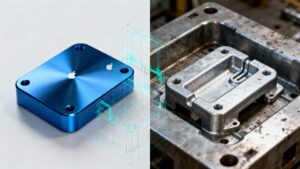
This is a manufacturing trap. While anodizing looks stunning on CNC machined 6061 aluminum (like an iPhone), it looks disastrous on die-cast ADC12.
Choosing the right finish isn’t just about color; it’s about Substrate Compatibility, Dimensional Tolerance, and Environmental Exposure. Here is the definitive engineering comparison to help you choose correctly.
1. Anodizing: The “Die Casting” Problem
Let’s address the elephant in the room. Can you anodize die-cast aluminum?
Technically, yes. Aesthetically, usually no.
The Chemistry Issue: Die casting alloys like ADC12 (Si 9.6-12%) and A380 (Si 7.5-9.5%) contain high levels of Silicon to improve fluidity. Silicon does not anodize. When the aluminum builds the oxide layer, the silicon remains as black/grey smut on the surface.
The Result: Instead of a clear, metallic silver finish, you get a dull, dark grey, blotchy, and uneven appearance.
When to Use It: Only use anodizing on die castings for functional purposes (corrosion resistance or wear resistance) where aesthetics do not matter (e.g., internal engine components).
The Exception: If you absolutely need a cosmetic anodized look, you must use special low-silicon alloys (like Al-Mg alloys), but these are expensive and harder to cast.
Sureton’s Advice: If you want the “Apple look” on a die-cast part, don’t anodize. Use a metallic silver Powder Coat or Wet Paint.
2. Powder Coating: The Industry Workhorse
Powder Coating is the most common finish for die casting for a reason. It is tough, cost-effective, and forgiving.
Hiding Defects: Die-cast parts often have minor surface imperfections like flow marks or knit lines. Powder coating creates a relatively thick layer (60µm – 100µm) that effectively hides these cosmetic issues without expensive polishing.
Durability: Excellent resistance to chipping, scratching, and UV fading.
The Tolerance Trap: Because the coating is thick (~0.1mm per side), you must mask critical features like bearing bores or threaded holes. Failure to account for this buildup in your tolerance stack-up will result in parts that don’t fit.
3. Wet Painting (Liquid Coating): The Aesthetic Choice
Wet painting is the traditional automotive-style spray process.
Appearance: It offers the smoothest possible finish (high gloss) and precise color matching (Pantone/RAL). It can achieve metallic or soft-touch textures that powder cannot match.
Thickness: Thinner than powder coating (15µm – 30µm). This is better for parts with tight assembly tolerances where masking is difficult.
The Downside: It is generally more expensive than powder coating due to multiple coats (primer + base + clear) and lower transfer efficiency. It is also less scratch-resistant.
4. E-Coating (Electrophoretic Deposition): The Corrosion Shield
If your part lives inside a vehicle chassis or an outdoor enclosure, E-Coating is your best friend.
The Process: The part is dipped into a bath, and paint is electrically deposited.
The Superpower: Because it’s a dip process, it coats everywhere—inside deep pockets, threads, and internal channels where spray guns can’t reach.
Performance: Incredible corrosion resistance. A standalone black E-coat can pass 500+ hours of salt spray testing.
The Combo: For the ultimate protection, we use E-Coat as a primer, followed by Powder Coat. This “Dual Coating” system is standard for automotive exterior parts (1,000+ hours salt spray).
5. Conversion Coating (Chromate/Passivation)
Sometimes, you don’t want a coating at all; you just want the part not to oxidize.
SurTec 650 / Alodine: This is a chemical conversion coating. It is conductive (great for EMI shielding) and adds minimal thickness (<1µm).
Use Case: Electronics housings where grounding is required, or as a pre-treatment primer before powder coating to ensure adhesion.
Summary: The Decision Matrix
Here is how we categorize these finishes based on Sureton’s manufacturing data:
| Feature | Anodizing (on ADC12/A380) | Powder Coating | Wet Painting | E-Coating (as Primer) |
| Cost | High | Low / Medium | High | Medium |
| Aesthetics | Poor (Dark/Blotchy) | Good (Hides defects) | Excellent (High Gloss) | Functional (Black) |
| Thickness | 3 – 15 µm (Non-uniform) | 60 – 100 µm | 15 – 30 µm | 10 – 20 µm |
| Corrosion (Salt Spray) | Good (Substrate-dependent) | Excellent | Good | Best (Foundation Layer) |
| Scratch Resistance | Best (Hard) | Very Good | Fair | Good |
| Masking Required? | Yes (to protect critical threads, sealing surfaces, or for electrical contact points) | YES (Critical) | Yes | Yes |
Don’t Let the Finish Be an Afterthought
The surface finish affects your tolerances, your cost, and your product’s lifespan. Don’t just copy-paste “Anodize” from a previous CNC project.
At Sureton, we treat surface finish as a critical manufacturing parameter, not a post-script. Our DFM report will explicitly address finish compatibility, thickness accumulation, and cost-impact—turning potential late-stage surprises into early, actionable decisions.
Stop Guessing. Start Testing.
Contact us today. Feel the texture, compare the gloss, and witness the stark difference between a properly and improperly finished die casting. Let data guide your specification.