
The question comes up a lot: you already paid for anodizing, the color is wrong, and someone suggests spraying Cerakote on top instead of starting over. It can be done. Whether it should be is a different question, and the answer depends on what the part has to survive.
1. The short answer
Yes, you can apply Cerakote over an anodized surface. The coating will cure and look right. It will not bond as well as it would to bare aluminum, because it is sitting on a hard ceramic oxide, not on metal. For a part that lives inside, away from abrasion and chemicals, that is often good enough. For a part that gets handled, washed, or exposed, it is a risk you should weigh on purpose.
2. How the two layers actually bond
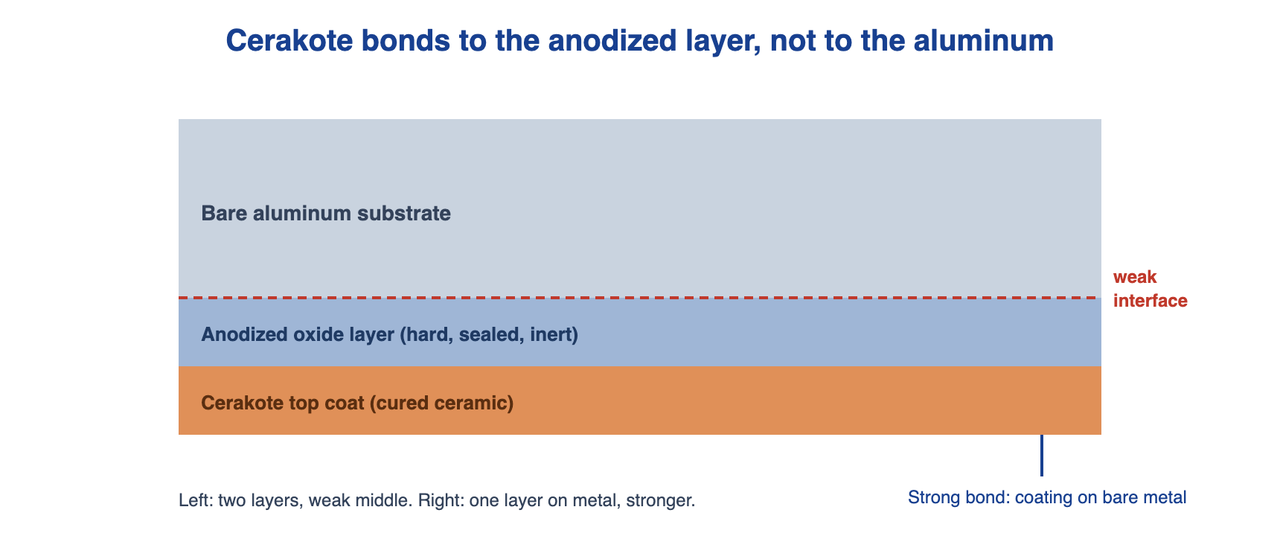
Anodizing grows a porous aluminum oxide on the surface. That oxide is hard and inert, which is exactly why anodizing protects well. It is also a finished, sealed surface.
Cerakote needs a profile. Cerakote is a ceramic coating that adheres by mechanical and chemical grip to the substrate. On bare aluminum it grips the metal and the natural texture. On anodized aluminum it grips the oxide layer, which was never prepared to be a bonding surface.
The weak point is the interface. The bond you care about is not Cerakote to aluminum. It is Cerakote to anodize, and that interface was not designed to be sticky. Adhesion test results on anodized substrates are consistently lower than on blasted bare metal.
3. Three real scenarios
Stack it. The part is indoor, low contact, and the anodize already meets the corrosion spec. You only need a different color or a matte look on top. Cerakote over anodize is the cheap, fast path, and the adhesion margin is enough.
Choose one. You need either anodizing or Cerakote, not both. Anodizing gives you the harder, more wear resistant surface with integral color. Cerakote gives you a wider color range and a thicker, more uniform film. Pick the one that matches the failure mode you are protecting against, and skip the second layer.
Strip and redo. The part sees abrasion, frequent cleaning, or chemicals, and the anodize color is wrong. Remove the anodize, prepare the bare aluminum properly, then apply the coating you actually want. One layer, bonded to metal, beats two layers with a weak middle.
4. Three questions to decide
| Ask | If yes | If no |
|---|---|---|
| Will the part be handled or cleaned often? | Strip and redo with one finish | Stacking may be fine |
| Does the anodize already meet the spec? | Cerakote only for color on top | Reconsider the base finish |
| Is this a cosmetic or a functional surface? | Functional: bond matters, redo | Cosmetic: stacking is acceptable |
5. What it costs you in process
Stacking is not free even when it works. You add a cleaning and degreasing step, a light abrasion to give the Cerakote something to hold, curing time, and then an adhesion check you would not need on a single finish. On a small batch that is a minor cost. On a production run it is a process step you will be defending on every quality review.
6. What we tell buyers
We do not push one finish. We ask what the part contacts and how it fails, then recommend the base process that matches. If the anodize is already correct and only the look is off, a top coat is a reasonable shortcut. If the surface has to perform, we strip and start from bare aluminum so the coating bonds where it should.
Send the part and the environment, not just the finish name
Tell us what the component touches and how often it gets cleaned. We will tell you whether to stack, choose one, or strip and restart, before you pay for either process.
Related reading: Surface treatment options at Sureton for the full list of finishes we run.
Related guides in this topic
Authoritative references
- MIL-A-8625 / MIL-PRF-8625 anodizing specification (AAC)
- Anodizing reference guide — Type I / II / III (AAC)
- Aluminum anodizing: types and process (Xometry)
Independent third-party standards and industry bodies, provided for further reading. Sureton is not responsible for third-party content.


