Why does Sureton charge for custom fixtures? We explain how smart CNC fixture design increases loading density, eliminates vibration, and drastically lowers your unit price for production runs.
We see this battle on quotation spreadsheets every day.
You look at the quote for your CNC machined parts.
Unit Price: Acceptable.
NRE (Non-Recurring Engineering) / Fixture Cost: $800.
The immediate reaction from Procurement is: “Can we waive this? Just use a standard vise. We want to save money.”
We understand. Nobody likes paying upfront fees.
But here is the counter-intuitive truth of manufacturing: Refusing to pay for a fixture is usually the most expensive decision you can make.
A standard vise incurs no additional direct charge, but it is slow, inconsistent, and limits how fast we can cut.
A custom fixture costs money, but it unlocks speed.
At Sureton, we don’t charge for fixtures to make extra profit (we price them fairly to cover engineering and fabrication, not as a major profit center). We charge for them because they are the tool that drives your CNC machining cost reduction. Here is the engineering logic behind why “Smart Fixturing” is a game changer.
1. The “Standard Vise” Trap
Imagine a standard CNC setup.
The operator opens the door. He blows away the chips. He unclamps the vise. He takes the part out. He puts a new raw block in. He grabs a rubber mallet and hammers it down to make sure it’s seated. He tightens the handle. He closes the door. Press Start.
The Problem: This process takes 30-60 seconds. And it happens for every single part.
The Cost: If the machining cycle is 2 minutes, and the loading takes 1 minute, then 33% of your billable time is just a guy opening and closing a door.
2. High-Density Workholding: The Efficiency Multiplier
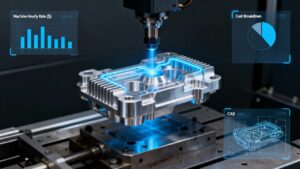
Now, imagine we build a custom “Tombstone” Fixture or a high-density plate for that $800 fee.
Instead of holding 1 part, we can hold 16 parts at once.
The magic isn’t just in holding more parts; it’s in the Tool Change.
Scenario A (1 Part): The machine picks up a drill, drills 1 hole, puts the drill away. Picks up a tap, taps 1 hole, puts it away.
Scenario B (16 Parts): The machine picks up a drill, drills 16 holes in a row, and then puts it away.
The Result: The machine completes the same operation on all 16 parts before changing tools, eliminating a cascade of non-productive time —15 unnecessary tool changes, 15 door-open cycles—allowing it to run uninterrupted at peak efficiency.
3. Rigidity = Speed (The Physics of Chatter)
Most people think fixtures are just for holding the part.
Actually, their main job is to stiffen the part.
If you hold a thin aluminum plate in a standard vise, the center of the plate is unsupported. As soon as the cutter touches it, the plate vibrates (Chatter).
To stop the chatter, the machinist often has to drastically reduce cutting parameters (slowing speeds and feeds by 50% or more) to suppress chatter.
The Smart Fixture Solution:
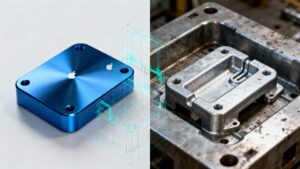
We build a custom Vacuum Fixture or a contoured “nest” that supports the part across its entire surface area.
The Physics: With the vibration eliminated, we can safely run the cutter at its optimal, aggressive parameters, often significantly increasing the metal removal rate, especially for thin-walled or flexible components where rigidity is the limiting factor.
The Payoff: Faster cutting means shorter cycle time. Shorter cycle time means a cheaper part for you.
4. Consistency: Removing the “Human Muscle” Variable
In a standard vise, the clamping force depends on how hard the operator pulls the handle.
8:00 AM: Operator is fresh. Clamps tight.
4:00 PM: Operator is tired. Clamps loose.
Result: Dimensional variation.
The Sureton Solution:
For precision jobs, we use Hydraulic Clamping or Pneumatic Systems.
You push a button, and the fixture clamps every part with exactly the same pressure (e.g., 500 PSI). This guarantees that Part #1 and Part #1,000 are identical, reducing scrap rates and the cost of quality failures.
5. The ROI Calculation: When to Buy?
So, should you always buy the fixture? No.
Here is the break-even logic we use at Sureton:
Qty 1-50 (Prototype): Use the standard vise. The setup time is negligible compared to the fixture cost.
Qty 500+ (Production): Buy the fixture.
The Math:
Option A (No Fixture): Unit Price $25.00. Total for 500 parts = $12,500.
Option B (With Fixture): Fixture $800. Unit Price $22.00. Total = $11,000 + $800 = $11,800.
You just saved $700 on the first order. On all subsequent orders, the $800 fixture cost disappears, and you lock in the lower unit price ($22.00) from day one, multiplying your savings.
Beyond direct cost savings, this efficiency also translates into shorter, more predictable lead times for every order, strengthening your supply chain.
Invest in Your Process
A fixture is not an “extra fee.” It is a dedicated piece of equipment custom-built to make your specific part faster and better.
At Sureton, our Workholding solutions team designs Fixtures that turn complex problems into routine production.
Reviewing a quote?
If you see a fixture charge, don’t delete it—ask us about it. Ask: “How much will this fixture lower my unit price?” The answer might surprise you.