Unlocking Geometry: What is 5-Axis CNC Machining?
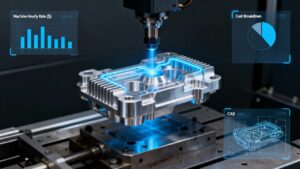
5-axis CNC machining represents the pinnacle of subtractive manufacturing technology. Unlike traditional 3-axis systems that move linearly along the X, Y, and Z axes, 5-axis machines incorporate two additional rotary axes (A and B). This capability allows the cutting tool to approach the workpiece from virtually any direction, enabling the creation of intricate components and complex geometries with unparalleled precision.
For the die casting industry, this technology is transformative. The mechanics of 5-axis machining allow for continuous tool engagement with the material surface. This constant contact facilitates smoother, more efficient cutting operations, resulting in reduced tool wear and extended machinery lifespan. By maintaining optimal cutting angles, Sureton ensures that even the most difficult alloys are machined to exact specifications.
Key Efficiency Gains:
Single-Setup Machining: By machining five sides of a part in a single setup, we eliminate the errors associated with manual repositioning.
Tighter Tolerances: Reducing fixture changes directly translates to superior cumulative accuracy.
Complex Contours: Capabilities to machine deep cavities and undercuts that are impossible with standard 3-axis equipment.
The Pivotal Role of 5-Axis CNC in Mold Making & Finishing
In the die casting process, 5-axis CNC machining serves two critical roles: creating high-precision molds (tooling) and performing post-machining on cast parts. Traditional methods often fall short when facing the demands of modern automotive and aerospace designs.
Superior Surface Finishes
One of the primary advantages of 5-axis machining is the ability to use shorter cutting tools. Shorter tools vibrate less, allowing for higher cutting speeds and a superior surface finish. For die casting molds, this reduces the need for manual polishing (benching), ensuring the final cast components have excellent aesthetics and functionality right out of the gate.
Industry Applications
Automotive: Producing complex aluminum engine blocks and transmission housings that require lightweight designs without sacrificing strength.
Medical Devices: Manufacturing intricate tooling for surgical instruments where precision is non-negotiable.
Aerospace: Creating turbine blades and structural components with complex aerodynamic profiles.
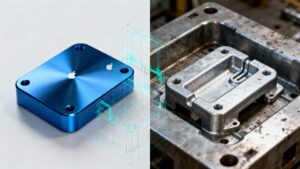
By integrating 5-axis technology, Sureton ensures that the dimensions of the die closely match the CAD design, leading to products that meet the most stringent industry standards.
Comparative Advantage: 5-Axis vs. Traditional Machining
When compared to traditional 3-axis machining, 5-axis CNC technology offers distinct competitive advantages that translate directly to cost savings and quality improvements for our clients.
1. Speed and Efficiency
Traditional machining often requires multiple setups and fixture changes to reach different features of a part. This not only consumes time but increases the risk of operator error. 5-axis machines handle complex geometries in a single operation, significantly reducing cycle times and accelerating time-to-market.
2. Cost-Effectiveness
While the hourly rate of a 5-axis machine may be higher, the total cost per part is often lower. This is due to the drastic reduction in total machining time, fewer required fixtures, and minimized material waste. Additionally, the improved workflow efficiency reduces labor costs associated with overseeing and troubleshooting the process.
3. Design Freedom
Traditional machining is limited by tool access. If the tool can’t reach a feature, it can’t be machined. The versatility of 5-axis systems removes these barriers, allowing engineers to design highly complex die casting molds with undercuts and off-axis features, pushing the boundaries of innovation.
4. Quality Consistency
Repetitive setups in traditional machining often lead to “stack-up errors” and misalignments. 5-axis technology mitigates this risk, ensuring that every batch of molds or components maintains consistent quality and high precision.
The Future of Machining: Trends and Innovations
The landscape of 5-axis CNC machining is evolving rapidly, driven by Industry 4.0 and digital integration. At Sureton, we are adopting these trends to stay ahead of the curve.
AI and Automation: The integration of Artificial Intelligence (AI) allows for predictive maintenance and optimized tool paths. Automated loading systems further streamline the workflow, reducing downtime and enhancing consistency.
Hybrid Manufacturing: The synergy between additive manufacturing (3D printing) and 5-axis CNC is growing. We can now 3D print near-net-shape metal parts and use 5-axis machining to finish critical surfaces, combining design freedom with precision tolerances.
Advanced Materials: As industries demand lighter, stronger materials (such as titanium and superalloys), 5-axis tooling is evolving with better heat dissipation and durability to handle these tough materials effectively.
Conclusion
The adoption of 5-axis CNC machining is not just an upgrade; it is a necessity for modern die casting success. It paves the way for enhanced precision, efficiency, and the ability to manufacture the “impossible.” At Sureton, we leverage these advanced capabilities to deliver superior molds and components, ensuring our clients remain competitive in a rapidly changing market.