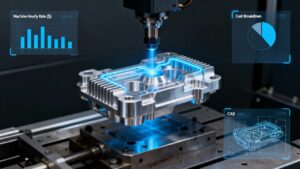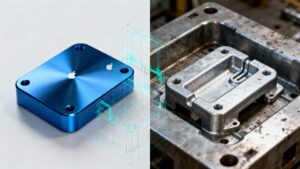
Die casting is more than just forcing metal into a mold. From controlling porosity in thin-walled EV parts to optimizing cycle times with conformal cooling, Sureton explores the advanced engineering behind modern HPDC.
In the global manufacturing landscape, High-Pressure Die Casting (HPDC) remains the undisputed king of scalability. No other process can transform molten metal into a finished, high-tolerance component in under 60 seconds with such consistency.
However, for engineers in the Automotive (EV), Aerospace, and Medical sectors, the definition of “Die Casting” has evolved. It is no longer just about churning out simple brackets. It is about producing thin-walled structural parts, pressure-tight housings, and cosmetic surfaces that require zero secondary machining.
At Sureton, we believe that understanding the capabilities—and the limitations—of modern die casting is the key to successful product development. Here is the engineering reality behind the process.
1. Precision at Scale: The “Net-Shape” Advantage
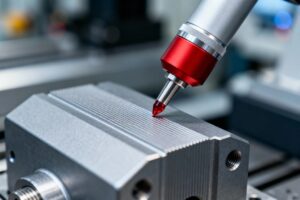
The primary competitive advantage of HPDC isn’t just speed; it’s Net-Shape Manufacturing.
While CNC machining removes material to find the part, die casting creates the part with minimal waste.
Dimensional Stability: With modern closed-loop control systems, we can hold tolerances of ±0.05mm on critical features directly from the mold.
Consistency (CpK): Unlike manual processes, a die casting machine repeats the exact same shot profile (pressure, speed, temperature) thousands of times. This ensures that Part #1 and Part #50,000 are identical, simplifying your assembly line validation.
2. Material Science: Matching Alloy to Application
“Aluminum” is not a specification. Choosing the right alloy is the first step in DFM (Design for Manufacturability).
Aluminum (ADC12 / A380): The workhorse. Ideal for lightweighting in EVs due to its high strength-to-weight ratio and excellent thermal conductivity for heatsinks.
Zinc (Zamak 3 / 5): The choice for precision and aesthetics. Its lower melting point allows for longer tool life (up to 1 million shots) and thinner walls (<0.5mm) than aluminum.
Magnesium (AZ91D): The ultra-lightweight option. 33% lighter than aluminum, offering superior vibration dampening for handheld devices and drones.
3. Solving the “Porosity Paradox” in Complex Geometries
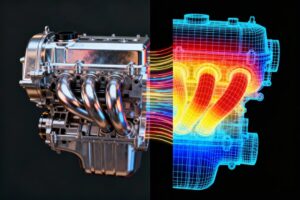
As designs become more organic and complex, the risk of defects increases. The biggest enemy is Porosity.
In traditional casting, turbulent metal flow traps air. In complex geometries with varying wall thicknesses, this leads to voids and structural weakness.
The Sureton Solution:
We don’t guess; we simulate.
Mold Flow Analysis: Before cutting steel, we simulate the injection process to predict air traps. We place Overflows and Vents strategically to capture the “dirty” metal front.
Vacuum Assist: For pressure-tight parts (like hydraulic pumps), we employ vacuum valves to evacuate air from the mold milliseconds before injection, creating a denser, stronger casting.
4. Tooling: The Heart of the Process
You cannot produce a precision part from a mediocre mold. Tooling is an investment, not just an expense.
Thermal Balance: The key to cycle time is cooling. We utilize Conformal Cooling channels—3D printed or drilled channels that follow the contour of the part—to extract heat uniformly. This reduces cycle time and prevents warpage.
Steel Selection: We use premium H13 or SKD61 steel, heat-treated to HRC 48-52, ensuring the mold can withstand the thermal shock of molten aluminum for over 100,000 cycles without heat checking (surface cracking).
5. The Future: Data-Driven Process Control
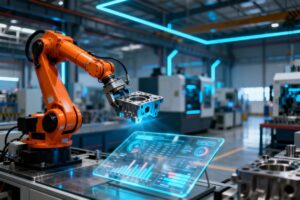
We are moving beyond “Trial and Error.” The future of die casting is Data.
At Sureton, we integrate Industry 4.0 principles into our casting cells.
Real-Time Monitoring: Sensors track the injection curve of every shot. If the pressure drops or the speed fluctuates outside the set window, the robot automatically rejects the part.
Traceability: We laser-mark parts with unique QR codes linked to their specific shot data, raw material batch, and heat treatment cycle. This level of traceability is now the standard for automotive and medical clients.
Conclusion: Partner with Precision
Die casting is a sophisticated balance of thermal dynamics, fluid mechanics, and metallurgy. To leverage its full potential, you need a manufacturing partner who acts as an extension of your engineering team.
Whether you are scaling a prototype or optimizing a legacy component for cost reduction, Sureton has the expertise to guide you from the drawing board to the shipping dock.
Ready to optimize your next project?
Contact Sureton today for a comprehensive DFM review and discover how our advanced die casting solutions can drive your business forward.