Most sourcing problems show up after the tool is cut. By then the deposit is spent, the lead time is booked, and the only move left is to argue. A couple of hours of verification before the RFQ goes out removes most of that risk, and it is the part buyers skip most often.
This is a buyer side checklist. It is not about whether aluminum or zinc is the right alloy, that question has its own guides. This is about whether the shop you are about to send drawings to can actually deliver the part you specified, and whether you will be able to prove it later.
1. Why a pre-RFQ check pays for itself
A supplier that looks fine on a homepage can fall apart on three specifics: it cannot hold the tolerance you drew, it outsources the operation you assumed was in house, or it cannot show a certificate that maps to the batch you received. None of these show up in a quote. All of them show up in the first production lot.
The check takes one call and a short document request. If a supplier pushes back on sharing basic evidence, that resistance is itself the answer.
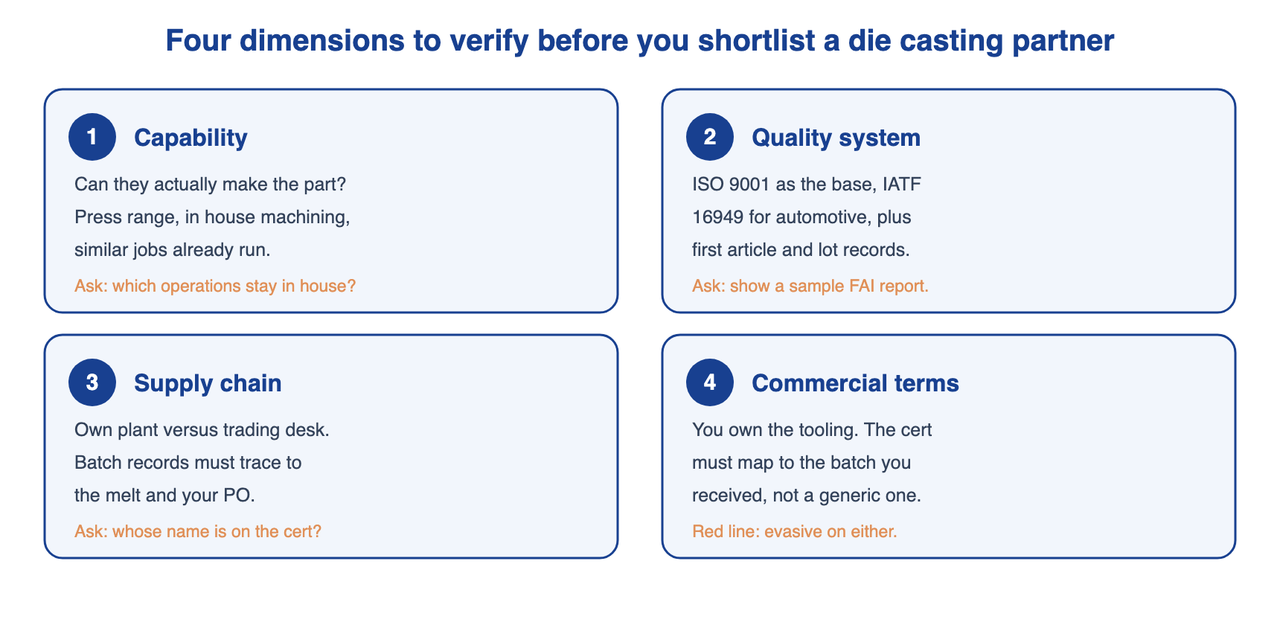
2. Capability: can they actually make the part
Start with the geometry, not the brochure. Ask for parts they have run in the same process family, in the same alloy, near your wall thickness and tolerances.
Press range. Confirm the tonnage range covers your part. Sureton runs high pressure die casting across the 88T to 800T range, which covers most small to mid size components but not large structural castings. If your part needs a bigger press, the shop should say so before quoting, not after the first shot fails.
Machining backing. Die casting rarely ships as cast. Find out whether the secondary machining, drilling, and threading happen in house or get subcontracted. In house work keeps one quality owner; subcontracted work means you are relying on a chain the supplier manages but may not control.
What to ask. “Which of my operations stay inside your walls, and which go out?” A straight answer tells you more than a capability list.
3. Quality system: the documents that matter
Certificates on a wall are not the same as a quality system that runs. The documents that actually tell you something:
ISO 9001 certification. This is the baseline. It means the shop has documented, audited processes for how it makes and checks parts. Ask for the current certificate, not a photo from three years ago.
IATF 16949, if your customer requires it. For automotive programs this is often mandatory. For non automotive parts it is a plus, not a substitute for ISO 9001. Do not let a supplier treat it as the only proof of quality.
First article and lot inspection records. Ask to see a sample first article report and a lot inspection sheet from a similar job. If they cannot show one, they are not running inspection as a system.
The red line: a shop that says “we inspect everything by eye” has no inspection system you can audit.
4. Supply chain: own plant versus trader
This is the dimension most buyers miss. A company that answers your RFQ may be a trading desk reselling another factory’s parts. That is not automatically wrong, but you should know which it is before you sign.
Own plant. A supplier with its own foundry can walk you through the line, show you the batch records, and trace a certificate to the melt. That traceability is what your own customers will ask for.
Partner network. Some capable suppliers run a mix: own plant plus a vetted partner network for overflow or special processes. That is workable if the lead supplier stays accountable for the result and the paperwork.
What to ask. “If my part is made off your floor, whose name is on the certificate, and can I audit that line?” A trader that cannot answer is a trader you should not onboard blind.
5. A one page supplier scorecard
Use this as the first screening. Score each line before you shortlist.
| Dimension | What to ask | Good answer | Red flag |
|---|---|---|---|
| Capability | Parts run in same alloy and tolerance? | Similar job, with photos or samples | “We can do anything” |
| Press fit | Tonnage covers my part? | Exact range stated | Vague or silent |
| Quality | ISO 9001 current? Inspection records? | Valid cert, sample FAI | Expired or none |
| Supply chain | Own plant or trading? | Clear, auditable | Evasive |
| Tooling | Who owns the mold? | Buyer owns, in writing | Supplier keeps it |
| Traceability | Cert maps to my batch? | Yes, batch linked | No |
6. Red lines you should not cross
Two items end the conversation regardless of price.
Tool ownership. The mold is your asset. Put it in the contract that you own the tooling and can take it elsewhere. A supplier that insists on keeping it is charging you twice.
Certificate to batch mapping. A material certificate with no batch number, or a batch number that does not match the box you received, is not evidence. It is paperwork. Your customers will ask for the real link, so ask for it first.
7. What Sureton shares with buyers
We run on ISO 9001 as the base quality system, supported by environmental and safety management systems, with documented first article and lot inspection on the jobs that need it. For automotive programs we hold IATF 16949.
On traceability, our batch records link the melt, the casting date, and your purchase order, and that link travels on the box and the certificate. If you want to see the line before you commit, we will walk you through it.
Send us the drawing, not just the RFQ
The fastest way to test a supplier is to hand them one real part. Send us your drawing and the tolerances that keep you up at night. We will tell you, before any quote, whether we can hold them and where the risk sits.
Related reading: Zinc vs aluminum: a total cost comparison if you are still deciding on alloy.
Authoritative references
- ISO 9001 - Quality management systems (ISO)
- IATF 16949 - Automotive quality management scheme (IATF)
- NADCA die casting standards & product specifications
Independent third-party standards and industry bodies, provided for further reading. Sureton is not responsible for third-party content.